
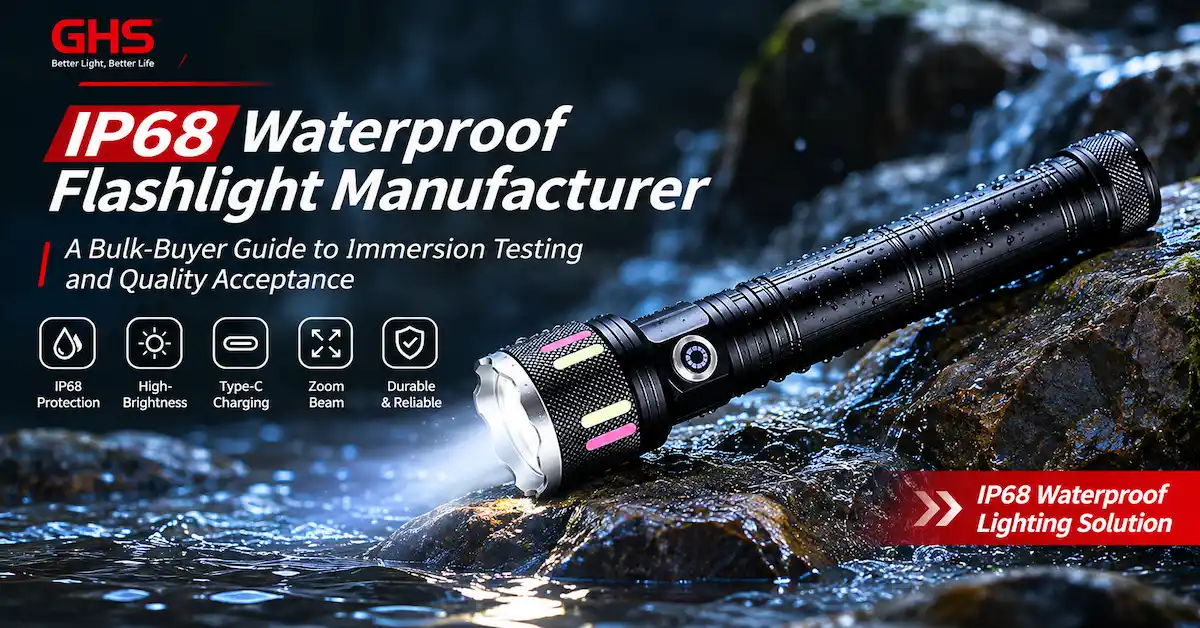
An IP68 waterproof flashlight manufacturer should be able to demonstrate more than an attractive product design or a label claiming advanced water resistance.
For outdoor equipment brands, industrial distributors, and international importers, the real challenge is verifying that a flashlight meets its specified ingress-protection requirements and that the approved construction can be reproduced consistently during mass production.
A flashlight may survive a brief water demonstration yet fail after repeated battery replacement, charging-port operation, or routine mechanical handling.
This creates an important distinction between a waterproof product claim and documented product performance.
TL;DR: When evaluating an IP68 waterproof flashlight manufacturer, buyers should request an applicable IEC 60529 test report covering the exact model, confirm the agreed immersion depth and duration, examine enclosure sealing and charging-port construction, and establish production quality controls. An IP68 marking alone does not prove unlimited underwater operation or guarantee that customized versions retain the original protection rating.
This article explains how to translate an IP68 requirement into a practical purchasing specification, review test evidence, evaluate samples, and establish acceptance criteria for wholesale orders.
Businesses researching rechargeable lighting products can begin with the GHS LED flashlight collection and discuss whether a suitable model can meet their required protection level.
Key Takeaways
-
IP68 is a defined enclosure-protection classification, not a universal guarantee against all water exposure.
-
Immersion conditions matter: Test depth, duration, sample configuration, and acceptance criteria must be documented.
-
Dust protection and immersion protection are separate requirements, even though both appear in the IP68 designation.
-
Rechargeable flashlights present additional sealing challenges at charging ports, switches, lenses, and battery compartments.
-
A successful prototype does not guarantee mass-production consistency. Assembly tolerances, seal materials, and quality inspection affect repeatability.
-
OEM modifications can change waterproof performance, particularly when they alter housing openings or sealing interfaces.
-
Product claims should match the tested configuration, including the exact model, version, and conditions.
1. What Does IP68 Mean for a Waterproof Flashlight?
IP68 is an ingress-protection designation defined under IEC 60529, Degrees of Protection Provided by Enclosures (IP Code).
It contains two characteristic numerals.
The first numeral describes protection against access to hazardous parts and ingress of solid foreign objects.
The second describes protection against harmful effects caused by water ingress.
IP68 Technical Definition
| IP Element | Classification | Meaning |
|---|---|---|
| IP | Ingress Protection Code | Identifies an enclosure protection classification |
| 6 | Dust protection | Dust-tight classification under applicable test conditions |
| 8 | Water protection | Protection under specified continuous-immersion conditions |
| Complete Rating | IP68 | Combines the specified dust and immersion protection classifications |
The important detail is that IPX8 immersion conditions are not identical for every product.
Under IEC 60529, the applicable conditions must be defined by a relevant product standard or agreed between the manufacturer and user. They must be more severe than those prescribed for IPX7 and take account of continuous immersion in actual use.
Consequently, two products both described as IP68 may have different documented immersion-test conditions.
Does IP68 Mean a Flashlight Can Stay Underwater Indefinitely?
No.
IP68 does not establish unlimited operating depth, unlimited exposure time, or suitability for every underwater activity.
A manufacturer should specify the actual immersion conditions supported by its documentation.
For B2B buyers, the useful question is not simply whether the product says IP68.
It is:
Under what exact conditions was the complete flashlight tested, and what evidence shows that it passed?
2. IP67 vs. IP68: Which Protection Level Does a Buyer Actually Need?
Different applications expose flashlights to different environmental conditions.
A flashlight used during rainy camping activities may have different protection requirements from equipment exposed to accidental immersion.
IP Protection Comparison
| Protection Level | Main Water-Protection Context | Purchasing Consideration |
|---|---|---|
| IP65 | Protection against water jets | Suitable where specified jet exposure is relevant |
| IP66 | Protection against powerful water jets | Relevant to more demanding jet exposure |
| IP67 | Temporary immersion under standardized conditions | Relevant to defined accidental-immersion risks |
| IP68 | Immersion under defined conditions more severe than IPX7 | Requires documented depth, duration, and acceptance conditions |
This table is a simplified purchasing reference. Actual requirements must follow the applicable standard.
Is IP68 Automatically Better Than IP66?
Not for every application.
IP68 addresses immersion protection, while IP65 and IP66 address water-jet exposure.
An immersion rating does not automatically establish compliance with the separate water-jet classifications.
For applications involving both immersion and forceful water exposure, buyers should specify and verify each relevant requirement.
Should All Outdoor Flashlights Be IP68?
Not necessarily.
Higher enclosure-protection requirements can increase engineering complexity, testing requirements, and procurement costs.
The correct rating should be selected according to actual operating conditions.
An outdoor retailer selling general camping flashlights may not need the same enclosure specification as an equipment supplier serving a frequently submerged application.
For a broader introduction to waterproofing principles, buyers can also review the GHS article Waterproof Flashlight Manufacturer: IP Rating, Sealing & Testing Guide.
3. What Should an IP68 Flashlight Test Report Prove?
A reliable test report is one of the most important documents in an IP68 purchasing project.
The buyer should establish whether the report applies to the exact product being offered.
IP68 Test Report Verification Checklist
| Verification Item | What the Buyer Should Check | Why It Matters |
|---|---|---|
| Product Identification | Model number and configuration | Confirms which product was tested |
| Manufacturer Information | Identified manufacturer or responsible applicant | Supports traceability |
| Applicable Standard | IEC 60529 edition and relevant requirements | Establishes the test reference |
| Dust Test | Evidence supporting the first numeral 6 | Confirms the dust-protection claim |
| Immersion Conditions | Defined water depth and duration | Establishes the scope of IPX8 protection |
| Sample Configuration | Battery, tailcap, charging cover, operating state | Shows the actual tested assembly |
| Test Method | Relevant procedure and conditions | Supports repeatability |
| Acceptance Criteria | Permitted ingress and functional requirements | Defines passing and failing |
| Results | Recorded inspection and test findings | Supports the claimed rating |
| Report Identification | Laboratory, date, report number | Enables verification and follow-up |
Why Model Identification Matters
A report for one flashlight model should not automatically be used to support a different model.
Differences involving the lens, switch, housing, charging cover, or tailcap can affect enclosure protection.
Likewise, a test completed on an earlier product version may not establish the performance of a modified version.
Buyers should confirm that the report matches the exact product configuration being purchased.
Does IP68 Require a Third-Party Certificate?
The IP Code is a classification system, not a universal standalone product-certification program.
A manufacturer may present test evidence supporting a specified rating. Independent laboratory testing can provide additional confidence, particularly when required by the buyer or destination market.
For commercial procurement, the important requirement is relevant, verifiable evidence rather than the unsupported statement that a product is “fully certified waterproof.”
4. How Should Buyers Specify an IP68 Immersion Test?
An IP68 purchasing requirement should describe the test conditions clearly enough for the manufacturer and buyer to understand the same acceptance standard.
Recommended Immersion Test Specification
A complete specification should identify:
-
The exact flashlight model and product revision.
-
The applicable standard and test procedure.
-
The required immersion depth.
-
The required test duration.
-
Water and sample temperature conditions.
-
The assembled condition of the flashlight.
-
Whether the flashlight is energized during testing.
-
The position of charging-port covers and removable joints.
-
Required inspection and functional tests after exposure.
-
The acceptance criteria for moisture ingress and equipment operation.
Example of a Buyer-Defined Requirement
A buyer might request evaluation at an immersion depth of 2 meters for 60 minutes, with specified sample conditions and post-test inspections.
This is only a hypothetical buyer-defined specification, not a universal IP68 requirement or a verified GHS product capability.
The actual test procedure must be reviewed against the applicable IEC requirements and agreed with the manufacturer or testing laboratory.
What Happens After Immersion Testing?
The buyer should not assess success solely by whether the flashlight remains illuminated immediately after removal from water.
Post-test examination may include checking the optical cavity, battery compartment, charging area, switch assembly, and other relevant internal locations.
The flashlight should then undergo the specified functional checks under safe conditions.
Any evidence of harmful water ingress or failure to meet the agreed acceptance criteria should trigger investigation and corrective action.
5. Which Flashlight Components Create the Greatest Water-Ingress Risk?
An IP68-rated flashlight depends on the integrity of its complete enclosure system.
Water can enter through interfaces between components if the design, materials, or assembly are inadequate.
Critical Sealing Components
| Component | Potential Failure Mode | Recommended Inspection |
|---|---|---|
| Lens and Bezel | Poor gasket seating or lens damage | Inspect sealing fit and optical cavity |
| Tailcap | Damaged O-ring or inconsistent closure | Verify seal condition and assembly |
| Charging Port | Inadequate cover or port sealing | Test the approved closed configuration |
| Side Switch | Water penetration through the control interface | Check sealing and post-test operation |
| Adjustable Head | Sealing changes during mechanical movement | Evaluate relevant adjustment positions |
| Battery Compartment | Incorrect seal compression or contamination | Inspect mating surfaces and sealing parts |
| Housing Joints | Dimensional variation or assembly defects | Verify tolerances and fit |
Why Are O-Rings Important?
O-rings are commonly used to create seals around removable or threaded flashlight components.
Their effectiveness depends on several factors, including material selection, dimensional accuracy, groove geometry, compression, and installation.
A damaged or incorrectly installed seal can compromise the enclosure even when the housing itself remains undamaged.
For repeat production, critical sealing components should be controlled as part of the approved bill of materials.
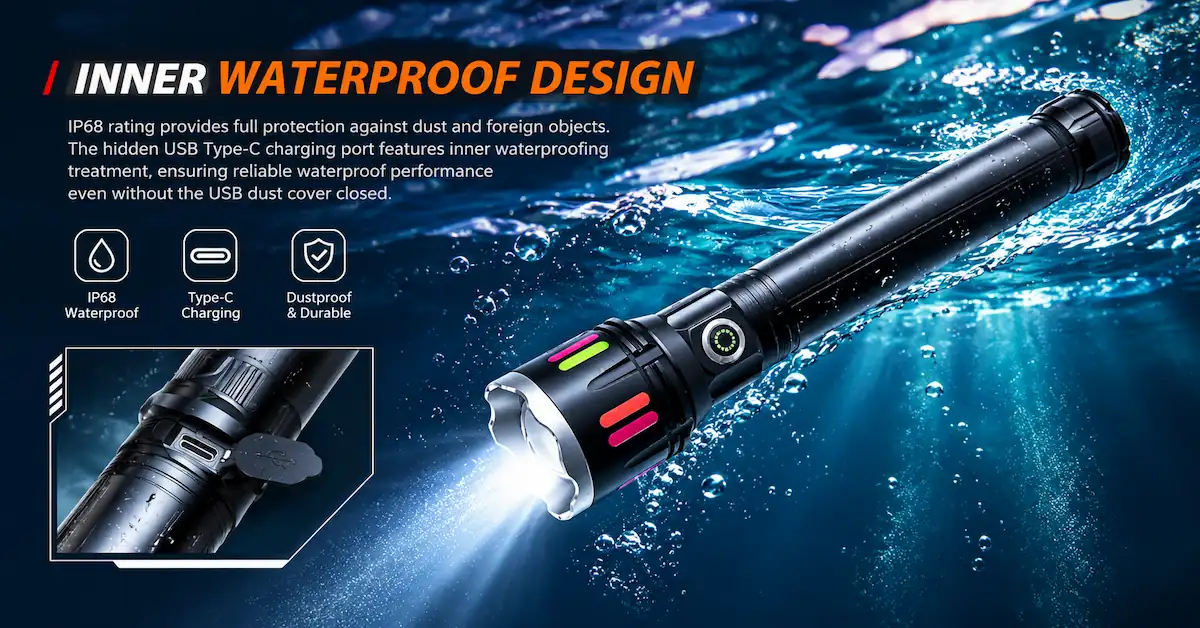
Why Are USB-C Charging Ports Challenging?
Rechargeable flashlights often include charging interfaces that must coexist with the enclosure-protection design.
A rubber cover may contribute to protection, but the complete port structure must be evaluated.
Buyers should verify the configuration in which the product was tested.
A flashlight tested with its charging cover fully seated should not automatically be considered protected when the cover is open.
Charging a wet flashlight or using an exposed wet connector should not be assumed safe unless the manufacturer has explicitly validated the relevant conditions.
6. How Can Buyers Verify IP68 Performance Before Mass Production?
A professional purchasing process should separate design qualification from production quality control.
These activities answer different questions.
Design qualification establishes whether a particular construction can satisfy the defined test.
Production quality control evaluates whether manufacturing continues to reproduce that construction.
Five-Stage IP68 Procurement Acceptance Process
| Stage | Main Activity | Required Outcome |
|---|---|---|
| 1. Specification Review | Define IP68 conditions and intended application | Approved test requirements |
| 2. Engineering Sample | Evaluate design and construction | Sample meets agreed criteria |
| 3. Pre-Production Validation | Test the production-representative configuration | Documented qualification evidence |
| 4. Manufacturing Inspection | Check critical seals, dimensions, assembly | Controlled production quality |
| 5. Final Batch Acceptance | Complete agreed inspections and sampling | Shipment meets contractual requirements |
Stage 1: Define the Target Requirement
Before requesting prices, communicate the intended operating environment and required immersion conditions.
Avoid ambiguous requirements such as “100% waterproof” or “best waterproof design.”
Stage 2: Evaluate Samples
Request production-representative samples and examine enclosure construction, charging-port design, switches, and sealing interfaces.
Verify whether the manufacturer has relevant test documentation.
Stage 3: Approve the Final Configuration
A successful initial test should be linked to a specific approved product design.
Record the model, drawings, relevant materials, sealing components, battery configuration, and permitted manufacturing tolerances.
Stage 4: Control Production
Establish inspection requirements for critical assembly processes.
Depending on the product and project, this may involve visual inspection, functional testing, leak-screening methods, and defined sampling.
Stage 5: Review Shipment Acceptance
Final approval should be based on the agreed inspection criteria and supporting records.
A passed engineering sample does not eliminate the need for production controls.
7. Can GHS Rechargeable Flashlights Be Evaluated for IP68 Requirements?
GHS (Guanghuishi) offers rechargeable handheld LED flashlights, including general-purpose and high-intensity product formats.
These products provide existing platforms that buyers may discuss when exploring waterproofing requirements and OEM possibilities.
However, the publicly available specifications reviewed for the following models do not establish verified IP68 ratings.
GHS Flashlight Platforms for Initial Technical Discussion
| GHS Model | Displayed Product Characteristics | Relevant Design Questions |
|---|---|---|
| TC-10120 | Rechargeable handheld design, Type-C charging, adjustable beam | Charging-port sealing, lens and switch protection |
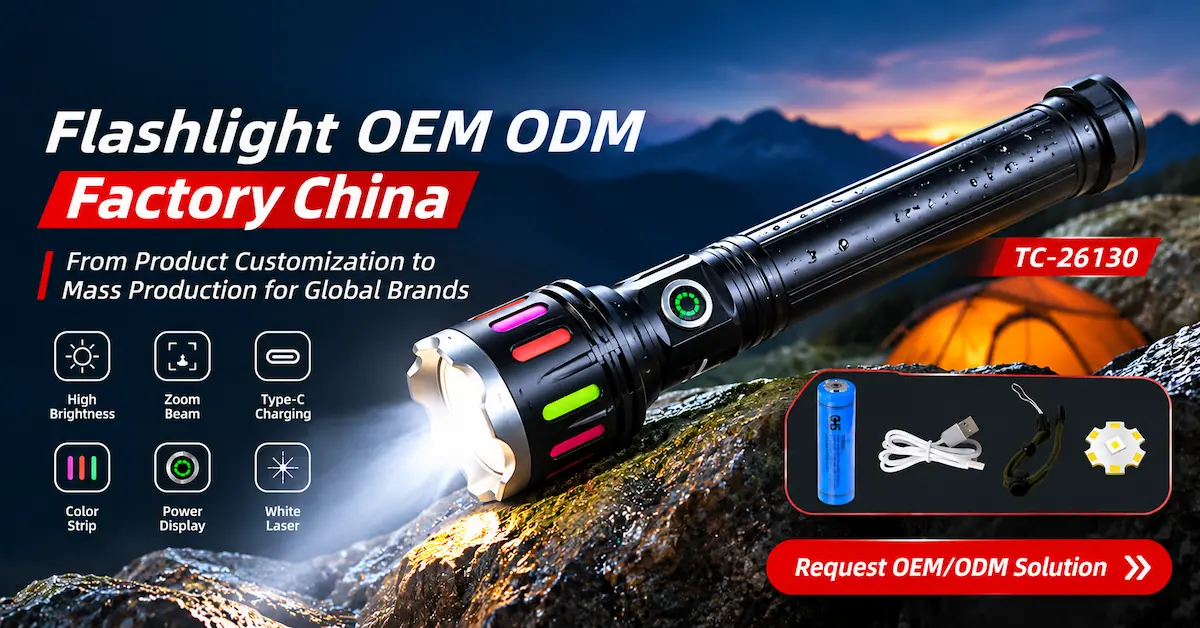
| TC-26130 | Rechargeable design, adjustable head, side controls | Moving-head interfaces and charging protection |
| S-P200W | Larger handheld format, adjustable illumination | Housing joints, thermal behavior and enclosure design |
These products should not be presented as IP68-rated without appropriate model-specific evidence.
What Should Buyers Ask GHS?
For an IP68-focused inquiry, buyers should ask whether an existing model has documented ingress-protection testing or whether the required rating would involve product redevelopment and additional validation.
If a product does not meet the requested conditions, the supplier should clarify the limitation rather than make an unsupported performance commitment.
Explore the GHS flashlight product range
8. How Do OEM Modifications Affect Waterproof Performance?
OEM customization can help brands develop differentiated flashlight products, but modifications may affect enclosure integrity.
Customization Risk Matrix
| OEM Modification | Potential Sealing Impact | Recommended Action |
|---|---|---|
| Surface Logo Printing | Usually lower structural impact | Confirm process compatibility |
| Laser Marking | Depends on material and marking depth | Review the actual process |
| Retail Packaging | Normally does not alter the enclosure | Maintain correct technical claims |
| Housing Color Change | Depends on coating and process | Review dimensional and finishing effects |
| Charging-Port Modification | Potentially significant | Reassess sealing and testing |
| Switch Replacement | Potentially significant | Validate the updated interface |
| Lens or Bezel Change | Potentially significant | Review sealing design |
| New Housing or Tailcap | Potentially significant | Requalify the changed enclosure |
Does a Customized IP68 Flashlight Retain Its Original Rating?
Not automatically.
If customization changes the enclosure structure or critical components, the original test evidence may no longer represent the finished product.
Buyers should require engineering review and appropriate revalidation.
For private-label projects, branding and packaging changes may be commercially attractive because they can provide differentiation without necessarily redesigning the entire enclosure.
Actual customization availability must be confirmed for the selected product.
9. How Can Buyers Maintain Waterproof Quality Across Bulk Orders?
Manufacturing consistency is essential for products sold with measurable environmental-protection claims.
Even when a prototype passes immersion testing, production variation can introduce risks.
Important Production Controls
Incoming Material Inspection
Verify critical sealing components and other specified materials against the approved design.
Dimensional Inspection
Check the important dimensions of O-ring grooves, mating surfaces, threaded joints, and other relevant interfaces.
Assembly Process Control
Confirm that seals are installed correctly and that specified assembly procedures are followed.
Functional Testing
Check switches, charging interfaces, illumination modes, and other required functions.
Ingress-Protection Verification
Use an agreed inspection and testing approach appropriate to the product, production volume, and purchasing risk.
Should Every Flashlight Be Immersion Tested?
Not necessarily.
The appropriate production inspection strategy depends on the design, manufacturing process, required protection level, and contractual risk.
An IP68 qualification test and a production leak-screening method may serve different purposes.
If a supplier uses an alternative screening method, buyers should ask how it has been validated against the relevant ingress-protection requirements.
Prevent Specification Drift
Repeat orders should use a controlled technical specification.
Changes involving O-rings, charging-port covers, switch structures, lenses, or housing dimensions should be reviewed before acceptance.
The commercial value of an IP68 product depends not only on passing the original test but also on maintaining the validated design during production.
10. What Are the Most Common IP68 Flashlight Purchasing Mistakes?
Mistake 1: Assuming Every IP68 Product Has the Same Immersion Rating
Different IP68 products may have different documented immersion conditions.
Better approach: Specify the required depth, duration, and test conditions.
Mistake 2: Using a Report for the Wrong Model
A visually similar flashlight may have a different enclosure structure.
Better approach: Match test evidence to the exact product revision.
Mistake 3: Ignoring Charging-Port and Tailcap Design
These components are common enclosure interfaces.
Better approach: Evaluate the complete assembled product, including removable parts.
Mistake 4: Assuming IP68 Includes Every Water-Jet Requirement
Immersion and water-jet classifications address different exposures.
Better approach: Define each required protection level separately.
Mistake 5: Equating IP68 With Professional Diving Capability
An IP68 designation alone does not establish specialized underwater operating suitability.
Better approach: Specify additional requirements for dedicated underwater applications.
Mistake 6: Neglecting Production Consistency
A successful prototype does not guarantee every production unit will meet the same requirements.
Better approach: Establish controlled components, inspection criteria, and batch acceptance procedures.
11. What Determines the Cost of an IP68 Waterproof Flashlight?
An IP68 waterproof flashlight manufacturer may incur different costs depending on the required enclosure construction, testing, and production controls.
Main Cost Drivers
| Cost Factor | Potential Commercial Impact |
|---|---|
| Housing Design | Engineering and manufacturing complexity |
| O-Rings and Gaskets | Material and component costs |
| Charging-Port Protection | Design and assembly requirements |
| Dimensional Tolerances | Processing and inspection costs |
| Qualification Testing | Laboratory and sample expenses |
| Production QC | Inspection and verification resources |
| OEM Modifications | Possible engineering and retesting |
| Packaging and Documentation | Retail and import requirements |
| Defects and Returns | Replacement and warranty exposure |
Compare Total Procurement Cost
A useful comparison is:
Cost per Accepted Unit = Total Product, Testing, Inspection and Delivery Cost ÷ Accepted Units
This helps buyers compare quotations based on actual delivered quality rather than nominal unit prices.
MOQ and Lead Time
MOQ and production lead time depend on the selected product, required testing, customization, components, and order quantity.
A project requiring a newly validated waterproof enclosure may involve more preparation than purchasing an existing qualified model.
Buyers should request project-specific commercial terms rather than assume a universal MOQ or production schedule.
12. Why Consider GHS for Waterproof Flashlight Development and Sourcing?
GHS (Guanghuishi), operating under the published English name Guangdong Guanghuishi Electrical Appliances Co., Ltd., is a China-based lighting company engaged in product development, manufacturing, and sales.
According to its published company information, the company was established in 2009 and operates a manufacturing facility in Zhaoqing, Guangdong, China.
GHS provides several rechargeable LED flashlight platforms and presents OEM/ODM cooperation as part of its business activities.
For buyers seeking waterproof flashlight products, these capabilities offer an initial basis for discussing available models, structural requirements, customization feasibility, and procurement options.
However, company manufacturing experience should not be interpreted as proof that a specific model already satisfies IP68.
Information Buyers Can Request
-
Available flashlight models and current specifications
-
Existing waterproof or ingress-protection test documentation
-
Defined IP68 test conditions, if applicable
-
Product samples
-
Housing and charging-port construction details
-
OEM customization feasibility
-
Relevant quality-control information
-
Order quantities and delivery conditions
Buyers can review GHS company information and GHS factory videos as part of their initial supplier evaluation.
Contact GHS to discuss waterproof flashlight requirements and model-specific documentation
13. IP68 Waterproof Flashlight RFQ Checklist
A detailed RFQ allows suppliers to determine whether an existing flashlight platform can meet the specified protection requirement.
| RFQ Item | Information to Provide |
|---|---|
| Buyer Type | Importer, outdoor brand, industrial distributor, OEM buyer |
| Target Market | Country or region of sale |
| Intended Application | Outdoor, industrial, marine-adjacent, emergency equipment |
| Required Rating | IP68 or another specified protection classification |
| Immersion Conditions | Required depth, duration, temperature, and test state |
| Product Configuration | Battery, charging system, switches, housing |
| Lighting Requirements | Output, beam pattern, runtime |
| Environmental Requirements | Dust, water jets, impact, temperature, other exposure |
| Documentation | Required test reports and verification evidence |
| OEM Customization | Logo, packaging, structure, accessories |
| Order Quantity | Initial order and expected repeat volume |
| Quality Inspection | Agreed acceptance and batch verification criteria |
| Delivery | Destination and requested schedule |
A complete RFQ enables a more meaningful discussion of product feasibility, testing requirements, pricing, and delivery planning.
Request a technical review or project-specific quotation from GHS
14. Frequently Asked Questions About IP68 Waterproof Flashlight Manufacturing
1. What is an IP68 waterproof flashlight manufacturer?
An IP68 waterproof flashlight manufacturer produces or develops flashlight products intended to satisfy the relevant IP68 enclosure-protection requirements. Buyers should verify the exact model, test conditions, and supporting evidence before treating any product as IP68-rated.
2. Does IP68 mean a flashlight is completely waterproof?
No. IP68 represents specified dust and immersion protection under defined conditions. It does not guarantee unlimited water exposure, operation at every depth, or resistance to every type of liquid.
3. What immersion depth and duration are required for IP68?
IPX8 does not have one universal depth-and-duration combination applicable to every product. The relevant conditions must follow the applicable product standard or the agreement required under IEC 60529 and must be more severe than IPX7 conditions.
4. Is IP68 better than IP67?
IP68 addresses immersion conditions more severe than the standard IPX7 test, but whether it is more appropriate depends on the intended application. Buyers should compare actual test conditions rather than rating labels alone.
5. Does IP68 automatically include IP66 protection?
No. IP66 addresses powerful water-jet exposure, while IP68 addresses immersion. Buyers requiring both should verify that both requirements are satisfied.
6. Can a USB-C rechargeable flashlight achieve IP68?
A rechargeable flashlight can potentially achieve IP68 if its complete enclosure, including charging interfaces, meets the applicable requirements. The result must be verified for the actual tested configuration.
7. Can an IP68 flashlight be used for scuba diving?
An IP68 designation alone does not establish suitability for scuba diving or other specialized underwater applications. Buyers must verify the relevant depth, pressure, operational, and safety requirements.
8. Does OEM customization affect IP68 performance?
It can. Changes to charging ports, switches, housings, lenses, or other sealing interfaces may affect protection. Modified configurations should undergo appropriate engineering review and testing.
9. How can buyers verify IP68 quality in bulk production?
Buyers should review relevant qualification reports, approve a controlled product configuration, establish critical component requirements, and agree on appropriate production inspections and batch acceptance procedures.
10. Does GHS offer an IP68-certified flashlight?
GHS displays waterproof flashlight products as part of its product offering, but an IP68 rating for a specific model has not been verified in the publicly reviewed product documentation. Buyers should contact GHS to request current model-specific test evidence and confirm available options.
Conclusion
Choosing a reliable IP68 waterproof flashlight manufacturer requires more than accepting an IP68 marking, evaluating product photographs, or comparing wholesale prices.
For overseas importers, outdoor equipment brands, and industrial distributors, the most important purchasing decisions involve defining the intended environment, verifying immersion-test conditions, examining critical sealing components, and establishing quality controls that support repeatable production.
An appropriate IP68 sourcing program should clearly identify the approved model, relevant IEC 60529 requirements, specified immersion conditions, tested configuration, inspection criteria, and permitted product modifications.
Buyers should also recognize that IP68 does not automatically guarantee resistance to powerful water jets, unlimited underwater operation, or continued protection after mechanical damage.
GHS offers rechargeable flashlight platforms and manufacturing-related services that buyers can investigate when discussing waterproof lighting requirements and OEM cooperation. Any IP68 performance claim must be supported by valid evidence for the exact product configuration before it is used commercially.
By combining technical verification, controlled product specifications, and realistic purchasing requirements, businesses can reduce sourcing uncertainty and make better long-term procurement decisions.
Looking for a China-based flashlight manufacturer to discuss IP68 waterproofing requirements, OEM customization, or bulk sourcing? Explore the GHS LED flashlight product range and contact GHS to request current specifications, available testing information, samples, and a project-specific quotation.