
How long does flashlight OEM production take?
The answer depends on whether the project involves branding an existing flashlight, modifying its functional components, or developing an entirely new product.
For international importers and private-label lighting brands, flashlight OEM production lead time should be evaluated as a complete sequence of purchasing, engineering, approval, manufacturing, and inspection activities rather than simply the number of days spent assembling products.
TL;DR: There is no universal OEM flashlight production period. Existing-platform branding generally involves fewer development stages than electronic or structural customization. Buyers should establish separate schedules for sample approval, component preparation, packaging, mass production, quality inspection, and shipping. A project-specific timeline should be confirmed before the purchase order is released.
For businesses preparing seasonal promotions, retail launches, or distribution programs, understanding these dependencies can help reduce inventory shortages and unexpected delivery delays.
Buyers can begin by reviewing the GHS rechargeable LED flashlight collection to identify an existing product platform before discussing customization and production schedules.
Key Takeaways
-
Existing flashlight platforms may require less preparation than newly developed products.
-
Logo approval, battery availability, and custom packaging can influence the delivery schedule.
-
Manufacturing lead time and international shipping time are separate planning elements.
-
Production should begin against approved specifications and confirmed commercial terms.
-
Optical, electrical, or structural modifications may require additional validation.
-
Buyers should plan backward from the required inventory arrival or retail launch date.
1. What Does Flashlight OEM Production Lead Time Include?
OEM lead time refers to the period required to complete an agreed manufacturing project within defined starting and finishing milestones.
A supplier may calculate production time from deposit receipt, final sample approval, material availability, or formal production authorization.
These starting points are not necessarily the same.
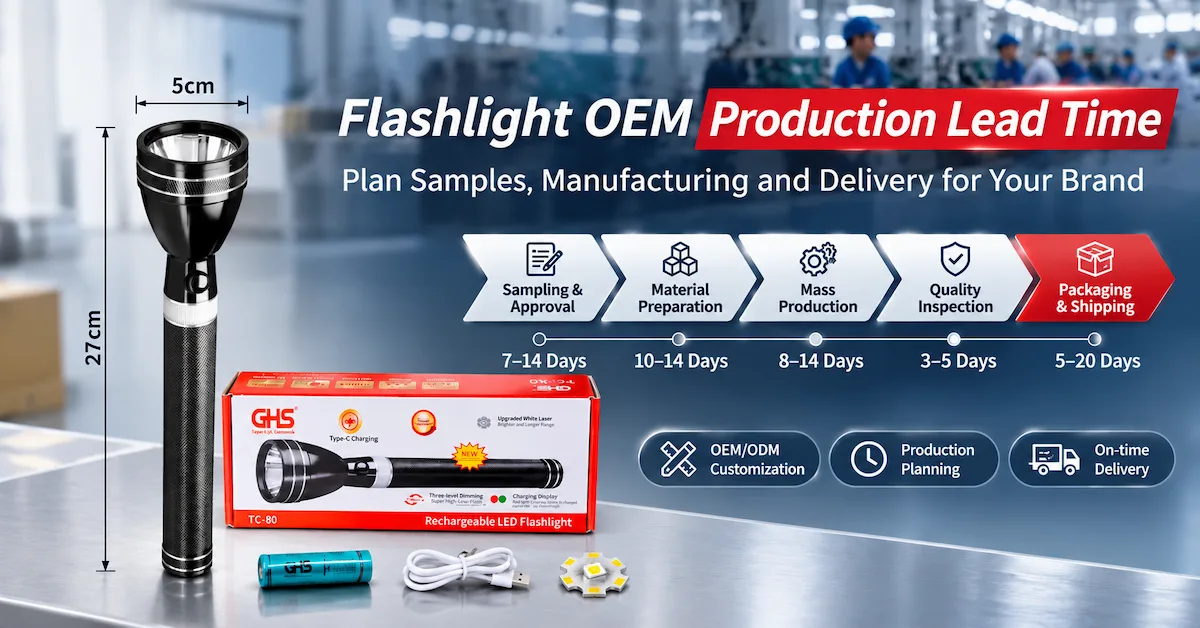
OEM Flashlight Production Timeline
| Production Stage | Main Activities | Completion Milestone |
|---|---|---|
| Requirement Review | Application, quantity, specifications, customization | Approved project scope |
| Sample Preparation | Product selection, branding, configuration | Sample available for evaluation |
| Sample Approval | Functional, appearance and packaging checks | Written buyer approval |
| Material Preparation | Batteries, LEDs, drivers, housings, accessories | Required components ready |
| Production Scheduling | Labor, equipment and assembly planning | Confirmed production slot |
| Mass Production | Assembly and process inspection | Required units manufactured |
| Final Quality Control | Functional checks and agreed inspections | Shipment acceptance |
| Packaging and Handover | Retail boxes, cartons and documentation | Goods ready for collection or dispatch |
Before accepting a quotation, buyers should ask whether the stated timeline includes sampling, material preparation, and final inspection.
A factory quotation stating a production period may not include international transportation or customs clearance.
2. How Long Does Flashlight OEM Production Take for Different Projects?
Customization complexity is one of the most significant factors affecting project duration.
A flashlight requiring only branded packaging follows a different development process from a product requiring new electronics or housing structures.
Comparison of Three OEM Project Types
| Project Type | Typical Requirements | Relative Schedule Complexity |
|---|---|---|
| Existing-Platform Branding | Logo, packaging, manuals, approved accessories | Lower |
| Functional Customization | Selected battery, optical, control or finish changes | Medium to high |
| New Product Development | New housing, electronics, tooling or original design | Higher |
Scenario-Based Production Planning
The following table illustrates how different project schedules might be constructed.
All durations are hypothetical planning assumptions. They are not GHS quotations, verified industry averages, or guaranteed delivery periods.
| Project Stage | Existing-Platform Branding | Functional Modification | New Product Development |
|---|---|---|---|
| Sampling and Technical Approval | 7 days | 14 days | 35 days |
| Component Preparation | 10 days | 14 days | 21 days |
| Packaging Preparation | 6 days | 8 days | 10 days |
| Assembly and Production | 8 days | 10 days | 14 days |
| Final Inspection and Packing | 3 days | 4 days | 5 days |
| Illustrative Total | 28 days | 42 days | 75 days |
These examples assume that component preparation and packaging preparation can run concurrently after sample approval.
In that arrangement, the longer of those two activities determines when assembly can begin.
Actual schedules may be shorter or longer depending on engineering requirements, approval cycles, material availability, testing, and factory workload.
For a first order, flashlight OEM production lead time should always be confirmed against the exact product configuration rather than copied from another project's schedule.
3. Which Factors Have the Greatest Impact on OEM Flashlight Delivery?
Several manufacturing and commercial factors can determine whether an order remains on schedule.
Product Customization Complexity
Logo marking and packaging changes may preserve an existing product's technical structure.
However, changing the LED, battery, charging circuit, switch, or housing can introduce additional engineering work.
New components may also require compatibility checks and updated performance testing.
Battery and Electronic Component Availability
Rechargeable flashlights commonly depend on several electrical components, including:
-
LED light sources
-
Electronic drivers
-
Rechargeable batteries
-
Charging circuits
-
Control switches
-
Printed circuit boards
If an approved component is unavailable, the supplier may need additional procurement time.
Substituting a battery or driver without technical review can affect runtime, charging behavior, heat generation, and supporting documentation.
Housing and Surface Treatment
Housing production and finishing requirements can influence preparation time.
A standard black housing may involve fewer changes than a newly designed structure or a special color finish.
New mechanical designs may require tooling, fixtures, machining changes, or prototype verification.
Custom Retail Packaging
Packaging can become a schedule-critical activity even when the flashlight itself uses an existing platform.
Retail boxes may require artwork approval, printing, inserts, barcode verification, and accessory checks.
A delayed packaging approval can prevent an otherwise completed order from being released.
Order Quantity and Factory Workload
Larger orders require more materials, production resources, inspection capacity, and packaging.
However, production time does not necessarily increase in direct proportion to quantity.
A manufacturer must assess available components, production capacity, and scheduling commitments before confirming delivery.
4. Which GHS Flashlight Models Can Help Buyers Start an OEM Project?
Selecting a suitable existing flashlight platform may reduce the amount of engineering development needed.
GHS (Guanghuishi) displays several rechargeable and high-intensity handheld flashlight products that international buyers can evaluate.
GHS Product Platform Comparison
| GHS Model | Publicly Displayed Features | Potential OEM Purchasing Direction | Main Scheduling Consideration |
|---|---|---|---|
| TC-80 | Basic rechargeable handheld flashlight | Utility and hardware retail products | Branding, component availability, packaging |
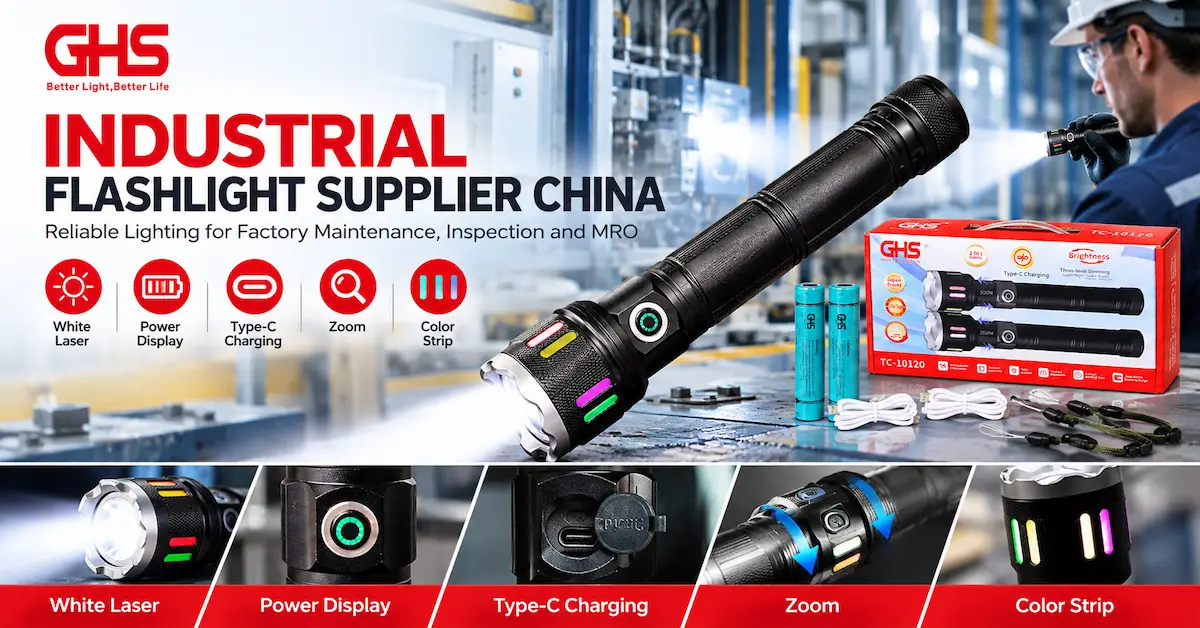
| TC-10120 | Type-C charging, side switch, adjustable beam | Outdoor and rechargeable retail lighting | Approved battery, accessories and retail presentation |
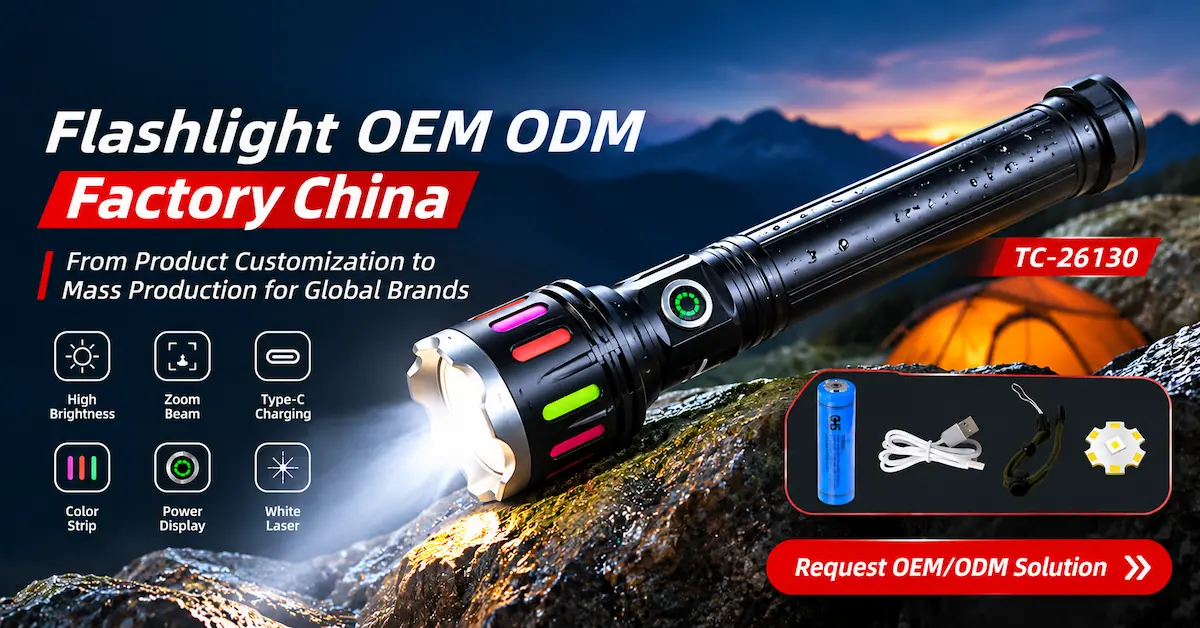
| TC-26130 | Rechargeable format, zoomable head, different package presentations | Private-label products and retail kits | Exact model variant and package configuration |
| S-P200W | Larger handheld format, adjustable beam, high-intensity series | Higher-positioned portable lighting products | Optical verification, battery configuration and testing |
These models provide starting points for product evaluation. Their actual customization options, stock availability, technical performance, MOQ, and production schedules must be confirmed individually.
Which Product Platform Should Buyers Evaluate First?
For a basic utility-lighting range, TC-80 may provide a straightforward starting point.
For rechargeable outdoor or retail products, TC-10120 and TC-26130 offer alternative handheld designs and accessory configurations.
For a larger high-intensity product format, S-P200W can be considered during initial evaluation.
The objective is to select a platform that already satisfies most of the intended market requirements.
Explore GHS rechargeable flashlight models for OEM projects
5. How Can Critical Path Planning Reduce Flashlight Production Delays?
Managing flashlight OEM production lead time requires identifying which activities determine the earliest possible completion date.
This is commonly known as critical path planning.
The GAO Schedule Assessment Guide explains established project-scheduling practices, including the importance of realistic activity sequences, dependencies, schedule risks, and completion milestones.
These principles can also be applied to OEM manufacturing projects.
Sequential vs. Parallel Production Planning
Consider an illustrative project requiring the following activities:
| Activity | Assumed Duration |
|---|---|
| Sample Preparation and Approval | 7 days |
| Component Preparation | 10 days |
| Packaging Preparation | 6 days |
| Mass Production | 8 days |
| Final Inspection | 3 days |
If every activity is completed sequentially, the total is 34 days.
If component preparation and packaging preparation can proceed in parallel after approval, the total becomes 28 days.
The potential six-day difference illustrates how better coordination can reduce unnecessary waiting.
This is a scheduling example, not a measured GHS production result.
Which Activities Can Run in Parallel?
Depending on the project, manufacturers and buyers may be able to coordinate:
-
Component purchasing and approved packaging production
-
Shipping-document preparation and manufacturing
-
Inspection scheduling and production planning
-
Retail product listing preparation and final packaging approval
However, parallel activities should only begin when their required inputs are approved.
Ordering incorrect packaging or unapproved components early can create additional costs and delays rather than save time.
6. How Should Buyers Plan Backward From a Retail Launch Date?
For outdoor brands and wholesale distributors, the most important date is often not the manufacturing completion date.
It is the date when finished inventory must be available for sale.
A practical schedule should work backward from that requirement.
Example: Planning a Private-Label Flashlight Launch
Assume a retailer is preparing a seasonal rechargeable flashlight promotion.
Its hypothetical purchasing schedule includes:
| Activity | Illustrative Planning Allowance |
|---|---|
| Sampling, Preparation and OEM Production | 28 days |
| International Transportation | 18 days |
| Customs Clearance and Warehouse Receiving | 5 days |
| Contingency Buffer | 5 days |
| Total Planning Requirement | 56 days |
Under these assumptions, the buyer would need to begin the project at least 56 days before the intended launch date.
The actual timing should be recalculated using the factory's confirmed production schedule and current freight arrangements.
Why Is a Contingency Buffer Important?
Unexpected events may include sample revisions, packaging corrections, material shortages, failed inspection results, or transportation changes.
A suitable buffer allows purchasing teams to respond without immediately missing the launch deadline.
The buffer should reflect the uncertainty and commercial importance of the project.
7. Which Technical Requirements Can Extend OEM Flashlight Production?
Not every customization has the same effect on engineering and testing.
Technical Change and Schedule Impact Matrix
| Customization Requirement | Potential Technical Impact | Additional Work to Consider |
|---|---|---|
| Custom Logo | Surface appearance | Artwork and marking approval |
| Custom Packaging | Retail identification | Packaging sample and print review |
| Housing Color | Surface finishing | Color and finish approval |
| Different LED | Output, beam and thermal behavior | Optical and thermal evaluation |
| New Battery | Runtime, charging and compatibility | Electrical and documentation review |
| Charging Circuit Change | Electrical performance | Charging and relevant safety testing |
| New Housing | Mechanical fit and assembly | Engineering, tooling and validation |
| Waterproof Design Change | Enclosure protection | Applicable ingress-protection testing |
A shorter flashlight OEM production lead time should never be achieved by skipping necessary technical verification.
If a product is modified, the buyer should confirm whether the original performance reports remain applicable.
For example, changing the battery system may affect both runtime claims and transportation documentation.
Products intended for specialized hazardous environments or other safety-critical applications require separate technical qualification rather than an accelerated standard OEM schedule.
8. How Can Buyers Prevent Sample Approval Delays?
Sample approval is often an important dependency between project development and mass production.
Incomplete requirements can lead to repeated revisions.
Recommended Sample Approval Checklist
Before authorizing production, confirm:
-
Exact flashlight model and version.
-
Approved housing design and finish.
-
Battery and charging configuration.
-
Required lighting modes and beam characteristics.
-
Logo placement and appearance.
-
Retail packaging artwork.
-
Included accessories and instructions.
-
Applicable technical and quality acceptance requirements.
A physical sample should be supported by written specifications.
This helps prevent production personnel from working with a different configuration from the one approved by the buyer.
Reduce Unnecessary Revisions
Instead of submitting branding and technical requirements gradually, buyers should provide a consolidated product brief.
Appoint one authorized approval contact and establish clear deadlines for reviewing samples and packaging.
Efficient decision-making can improve schedule predictability without reducing quality requirements.
9. Why Are Quality Control and Battery Documentation Part of the Schedule?
Manufacturing completion does not necessarily mean an order is ready for shipment.
Flashlights must also satisfy the agreed quality and packaging requirements.
Recommended Production Quality-Control Milestones
| Inspection Stage | Main Verification |
|---|---|
| Incoming Inspection | Batteries, LEDs, electronic components, housings |
| Assembly Inspection | Component fit, connections, workmanship |
| Functional Testing | Charging, switches, lighting modes |
| Performance Sampling | Agreed light output, runtime and other requirements |
| Final Inspection | Branding, accessories, packaging and quantities |
If a batch fails an agreed inspection, corrective work and reinspection may affect the delivery date.
Buyers should therefore include sufficient time for quality acceptance rather than schedule collection immediately after assembly.
Lithium Battery Transportation
Rechargeable flashlight shipments may require specific battery transportation arrangements.
According to the International Air Transport Association's battery guidance, applicable air-transport requirements depend on factors including battery configuration and energy rating.
Buyers should coordinate battery identification, applicable testing documents, packing requirements, and carrier acceptance before shipment.
A finished flashlight order may experience delivery delays if its battery transportation requirements have not been resolved.
10. How Do MOQ and Cost Affect the Production Schedule?
Minimum order quantity and production scheduling are closely connected.
Customization may require separate minimum quantities for components, surface finishes, or printed packaging.
A buyer should distinguish between:
-
Standard product MOQ
-
Custom branding MOQ
-
Customized packaging MOQ
-
Special component purchasing quantities
-
Development or tooling requirements
There is no universal MOQ applicable to every GHS flashlight model.
Cost of Accelerating Production
An urgent order may require alternative scheduling arrangements, expedited material purchasing, or faster transportation.
These options may increase the total sourcing cost.
Buyers should ask which activity is delaying completion before paying for expedited services.
Faster freight cannot resolve an unapproved product specification, and additional assembly resources cannot compensate for unavailable batteries.
The most effective way to reduce schedule risk is to identify and resolve the actual production constraint.
11. Why Consider GHS for Flashlight OEM Production?
GHS (Guanghuishi) operates under the published English company name Guangdong Guanghuishi Electrical Appliances Co., Ltd.
According to its company profile, GHS was established in 2009 and integrates lighting product development, manufacturing, and sales.
Its manufacturing facility is located in Zhaoqing, Guangdong, China.
The company offers multiple rechargeable LED flashlight platforms that international buyers can evaluate for wholesale and OEM/ODM projects.
What Can Buyers Discuss With GHS?
Buyers can inquire about suitable product models, branding and packaging requirements, sample availability, technical specifications, customization feasibility, order quantities, inspection requirements, and project-specific production schedules.
The company's factory videos and product demonstration videos provide additional background for initial supplier evaluation.
For accurate flashlight OEM production lead time information, GHS should review the actual model, quantity, customization requirements, and expected delivery date.
Prepare an OEM Flashlight Production RFQ
| RFQ Item | Information to Provide |
|---|---|
| Product Reference | Preferred GHS model |
| Target Application | Outdoor, utility, industrial or retail |
| Order Quantity | Initial order and repeat-order forecast |
| Branding | Logo, colors and artwork |
| Packaging | Retail box, accessories and instructions |
| Technical Requirements | Battery, charging, beam and runtime |
| Testing | Applicable product verification requirements |
| Destination | Country and delivery location |
| Required Completion Date | Target inventory arrival or retail launch |
Providing these details enables a more meaningful review of product feasibility and purchasing schedules.
Contact GHS to request a model-specific OEM quotation and production schedule.
12. Frequently Asked Questions
1. How long does flashlight OEM production take?
Production time depends on the selected model, customization scope, material availability, sample approval, order quantity, and factory scheduling. Existing-platform projects generally involve fewer development stages than new product designs.
2. Does flashlight OEM production lead time include shipping?
Not necessarily. Manufacturing, final inspection, freight, customs clearance, and warehouse receiving should be identified separately in the purchasing schedule.
3. Can using an existing flashlight model shorten production time?
Potentially. An existing platform may reduce engineering and tooling requirements if it already satisfies the buyer's application. Component availability and branding requirements must still be confirmed.
4. How long does custom flashlight sampling take?
Sampling time depends on the availability of the reference product, requested modifications, packaging requirements, and the number of approval revisions. Request a project-specific sample schedule.
5. Does custom packaging affect production lead time?
Yes. Artwork approval, printing, packaging materials, inserts, and accessory preparation may affect the final order completion date.
6. Can changing a flashlight battery delay production?
Yes. Battery changes may require additional component purchasing, compatibility checks, charging verification, performance testing, and transportation-document review.
7. Are repeat OEM orders faster than first orders?
Repeat orders may require fewer development and approval activities when the configuration remains unchanged. However, actual timing still depends on material availability, factory workload, and order quantity.
8. Can flashlight OEM production be expedited?
Potentially, depending on available resources and the project's critical path. Buyers should confirm feasibility, additional costs, and whether the revised schedule maintains all required inspections.
9. When should outdoor brands place seasonal flashlight orders?
Brands should calculate backward from the required inventory arrival date, allowing for sampling, production, inspection, freight, customs clearance, and an appropriate contingency buffer.
10. How can I obtain a production schedule from GHS?
Visit the GHS Contact Us page and provide your preferred product model, customization scope, estimated quantity, target market, documentation requirements, and expected delivery date.
Conclusion
Understanding flashlight OEM production lead time is essential for importers, distributors, outdoor equipment brands, and private-label businesses planning reliable product launches.
The actual production period depends on customization complexity, component availability, sample approval, packaging preparation, manufacturing capacity, and quality-control requirements.
For buyers seeking efficient OEM cooperation, selecting a suitable existing flashlight platform, approving complete specifications early, and coordinating parallel activities can help reduce unnecessary delays.
GHS offers multiple rechargeable flashlight platforms that buyers can evaluate for branded retail products, wholesale distribution, and customized lighting projects.
Rather than relying on a universal production estimate, buyers should request a detailed schedule based on their actual product requirements, order quantity, and delivery expectations.
Planning your next OEM flashlight order? Explore the GHS rechargeable LED flashlight range and contact GHS to discuss product selection, customization, samples, bulk pricing, and a project-specific production schedule.