
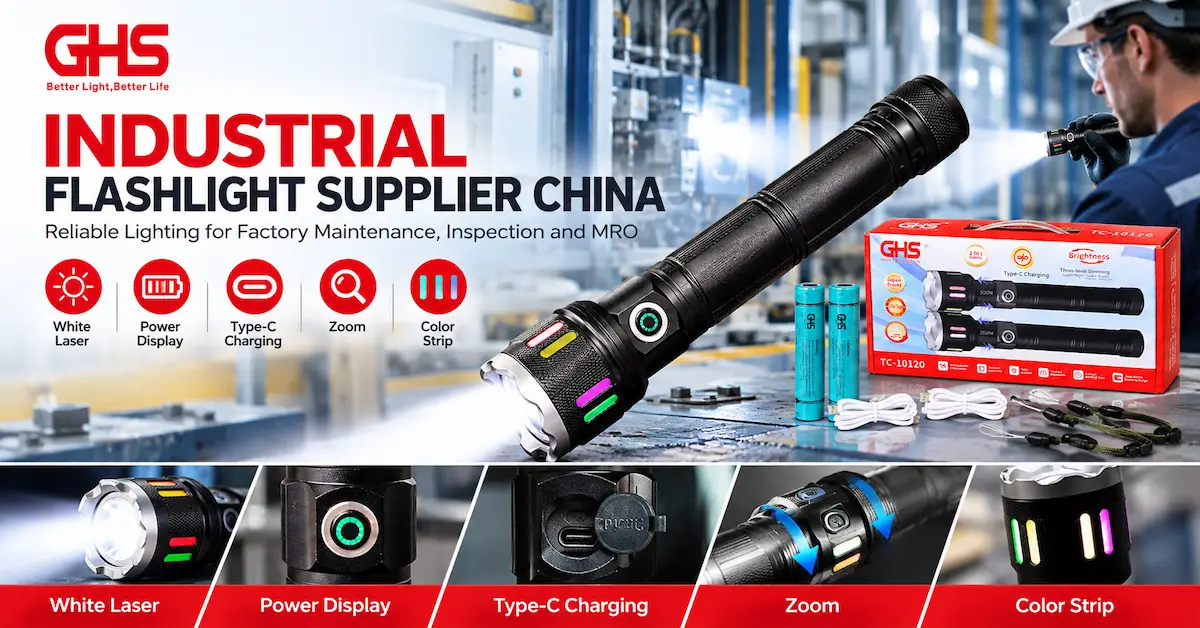
Finding an industrial flashlight supplier China is not simply about purchasing the brightest handheld light at the lowest price. Industrial procurement teams need portable lighting that matches specific inspection tasks, operates reliably during routine maintenance, and can be reordered with consistent specifications.
A flashlight used to inspect machinery inside a factory may require a different beam pattern from one used for checking warehouse aisles or outdoor equipment.
For maintenance, repair, and operations (MRO) buyers, the best sourcing approach begins with the work environment rather than a product catalog.
Quick Answer: When sourcing industrial flashlights from China, buyers should define the inspection distance, required illumination, operating duration, charging method, handling conditions, and applicable safety requirements. Then they should compare suitable models, test representative samples, establish quality acceptance criteria, and confirm bulk-order specifications before purchasing.
This guide explains how to build a practical industrial flashlight procurement plan using task-based selection, technical verification, and supplier evaluation.
Buyers exploring rechargeable handheld lighting products can review the GHS LED flashlight product collection as an initial sourcing reference.
1. Why Do Industrial Buyers Need Task-Specific Flashlights?
Industrial flashlights support workers when fixed lighting does not adequately illuminate the task area.
Common applications include equipment inspection, maintenance checks, electrical cabinet examination, warehouse operations, and emergency preparation.
However, different tasks create different lighting requirements.
Factory Equipment Maintenance
Maintenance technicians may need to illuminate machine interiors, inspect components, or locate parts behind equipment.
The key requirements are manageable size, practical near-field illumination, convenient controls, and dependable operation.
Warehouse and Logistics Inspection
Warehouse personnel may need portable lighting for checking storage racks, loading areas, containers, or equipment during reduced-light conditions.
A suitable beam pattern and reliable battery performance are important.
Industrial Facility Inspection
Facility maintenance teams may inspect utility areas, building systems, machinery, or other difficult-to-illuminate locations.
They may need a handheld flashlight that is easy to carry, operate, and recharge.
Outdoor Equipment Checks
Some industrial sites require routine nighttime checks of equipment installed outdoors.
For these applications, buyers should consider beam performance, carrying convenience, operating temperature, and environmental protection.
Important: These are general industrial utility applications. Hazardous locations involving flammable gases, vapors, or combustible dust may require specially approved lighting equipment.
2. Who Should Source Industrial Flashlights From China?
An industrial LED flashlight supplier may serve several types of professional buyers.
| B2B Buyer | Purchasing Objective | Main Evaluation Priority |
|---|---|---|
| Industrial MRO Distributors | Supply replacement and maintenance equipment | Repeat-order consistency |
| Factory Purchasing Managers | Equip maintenance personnel | Functionality and cost control |
| Warehouse Equipment Suppliers | Provide inspection lighting | Beam coverage and portability |
| Electrical Maintenance Contractors | Support routine equipment inspections | Handling, charging, suitable illumination |
| Industrial Hardware Wholesalers | Build professional tool collections | Product range and bulk pricing |
| Facility Management Suppliers | Supply building maintenance teams | Reliable operation and replenishment |
| Industrial Equipment Importers | Source products for regional distribution | Documentation, quality, logistics |
| OEM Tool Brands | Add branded utility lighting | Customization and quality control |
For these buyers, product performance should be evaluated alongside commercial factors such as packaging, inventory planning, inspection requirements, and after-sales support.
3. Match Industrial Flashlights to Maintenance Tasks
A useful procurement strategy is to classify industrial lighting requirements according to the work being performed.
Industrial Flashlight Application Matrix
| Industrial Application | Recommended Lighting Characteristics | Main Procurement Risk |
|---|---|---|
| Machine Component Inspection | Controlled near-field illumination, easy operation | Glare and unsuitable beam width |
| Electrical Cabinet Inspection | Portable light, suitable beam control | Poor illumination or unsafe working practices |
| Warehouse Rack Inspection | Practical beam reach and runtime | Inadequate coverage |
| Equipment Maintenance | Comfortable grip, rechargeable operation | Switch or charging failures |
| Outdoor Facility Patrol | Concentrated beam where needed | Insufficient sustained illumination |
| Vehicle and Machinery Checks | Portable construction and convenient storage | Battery discharge during storage |
| Industrial Emergency Kits | Straightforward controls and documented readiness checks | Missing or depleted equipment |
Why Beam Shape Matters
A narrow, concentrated beam can help technicians inspect a specific component at a distance.
A wider beam may be more useful when examining equipment interiors or working near a maintenance bench.
Therefore, purchasing teams should not compare products using advertised lumen values alone.
They should also evaluate beam distribution, switching convenience, and actual lighting performance at the required working distance.
A flashlight that delivers suitable illumination consistently may be more useful than one with a very high short-duration output.
4. Which GHS Flashlight Models Can Industrial Buyers Evaluate?
GHS (Guanghuishi) offers rechargeable handheld LED flashlight products that can be evaluated for general industrial utility and inspection applications.
Several models feature USB Type-C charging, portable cylindrical structures, and adjustable illumination designs.
GHS Industrial Utility Flashlight Comparison
| Model | Displayed Features | Potential Industrial Application | Specifications to Verify |
|---|---|---|---|
| TC-80 | Rechargeable design, Type-C charging, handheld structure | Routine factory maintenance, toolkits | Output, runtime, housing material |
| TC-10120 | Type-C charging, side switch, zoomable design | Equipment inspection, portable utility lighting | Battery, actual beam performance, weight |
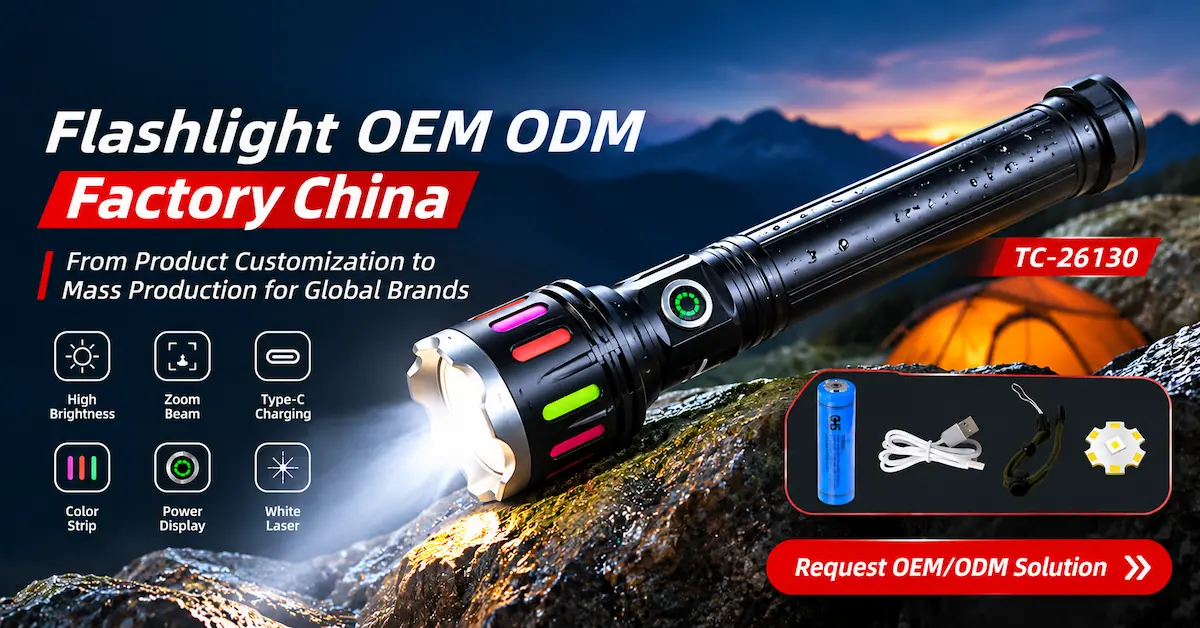
| TC-26130 | Rechargeable operation, adjustable head, side controls | Warehouse inspection, maintenance kits | Model variant, charging, runtime |
| S-P200W | Larger rechargeable format, adjustable beam | Outdoor facility checks, distance-oriented inspection | Measured output, beam distance, heat management |
These are preliminary application matches based on publicly displayed product characteristics. They do not constitute industrial safety certification or confirmation of suitability for every operating environment.
How Should Buyers Shortlist Models?
For general maintenance kits, the TC-80 is a practical starting point because of its straightforward rechargeable handheld format.
For inspection tasks requiring adjustable illumination, TC-10120 and TC-26130 offer alternative designs worth comparing.
For larger outdoor areas or applications requiring a more concentrated beam, the S-P200W series can be evaluated.
The S-P200W designation should not be interpreted as verified electrical wattage.
Before purchasing, request current model specifications, samples, and confirmation of the exact configuration.
Compare available GHS industrial utility flashlight models
5. What Technical Specifications Matter for Industrial Flashlights?
Technical specifications should be defined according to actual working conditions.
A procurement document should identify measurable requirements wherever those requirements affect usability, performance, or reliability.
Industrial Flashlight Specification Checklist
| Parameter | Technical Meaning | Recommended Buyer Verification |
|---|---|---|
| Light Output | Total light emitted, measured in lumens | Request test data by mode |
| Beam Intensity | Concentration of light, measured in candela | Compare focused-beam performance |
| Beam Distance | Distance under specified illumination conditions | Evaluate required inspection range |
| Runtime | Operating duration at a defined output | Request runtime measurements |
| Battery Capacity | Electrical charge or energy capacity | Check battery specifications |
| Charging System | Charging connector and electrical configuration | Test charging functionality |
| Housing Construction | Material, finish, dimensions, weight | Review material and physical sample |
| Ingress Protection | Resistance to dust or water entry | Verify applicable test reports |
| Impact Resistance | Mechanical durability under specified tests | Review evidence where required |
| Control System | Switches and lighting modes | Conduct repeated functional tests |
Lumens vs. Candela
Lumens represent the overall quantity of visible light produced.
Candela describes luminous intensity in a particular direction.
For industrial inspection, both measurements can be relevant.
A maintenance technician examining machinery at close range may benefit from a wider beam, while someone checking equipment farther away may prefer a concentrated beam.
Runtime and Sustained Output
Runtime should be evaluated at the brightness setting the worker will actually use.
A flashlight may deliver a strong initial output but reduce its brightness as operating conditions change.
The ANSI/PLATO FL 1-2025 portable lighting standard provides standardized methods for reporting flashlight performance, including light output, beam distance, runtime, impact resistance, and dust or water protection.
Its updated approach also distinguishes certain short-duration elevated-brightness modes from normal operating modes.
For industrial procurement, buyers should request comparable testing and avoid relying only on maximum advertised brightness.
Using this standard as a purchasing reference does not mean any specific GHS model has been certified to it.
6. How Do Industrial Flashlight Components Affect Reliability?
Industrial buyers should understand the basic components that influence flashlight performance.
LED and Optical Assembly
The LED light source, lens, and reflector affect light distribution and illumination quality.
For inspection applications, the optical system should produce a useful beam at the intended working distance.
Electronic Driver
The driver regulates electrical operation and controls the power supplied to the LED.
Driver characteristics influence lighting modes and output behavior.
Rechargeable Battery
Battery configuration affects operating time, charging requirements, and product weight.
Buyers should verify the actual battery chemistry, capacity, and protection features.
Charging Circuit
USB Type-C charging provides a convenient interface for many rechargeable lighting products.
However, a Type-C connector does not automatically guarantee a particular charging speed, power-delivery protocol, or safety function.
Housing and Assembly
Housing design influences grip comfort, component protection, and thermal management.
Buyers should inspect switches, threaded connections, charging-port covers, lens installation, and overall assembly quality.
The actual materials and manufacturing methods should be confirmed through product specifications rather than assumptions based on appearance.
7. Are Ordinary Industrial Flashlights Suitable for Hazardous Locations?
Not every industrial flashlight is approved for use in hazardous environments.
This distinction is particularly important for chemical plants, fuel-handling facilities, certain manufacturing processes, and locations where flammable atmospheres or combustible dust may exist.
General Industrial vs. Hazardous-Area Lighting
| Environment | General Requirement | Sourcing Recommendation |
|---|---|---|
| Ordinary Factory Maintenance Area | Portable lighting suitable for routine work | Verify practical performance and workplace requirements |
| Warehouse Without Hazardous Classification | Suitable illumination, handling, and runtime | Evaluate rechargeable utility models |
| Outdoor Industrial Equipment Area | Appropriate environmental performance | Check tested ingress protection and operating conditions |
| Hazardous Classified Location | Equipment approved for the applicable hazardous-area classification | Obtain documented approval for the exact equipment |
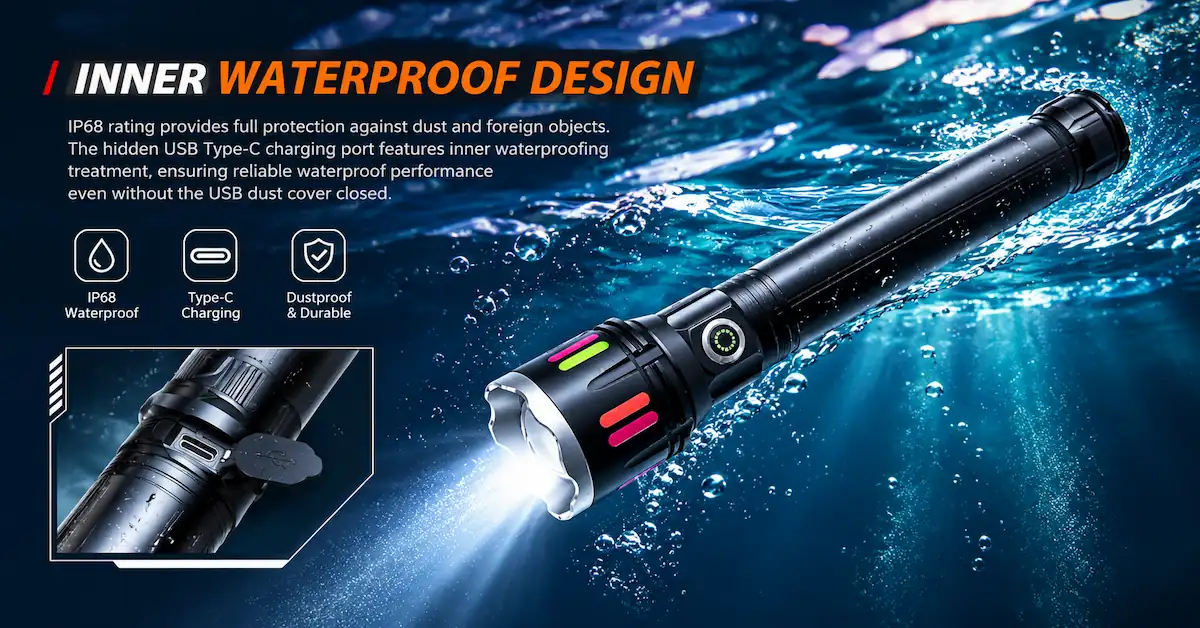
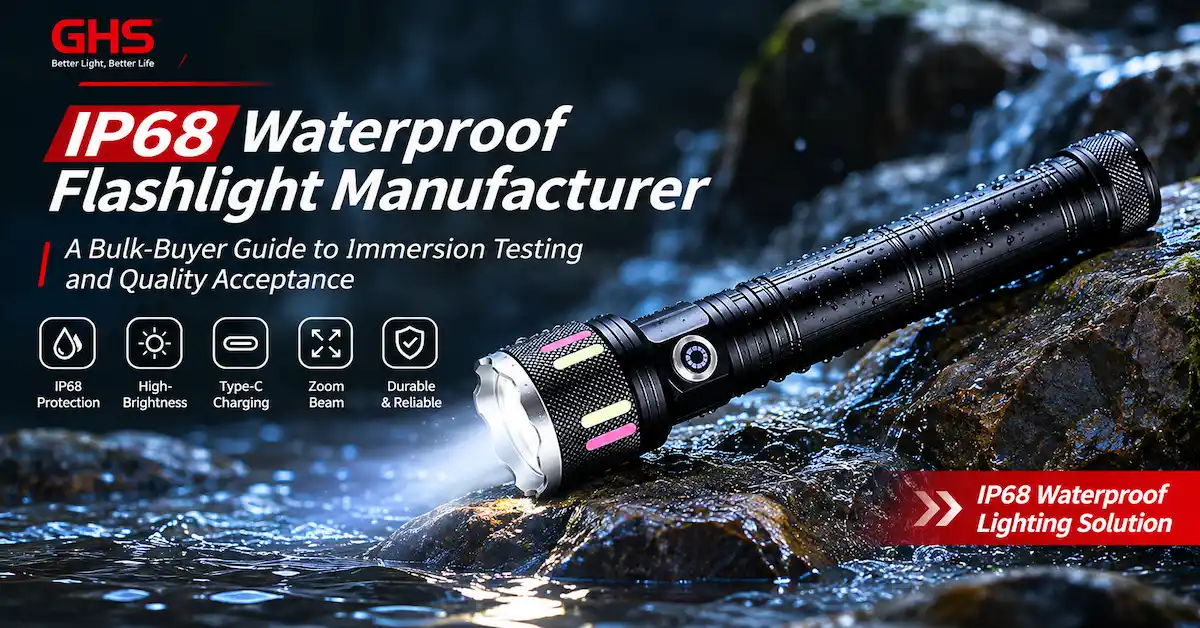
IEC 60529 defines the classification system for protection provided by electrical equipment enclosures against ingress and access hazards.
However, an IP rating does not mean a flashlight is explosion-proof.
For potentially explosive atmospheres, the applicable hazardous-area requirements must be assessed separately.
In the United States, OSHA's 29 CFR 1910.307 addresses electrical equipment in hazardous classified locations.
A standard rechargeable flashlight should never be described as intrinsically safe, explosion-proof, or certified for hazardous locations without appropriate evidence.
Industrial buyers should establish site requirements before selecting a flashlight.
8. How Should Buyers Inspect Industrial Flashlight Samples?
Sample approval should go beyond appearance.
For maintenance and industrial supply programs, buyers should verify whether a flashlight can perform its intended job under representative conditions.
Recommended Sample Acceptance Tests
| Test Area | Inspection Method | Acceptance Consideration |
|---|---|---|
| Lighting Function | Test each specified mode | Consistent switching and illumination |
| Beam Performance | Compare illumination at the intended distance | Suitable beam coverage |
| Runtime | Measure output under agreed conditions | Meets written requirement |
| Charging | Test connector, charging cycle, and indicators | Stable operation |
| Handling | Check grip, weight, controls, and accessibility | Suitable for intended workers |
| Mechanical Assembly | Inspect connections, head, switches, and finish | No unacceptable defects |
| Environmental Performance | Review appropriate tests where specified | Meets required protection level |
| Packaging | Check accessories, labels, and instructions | Matches approved configuration |
Use a Written Acceptance Record
A sample inspection report should identify:
-
Product model and version
-
Tested battery configuration
-
Operating mode
-
Test conditions
-
Performance results
-
Observed defects
-
Required corrections
-
Final approval status
Where possible, test more than one unit.
A written approval record helps prevent misunderstandings when the supplier begins bulk production.
9. What Quality Control Should an Industrial Flashlight Supplier Provide?
Quality control should be discussed before the purchase order is finalized.
Industrial buyers need confidence that production units will match the approved product specification.
Recommended QC Stages
Incoming Component Inspection
Check critical components such as LED modules, batteries, drivers, charging interfaces, switches, housings, and packaging materials.
In-Process Inspection
Review assembly operations that affect electrical connections, mechanical fit, and product functionality.
Functional Testing
Verify switching, charging, illumination modes, and other specified functions.
Performance Verification
Conduct agreed sampling tests for light output, runtime, charging behavior, and relevant durability requirements.
Final Inspection
Check product appearance, model identification, packaging contents, accessories, labeling, and shipping cartons.
Why Component Consistency Matters
Two flashlights can look identical while containing different batteries, drivers, or LED components.
Such differences may affect brightness, charging, runtime, or thermal behavior.
For repeat orders, buyers should establish a critical component list and a process for reviewing substitutions.
The quality agreement should define acceptance criteria, defect classifications, and any required inspection sampling plan.
10. How Can MRO Buyers Reduce Industrial Flashlight Procurement Costs?
Industrial flashlight sourcing costs include more than the initial unit price.
For MRO distributors and facility operators, the total cost also includes equipment availability, replacement requirements, shipping, and quality-related expenses.
Major Cost Factors
| Cost Factor | Business Impact | Procurement Action |
|---|---|---|
| Flashlight Unit Price | Initial purchasing expense | Compare equivalent configurations |
| Battery Configuration | Performance and replacement cost | Confirm battery requirements |
| Charging Accessories | Equipment readiness and convenience | Standardize where practical |
| Packaging | Storage and distribution cost | Select suitable industrial packaging |
| Inspection | Verification expense | Define proportionate QC requirements |
| Freight and Import Charges | Landed cost | Review shipping terms |
| Product Failure | Replacement and operational disruption | Evaluate reliability |
| Inventory Availability | Potential maintenance delays | Plan repeat orders |
Consider the Cost of Equipment Unavailability
A lower-cost flashlight may not deliver the best value if it creates recurring problems for maintenance personnel.
For example, inconsistent charging accessories, unreliable switches, or unavailable replacement units can increase administrative work and disrupt planned inspections.
Purchasing teams should compare suppliers based on usable performance and repeat supply, not unit price alone.
Plan Standardized Maintenance Kits
For organizations purchasing equipment for multiple technicians, standardized flashlight kits may simplify procurement.
A kit may include the flashlight, approved charging accessories, instructions, and carrying components.
Actual accessory availability and packaging options should be confirmed with the supplier.
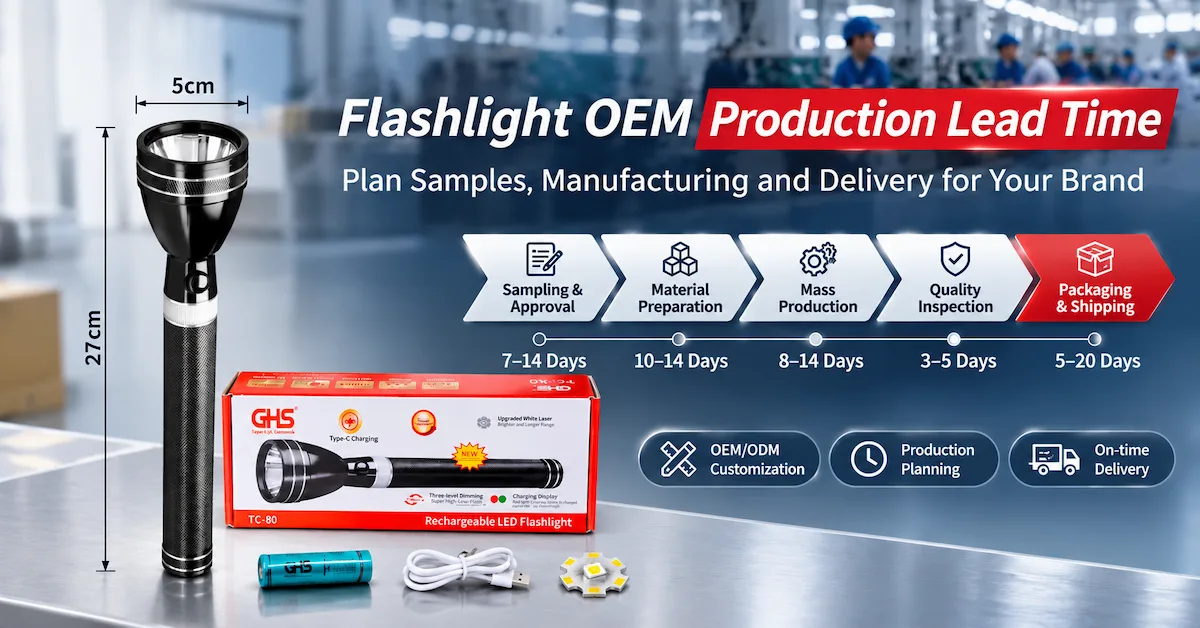
11. What Should Buyers Confirm About MOQ, Lead Time, and OEM Services?
A China industrial flashlight supplier should provide commercial terms based on the selected product and actual order requirements.
MOQ and Bulk Purchasing
Minimum order quantities may vary according to:
-
Product model
-
Battery configuration
-
Branding requirements
-
Packaging type
-
Accessories
-
Component availability
-
Order volume
Do not assume that every product has the same MOQ.
Production and Delivery Planning
A practical purchasing schedule should account for sample approval, component preparation, assembly, quality inspection, packaging, and shipping.
The supplier should confirm lead times after reviewing the final specifications.
OEM Industrial Flashlight Options
Potential customization discussions may include product logos, packaging, manuals, accessories, and selected configuration requirements.
More substantial changes involving electronics, optics, batteries, or housing structures may require additional engineering and validation.
Contact GHS for industrial flashlight model information and bulk-order terms
12. Why Consider GHS as an Industrial Flashlight Supplier in China?
GHS (Guanghuishi), operating under Guangdong Guanghuishi Electrical Appliances Co., Ltd., is a China-based lighting company engaged in product development, manufacturing, and sales.
According to its published company profile, GHS was established in 2009 and operates a manufacturing facility in Zhaoqing, Guangdong, China.
The company also reports establishing a Dubai branch in 2017 to support business activities in the Middle East.
GHS provides various rechargeable LED flashlight platforms, including general-purpose handheld models and larger high-intensity lighting designs.
For industrial buyers, these products offer starting points for evaluating routine maintenance, equipment inspection, warehouse utility, and general portable lighting applications.
What Can Industrial Procurement Teams Discuss With GHS?
-
Flashlight model selection for maintenance applications
-
Rechargeable and Type-C charging configurations
-
Physical samples and technical specifications
-
Packaging and accessory requirements
-
Applicable quality-control information
-
OEM branding options
-
Bulk order quantities and commercial terms
-
Product documentation and shipping requirements
Buyers can review the GHS company profile, factory videos, and product demonstration videos during their initial evaluation.
Specific technical performance, certification, customization scope, and delivery terms must be confirmed for the actual model and order.
13. Industrial Flashlight RFQ Checklist for International Buyers
A detailed RFQ helps suppliers identify suitable products and provide accurate commercial information.
| RFQ Item | Information to Provide |
|---|---|
| Buyer Type | Industrial distributor, MRO supplier, factory purchasing team |
| Application | Machinery inspection, warehouse maintenance, facility patrol |
| Work Environment | Indoor, outdoor, dusty, wet, or hazardous classified |
| Product Model | Preferred GHS model or reference |
| Lighting Requirements | Beam type, target performance, working distance |
| Runtime | Required operating duration and mode |
| Battery and Charging | Battery preference, charging interface |
| Quantity | Estimated first order and repeat demand |
| Packaging | Individual units, accessories, maintenance kits |
| Documentation | Required tests and applicable market requirements |
| Delivery | Destination and purchasing schedule |
When requesting quotations, prioritize suppliers that can clarify the relationship between product specifications, application requirements, testing, and price.
Looking for rechargeable industrial utility flashlights for your maintenance or distribution business?
Contact GHS to discuss suitable products, sample evaluation, and bulk purchasing requirements.
14. Frequently Asked Questions About Industrial Flashlight Sourcing
1. What should buyers look for in an industrial flashlight supplier in China?
Buyers should evaluate application suitability, measurable lighting performance, battery and charging reliability, quality control, product consistency, documentation, and repeat-order support. Representative samples should be tested before bulk purchasing.
2. Are rechargeable LED flashlights suitable for factory maintenance?
Rechargeable LED flashlights can support routine maintenance when their beam characteristics, runtime, handling, and environmental suitability meet the task requirements. They should not replace other required workplace safety measures.
3. What is the difference between industrial and tactical flashlights?
Industrial flashlights are generally selected for maintenance, inspection, and workplace tasks. Tactical flashlights are often marketed around specialized handling or operational features. These categories can overlap, so buyers should evaluate actual specifications rather than marketing labels.
4. How many lumens does an industrial flashlight need?
There is no universal lumen requirement. Suitable output depends on working distance, task size, beam distribution, ambient lighting, and operating conditions. Testing the product at the intended work location is more useful than relying on one brightness figure.
5. Can Type-C rechargeable flashlights be used for industrial inspection?
Yes, when the product is appropriate for the work environment. Type-C charging can simplify charging arrangements, but buyers should still verify electrical performance, connector durability, and battery safety.
6. Are all industrial flashlights waterproof?
No. Water resistance depends on product construction and verified performance. Buyers should request relevant IP test results for models intended for wet or dusty conditions.
7. Can standard industrial flashlights be used in explosive atmospheres?
Not without satisfying the applicable hazardous-area requirements. Buyers must verify the equipment's approval and suitability for the specific classified location before use.
8. What is the MOQ for wholesale industrial flashlights?
MOQ depends on the selected model, configuration, packaging, accessories, and customization requirements. Buyers should request project-specific terms rather than assuming a standard quantity.
9. How can importers verify industrial flashlight quality?
Use approved samples, written specifications, critical component requirements, functional tests, agreed inspection criteria, and suitable product documentation. Repeat orders should be checked against the same approved requirements.
10. How can I request an industrial flashlight quotation from GHS?
Visit the GHS contact page and provide the target application, preferred product model, expected quantity, destination market, environmental conditions, and required technical specifications. GHS can then review the inquiry and discuss available options.
Conclusion
Choosing an industrial flashlight supplier China requires a clear understanding of the work environment, lighting requirements, product reliability, and bulk purchasing expectations.
For industrial distributors, MRO purchasing managers, and facility maintenance teams, the most effective sourcing method is to match flashlight specifications to actual tasks, evaluate representative samples, verify relevant safety requirements, and establish consistent quality standards before ordering.
Important purchasing considerations include beam performance, sustained runtime, charging reliability, housing construction, component consistency, documentation, and repeat-order availability.
GHS offers several rechargeable LED flashlight platforms that can be evaluated for general industrial utility applications, including TC-80, TC-10120, TC-26130, and S-P200W. Model-specific performance and environmental suitability should be confirmed before selection.
By combining task-based product evaluation with clear purchasing specifications and documented quality requirements, industrial buyers can reduce sourcing uncertainty and make better long-term procurement decisions.
Looking for a dependable industrial flashlight supplier in China for your next wholesale or maintenance equipment order? Explore the GHS LED flashlight product range and contact GHS to discuss model recommendations, product samples, customization options, and bulk quotations.