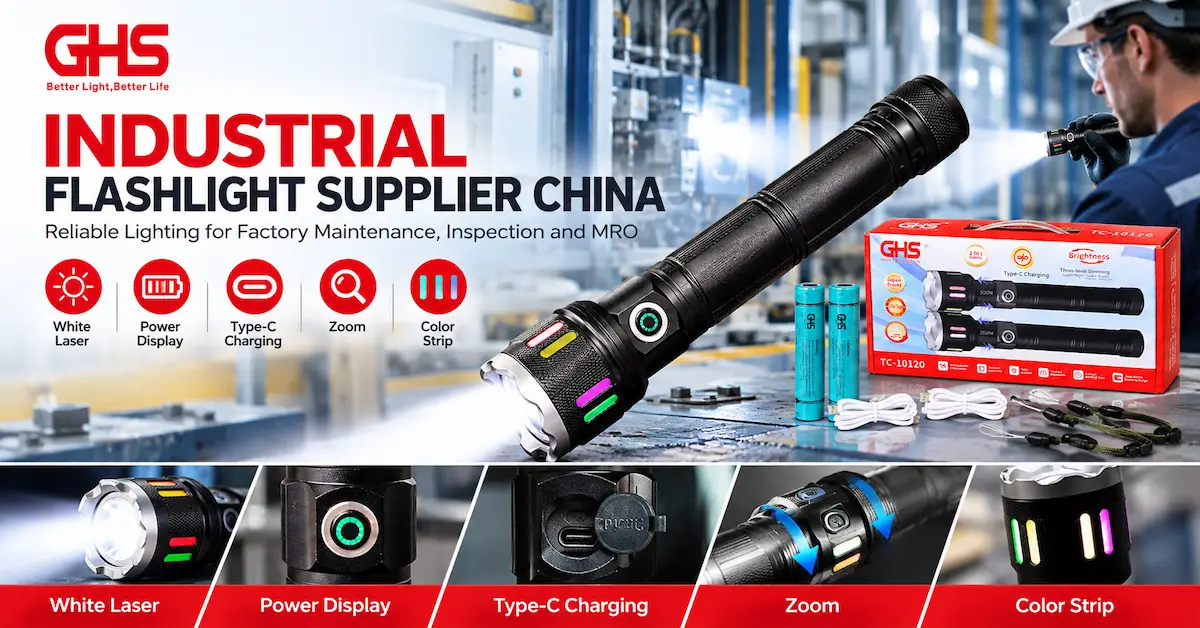

A product catalog can show what a supplier offers, but it cannot establish whether the same flashlight will arrive with the same battery, beam performance, packaging, and finish in every shipment. For importers and distributors, learning how to choose a flashlight manufacturer means checking evidence—not counting product images or comparing headline prices.
Quick Answer: To understand how to choose a flashlight manufacturer, first define an application-specific RFQ. Then apply non-negotiable safety and documentation checks, compare suppliers using a weighted proof scorecard, test representative samples, and approve a written product specification before bulk production. Reject suppliers that cannot substantiate mandatory requirements, regardless of their overall score.
This guide introduces a practical 100-point purchasing method for general-purpose rechargeable LED flashlights, outdoor retail ranges, utility lighting, and private-label programs. The scorecard is an illustrative buyer-developed tool, not a third-party certification or an assessment that GHS has already passed.
Key Takeaways
-
Verify the legal supplier and real manufacturing scope, including any outsourced processes.
-
Require measurable light output, beam, runtime, battery, and charging evidence rather than marketing claims.
-
Use mandatory pass/fail gates before a points-based comparison; no numerical score overrides an unresolved safety or compliance failure.
-
Approve a reference sample, written specification, and critical component list together.
-
Compare equivalent quotations and landed costs, not just factory unit prices.
-
Plan how the supplier will manage defects, component substitutions, and repeat orders.
1. Define the Flashlight Before Comparing Factories
Buyers asking how to choose a flashlight manufacturer often send a broad inquiry such as “Please quote your best rechargeable flashlight.” That invites different suppliers to price incomparable configurations. Begin with a brief that separates mandatory requirements from preferences.
| RFQ Field | What the Buyer Should Specify | Why It Changes the Decision |
|---|---|---|
| End Application | Hardware retail, camping, inspection, emergency kit | Sets the use conditions |
| Light Performance | Measured output, beam type, required working distance | Prevents vague “high power” claims |
| Operating Time | Required mode and useful runtime | Establishes power needs |
| Battery and Charging | Cell configuration, connector, accessories | Affects reliability and logistics |
| Construction | Dimensions, finish, handling, environmental requirements | Determines product fit |
| Branding | Logo, packaging, manual, barcode, accessory kit | Changes cost and approval work |
| Market and Quantity | Destination, first order, forecast | Shapes documentation and quotation |
| Acceptance | Sample tests, inspection method, permitted defects | Makes quality verifiable |
For instance, an entry-level retail flashlight and a larger adjustable-beam model may both be rechargeable yet require different test plans. Define the intended customer before requesting prices.
2. How to Choose a Flashlight Manufacturer With a 100-Point Proof Scorecard
A useful scorecard rewards documents, demonstrations, and agreed tests, not unsubstantiated statements. Apply the following weights consistently to every shortlisted supplier.
| Evaluation Area | Maximum Points | Evidence to Request |
|---|---|---|
| Product Fit and Sample Performance | 25 | Correct model, controlled sample, defined optical/runtime/charging results |
| Quality System and Component Control | 20 | Incoming checks, in-process controls, critical-part list, final QC records |
| Manufacturing Scope and Traceability | 15 | Factory identity, actual operations, outsourced-process disclosure, batch tracking |
| Applicable Documentation | 15 | Relevant product tests, battery transport documents, destination-market requirements |
| Quotation and Delivery Clarity | 10 | Equivalent BOM/configuration, trade terms, MOQ basis, schedule assumptions |
| OEM/ODM and Change Management | 10 | Feasibility boundaries, artwork approvals, engineering-change procedure |
| Communication and Corrective Action | 5 | Technical response quality, responsible contacts, defect-resolution process |
| Total | 100 | Evidence reviewed against the same RFQ |
Suggested internal interpretation: 85–100 = promising for final qualification; 70–84 = conditional, with evidence gaps to resolve; below 70 = reconsider. These thresholds are proposed procurement controls, not industry-wide grades, and no supplier should be approved on points alone.
This method shows how to choose a flashlight manufacturer using observable proof and the buyer's own priorities. A company with strong marketing but weak component traceability should not outscore a better-documented supplier simply because it quoted more models.
3. Apply Four Non-Negotiable Pass/Fail Gates
Before ranking prices, check whether the supplier can satisfy these conditions:
-
Identity: The contracting entity, company information, and manufacturing or sourcing role can be verified.
-
Fitness: A production-representative sample meets the buyer's mandatory technical requirements.
-
Documentation: Mandatory market and battery-shipping requirements can be met for the actual configuration and route.
-
Control: The supplier accepts agreed specifications, inspection criteria, and approval of critical changes.
A missing decorative packaging feature may be negotiable. A battery shipment that cannot lawfully travel by the intended method, or a required IP claim with no suitable evidence, is not a minor scoring deduction.
4. Verify What the Supplier Actually Makes
A credible manufacturer should explain which operations it performs directly and which are supplied or subcontracted. A factory tour or video is useful, but a showroom photograph cannot answer whether critical flashlight components are controlled.
Ask which processes are handled in-house or by partners: optical and electronic design, housing parts, PCB sourcing or assembly, battery procurement, final assembly, testing, and packaging. Outsourcing is not inherently a problem; undisclosed dependencies and unclear quality responsibility are.
Request a workflow showing how incoming parts become finished, tested inventory. If the supplier claims exceptional capacity or specialized testing, ask for evidence relevant to the actual product instead of repeating promotional figures.
5. Demand Comparable Technical Evidence, Not Just Claimed Brightness
A common mistake in learning how to choose a flashlight manufacturer is to compare two flashlights by the highest lumen number on their boxes. Relevant tests should address the complete lighting system, including LEDs, optics, driver electronics, battery, charging circuit, and thermal behavior.
| Technical Claim | Evidence or Test to Request | Common Pitfall |
|---|---|---|
| Lumens | Defined light-output test and operating mode | Treating short turbo output as sustained output |
| Candela / Beam Distance | Beam intensity and standardized distance data | Confusing distance with total light output |
| Runtime | Test conditions, selected mode, output behavior over time | Assuming mAh alone predicts runtime |
| USB-C Charging | Connector, charging input, cycling or functional tests | Assuming Type-C guarantees fast charging |
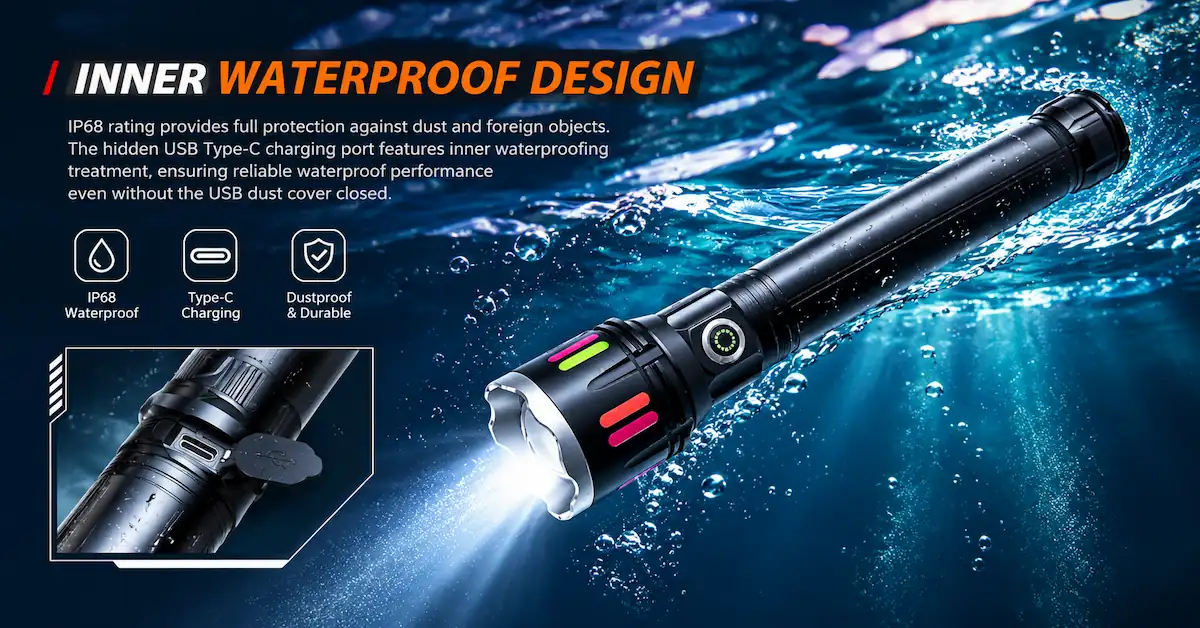
| Dust/Water Protection | Model-specific IP report and test conditions | Assigning a rating to untested versions |
| Housing and Fit | Material evidence, dimensions, sample inspection | Treating a metallic appearance as a verified alloy |
| Impact Resistance | Relevant method and measured result | Assuming every “tactical” product is drop-tested |
ANSI/PLATO FL 1-2025 provides a portable-lighting performance framework covering light output, beam distance, peak intensity, runtime, impact, and ingress-related reporting, including short-duration elevated brightness. IEC 60529 defines enclosure ingress-protection classifications. They are useful references for a buyer's test plan, not proof that any GHS model has passed them.
For rechargeable products, ask for applicable cell/battery transport information and coordinate with the freight forwarder. The IATA 2026 battery guidance distinguishes batteries shipped alone, packed with equipment, or installed in equipment; document and packaging obligations depend on the actual configuration and route.
6. Test the Sample, Then Lock the Specification
Sample review should happen before a bulk commitment. It should also be more rigorous than checking whether the light turns on.
Sample approval sequence:
-
Confirm the model and battery version.
-
Inspect dimensions, finish, switches, and accessories.
-
Test charging and each agreed mode.
-
Evaluate beam and runtime under defined conditions.
-
Check any required ingress or durability evidence.
-
Approve packaging and labels.
Record the outcome in a sample report. Keep an approved physical reference, but also retain the written specifications and critical component list. A flashlight's exterior will not reveal whether a later batch contains a different driver or cell.
Ask how production changes will be notified. If the manufacturer proposes replacing an LED, battery, switch, charging circuit, or optical component, the buyer should review possible performance and documentation effects before approval.
7. Check Batch Quality and Repeat-Order Controls
Strong sample results are insufficient if the factory cannot reproduce them. Evaluate the controls for incoming parts, assembly, functional inspection, performance sampling, final packaging, and lot identification.
Ask for sample inspection records or an agreed inspection plan. Define critical, major, and minor defects for the particular order; do not rely on the instruction “check quality.” A missing battery, wrong charger, failed switch, or unapproved configuration may have a different consequence from a minor cosmetic variation.
For repeat distribution programs, the approved configuration should include model revision, battery, driver, optics, accessories, artwork, and carton details. Traceable batch identification helps investigate claims and manage corrective actions.
8. Compare Real GHS Models Instead of Generic Catalog Claims
GHS (Guanghuishi) lists rechargeable and high-intensity flashlight platforms that importers can use as product references while preparing a common supplier RFQ.
| Model and Official Page | Publicly Displayed Characteristics | Appropriate Preliminary Buying Discussion |
|---|---|---|
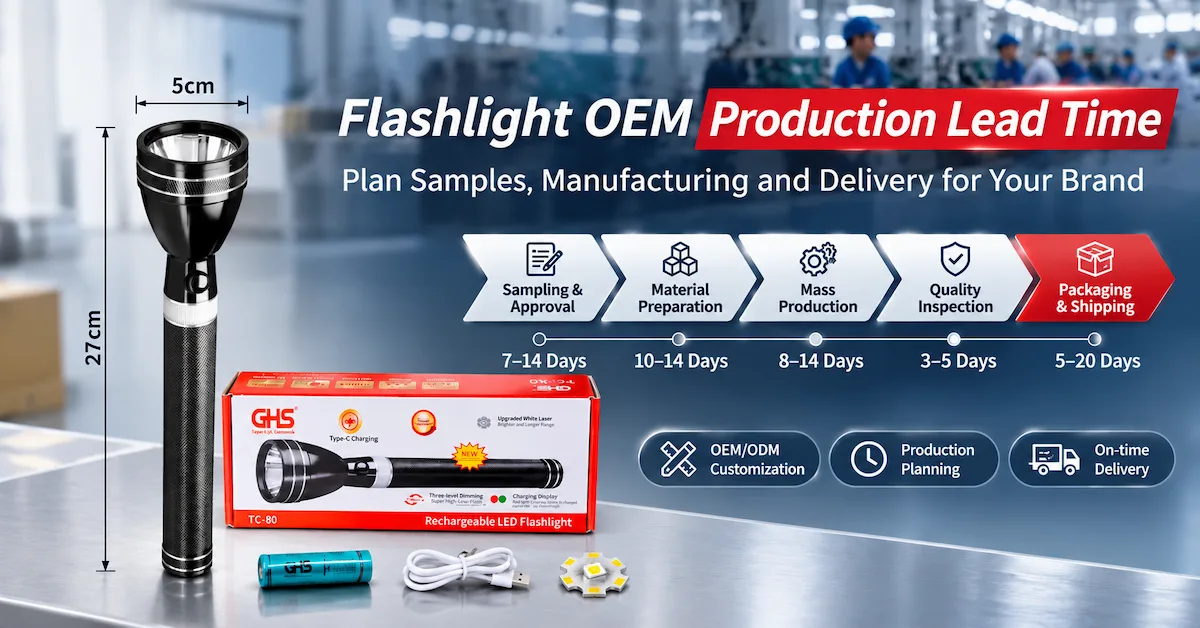
| TC-80 | Basic handheld rechargeable flashlight | Utility and general retail product fit |
| TC-10120 | Type-C charging, side switch, adjustable-beam design | Charging, handling, retail kit configuration |
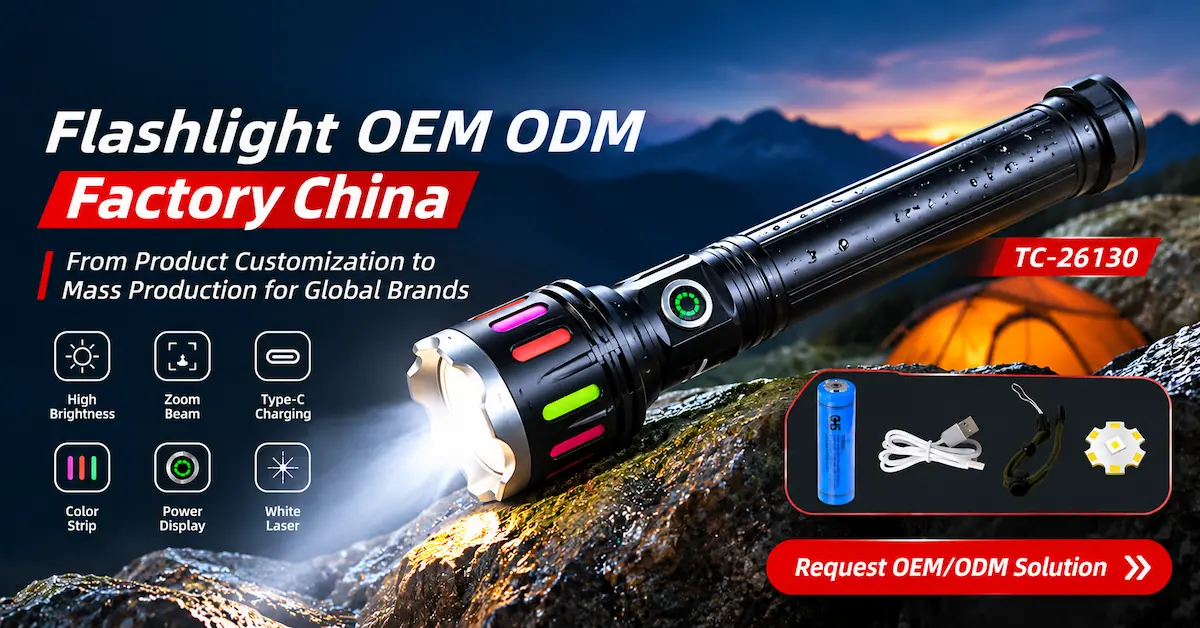
| TC-26130 | Type-C charging, adjustable head, version-dependent accessory presentations | Variant control, packaging, critical-part approval |
| S-P200W | Larger high-intensity-series handheld format | Beam measurements, thermal behavior, carry dimensions |
These links provide product examples—not confirmed certifications, precise lumen or runtime figures, available OEM modifications, or suitability for specialized safety-critical tasks. The S-P200W suffix should not be read as independently measured electrical wattage.
A supplier comparison becomes meaningful when competing samples meet the same buyer-defined specification. Browse the GHS flashlight catalog to identify a reference model before requesting evidence.
9. Evaluate Commercial Terms Only After Technical Qualification
A lower quote may reflect a different battery, driver, housing, accessory set, inspection scope, or trade term. Ensure the quotes describe equivalent products.
Illustrative landed cost per accepted unit:
(Total Product Cost + Customization + Inspection + Freight + Applicable Import Charges + Expected Replacement Allowance) ÷ Accepted Units
This is a comparison method, not a GHS price. Ask each supplier to identify included accessories, sample/tooling charges if applicable, MOQ basis, delivery assumptions, responsibility for testing, and defect remedies.
Private-label buyers should also confirm which logo or packaging changes are supported. For ODM developments, clarify engineering deliverables, IP and tooling rights, and revision approval. Do not assume an advertised OEM/ODM service includes a complete new electronic or mechanical design.
10. Illustrative Supplier Decision: Why a Higher Score Can Still Fail
Hypothetical example—not a GHS case study: An outdoor equipment importer shortlists three suppliers for a rechargeable utility flashlight. After reviewing samples and evidence, its team records the following:
| Candidate | Weighted Score | Mandatory-Gate Result | Decision |
|---|---|---|---|
| Factory A | 91/100 | Missing required battery-shipping documentation | Hold until resolved |
| Factory B | 86/100 | All gates passed | Proceed to pilot order review |
| Supplier C | 73/100 | Sample misses required runtime | Reject for this specification |
The point is not that 86 is a universally safe score. It is that a verified fit and complete evidence matter more than an impressive total with an unresolved critical requirement.
For teams deciding how to choose a flashlight manufacturer, the scorecard should document decisions rather than replace engineering judgment or importer obligations.
11. Why Include GHS in a Shortlist?
According to its company profile, GHS (Guanghuishi) describes itself as a China-based lighting business combining product development, manufacturing, and sales. It states that it was established in 2009, operates a 1,300 m² facility in Zhaoqing, Guangdong, and established a Dubai branch in 2017.
These are company-published details, not independent verification of every manufacturing process or product qualification. The factory videos and product videos can support preliminary research; buyers should still request current specifications, representative samples, relevant test documents, and model-specific commercial terms.
Send a Better RFQ
When contacting GHS or another shortlisted manufacturer, include the intended application, target market, preferred model, required output and runtime, battery/charging requirements, any environmental protection specification, initial and repeat quantities, packaging, test requirements, destination, and launch schedule.
Contact GHS to request model information, samples, and a project-specific bulk quotation.
12. Frequently Asked Questions
1. How to choose a flashlight manufacturer for the first bulk order?
Start with one detailed RFQ, verify company identity and manufacturing scope, enforce mandatory documentation and performance gates, test comparable samples, then use a weighted evidence scorecard. Approve the configuration in writing before ordering.
2. How can I check whether a flashlight supplier is a real factory?
Verify the contracting entity and actual facility, ask which production and testing steps occur in-house, and use a factory visit, live walkthrough, or third-party audit where justified. A broad product catalog alone is not evidence.
3. How to choose a flashlight manufacturer when prices differ substantially?
Compare the same model specification, battery, LED/driver, tests, packaging, accessories, order quantity, and trade terms. Investigate what the cheaper quote excludes before judging value.
4. What should a flashlight sample test include?
Check the exact configuration, operating modes, charging, beam pattern, runtime, switches, workmanship, relevant environmental requirements, accessories, and packaging against written acceptance criteria.
5. Does a higher lumen rating mean a better flashlight?
No. Beam intensity, usable runtime, sustained output, battery, optics, and application fit also matter. Request test methods and performance results, not just peak marketing figures.
6. What is the difference between OEM and ODM flashlight production?
OEM usually refers to manufacturing an agreed configuration; ODM involves more extensive manufacturer-supported design or development. Responsibilities and ownership must be documented for each project.
7. What MOQ should I expect from a China flashlight factory?
There is no universal MOQ. It varies by product, components, packaging, branding, and production requirements. Request a quantity-specific quotation for the exact configuration.
8. Are all rechargeable flashlights eligible for international shipping?
No shipment should be assumed compliant without checking the battery type, configuration, packaging, routing, and applicable documentation with the supplier and freight forwarder.
9. Can a supplier change batteries or LEDs after sample approval?
Changes should follow an agreed review process. Critical substitutions can affect output, runtime, charging, and transport documentation, and may require buyer authorization and retesting.
10. How can I request a quote from GHS?
Visit the GHS contact page with the intended application, preferred model, quantities, destination market, branding requirements, and technical acceptance criteria.
Conclusion
Knowing how to choose a flashlight manufacturer means moving beyond showroom promises to verifiable product performance, controlled production, realistic commercial terms, and dependable repeat supply.
Use a consistent RFQ and the 100-point proof scorecard to compare candidates, but allow non-negotiable safety, documentation, and sample-performance requirements to override a numerical result. Approve both a representative sample and a written specification before mass production.
GHS offers several rechargeable flashlight platforms for initial evaluation. Buyers can review GHS products and contact the company to discuss current specifications, sample availability, OEM options, and quotations based on their actual requirements.