
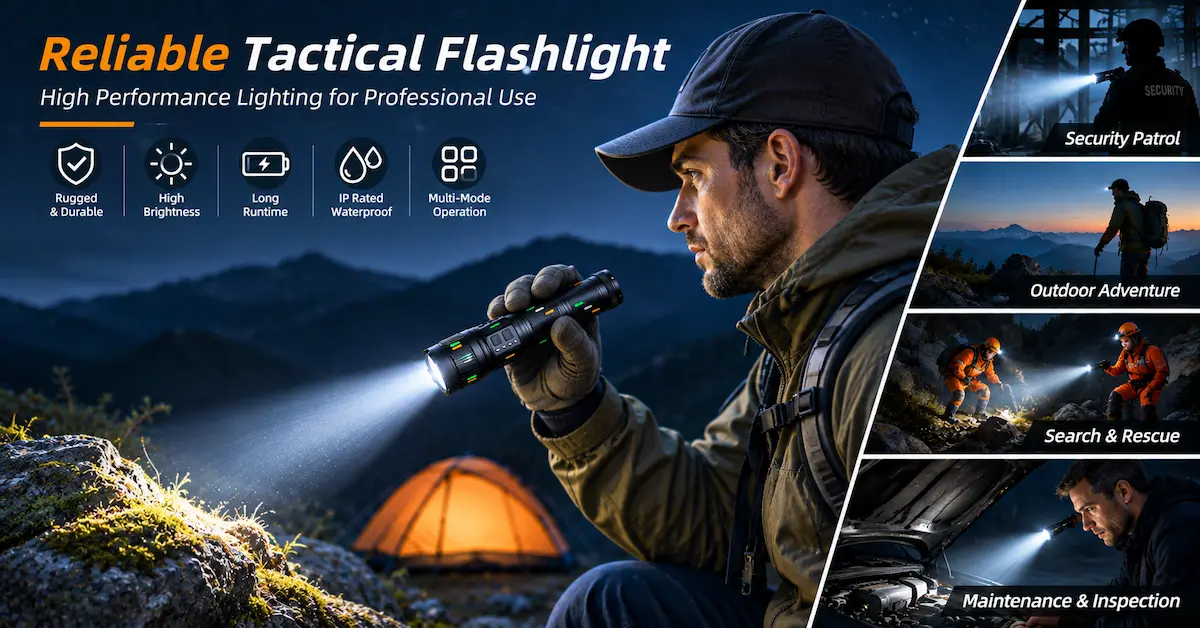
A reliable tactical flashlight is one that produces appropriate illumination when needed, operates predictably, withstands the conditions it is designed for, and matches the approved specification across production batches. High brightness alone cannot establish any of these qualities.
TL;DR: To determine whether a tactical-style flashlight is dependable, buyers should test seven failure points: sustained light output, battery and charging system, switch operation, beam quality, ingress protection, impact resistance, and production consistency. Set pass/fail limits before testing. A marketing description such as “tactical,” “high power,” or “waterproof” is not a substitute for model-specific evidence.
For outdoor brands, maintenance suppliers, security-equipment distributors, and private-label importers, these tests turn a broad product claim into a repeatable purchasing decision. Browse GHS rechargeable flashlight products to identify a platform for evaluation; its public listings should not be interpreted as proof of professional-duty certification.
Key Takeaways
-
Reliability is task-specific: a convenient inspection light may not meet specialized safety-critical requirements.
-
Sustained performance matters more than a peak lumen claim: request output-over-time data.
-
Controls, batteries, and seals are common points to evaluate: failure in any one can make the whole flashlight unsuitable.
-
Sample approval is not mass-production approval: critical-component controls and batch checks are needed.
-
Ask for evidence by model and version: a standard's name or a packaging icon does not confirm a test result.
1. What Does “Reliable” Mean for a Tactical Flashlight?
The term tactical flashlight describes a market and product style, not a universal certification category. A product's reliability is better defined as the probability of performing its intended lighting function under stated conditions for an agreed duration; procurement teams translate that principle into measurable acceptance checks.
| Intended Buyer or Use | Most Important Reliability Question | Potential Mismatch |
|---|---|---|
| Outdoor-equipment distributor | Will the light remain usable during expected outdoor activities? | High initial output with short usable runtime |
| Industrial or MRO buyer | Can the operator activate and recharge it repeatedly? | Unreliable controls or connectors |
| Security-equipment reseller | Is output and handling consistent across units? | Different switches or battery versions between batches |
| Private-label brand | Can product claims be supported and reproduced? | Unverified performance printed on retail packaging |
| Emergency-kit assembler | Will the stored unit and complete kit work when checked? | Depleted batteries or missing accessories |
A reliable tactical flashlight is not automatically appropriate for explosive atmospheres, underwater rescue, or other restricted environments. Those applications require a separate assessment and applicable approvals.
2. Which Specifications Actually Predict Dependable Performance?
Buyers need a specification table that defines not just the claimed feature but also how it will be verified.
| Specification | What It Describes | What to Request |
|---|---|---|
| Lumens (lm) | Total light output | Mode-specific measured output |
| Candela (cd) | Peak luminous intensity in a direction | Measured beam intensity |
| Beam Distance (m) | Standardized distance for a defined illuminance threshold | Test method and conditions |
| Runtime (h) | Operating duration under stated measurement rules | Output-versus-time record and useful-mode target |
| Battery System | Chemistry, configuration, protections | Exact cell/battery identification |
| Charging | Interface and charging behavior | Connector and charge-cycle verification |
| Controls | Switch and mode behavior | Repeated activation testing |
| Housing | Material, interfaces, assembly | Drawings, sample inspection, durability evidence |
| Ingress Protection | Dust and water resistance | Applicable IP test report for exact model |
| Impact Performance | Function following defined mechanical exposure | Test method, conditions, post-test results |
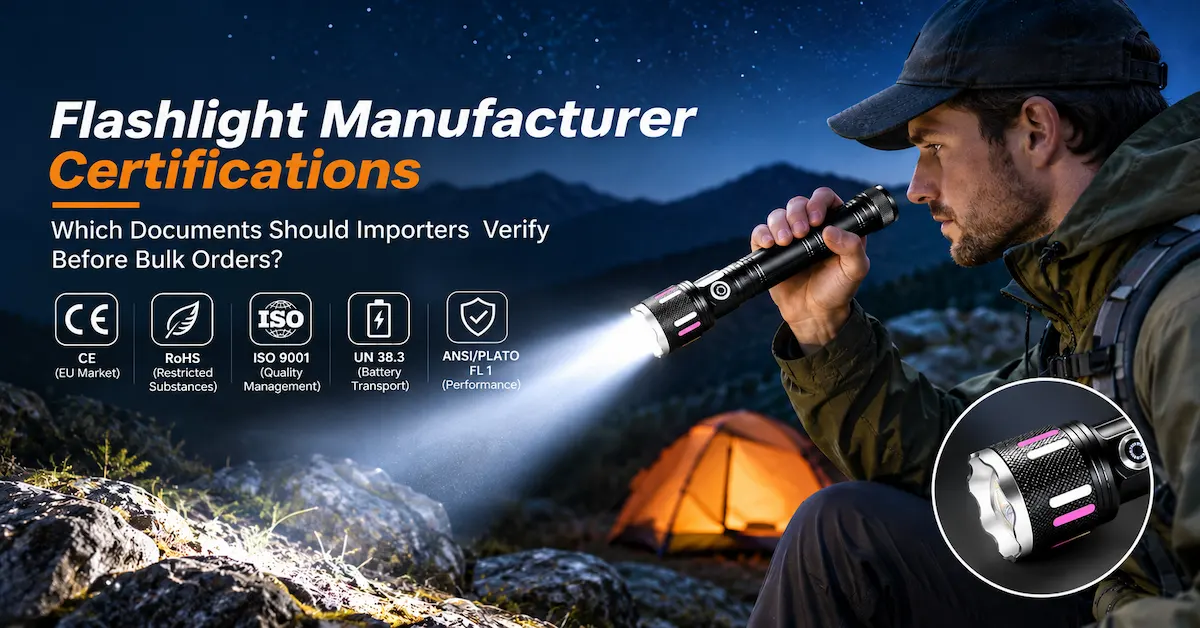
The official ANSI/PLATO FL 1-2025 testing guidance distinguishes normal-mode testing from short-duration elevated brightness (often called Turbo or Boost). Standard-mode runtime uses a defined measurement endpoint; it should not be confused with the duration of illumination a particular customer considers useful. Referencing FL 1 does not imply that any GHS model has passed it.
3. The Seven Failure-Point Tests for Tactical Flashlight Reliability
Test 1 — Can It Sustain Useful Light Without Excessive Step-Down?
Record output at the specified mode and track changes over the expected operating period. A brief initial peak may look impressive but say little about subsequent illumination. Review the output curve, thermal behavior, and the lowest light level acceptable for the buyer's task. Specify the test temperature, battery state, and pass/fail criteria in advance.
Fail condition: the sample no longer provides the agreed illumination before the required period ends, even if its advertised maximum lumen figure is high.
Test 2 — Are the Battery and Charging System Repeatable?
Check the actual battery type, battery contacts, charge completion behavior, connector fit, status indication, and operation after repeated normal charging. If removable cells are supplied, verify compatibility with the approved configuration. USB-C refers to a connector format; it does not automatically mean a particular fast-charging protocol or protection system is present.
Fail condition: intermittent contact, unpredictable charging, unapproved cell substitution, or failure to meet the specified operating time.
Test 3 — Do the Switch and Modes Work Predictably?
Activate the light repeatedly and check the control response, mode sequence, and risk of accidental activation during ordinary carrying or storage. If the buyer expects users to wear gloves, include representative glove-use checks. More operating modes are not necessarily better when they make routine activation confusing.
Fail condition: inconsistent activation, unintended mode changes, or a control arrangement that fails the agreed usability test.
Test 4 — Is the Beam Appropriate, Not Just Bright?
Compare illumination across the intended working distances. Examine beam spread, center intensity, uneven rings, and—where fitted—the repeatability of a zoom mechanism. Lumens describe total light; candela and beam geometry help explain how that light is distributed. A tight beam is not always preferable for close-range inspection.
Fail condition: the beam pattern or adjustment does not meet the written application requirement.
Test 5 — Do the Seals Protect the Actual Assembly?
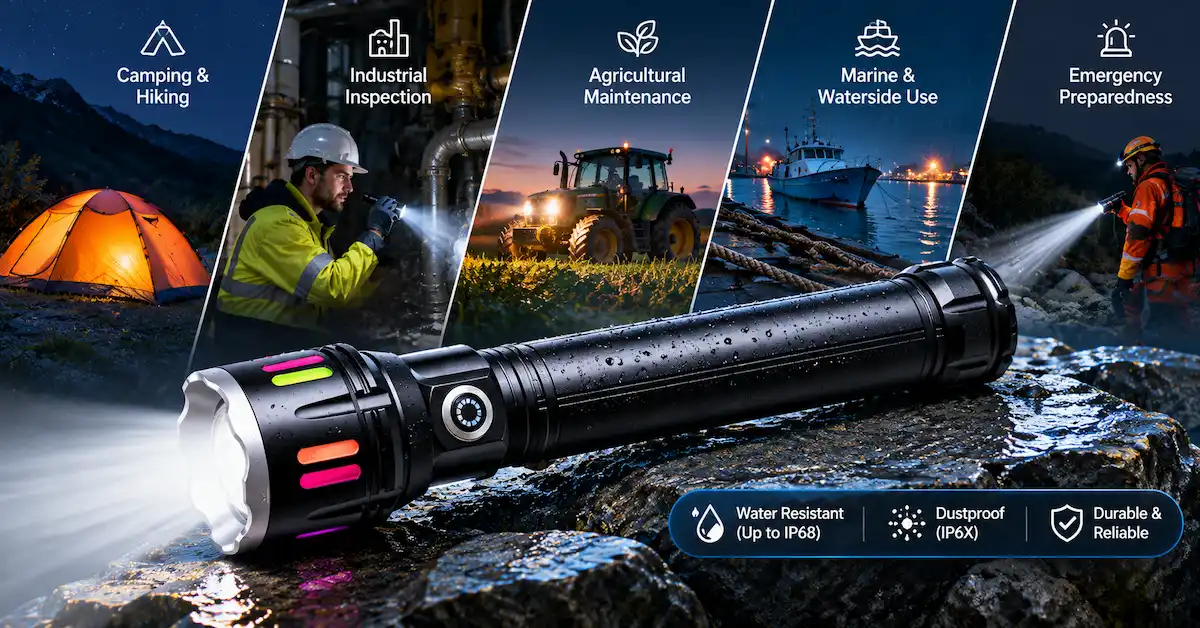
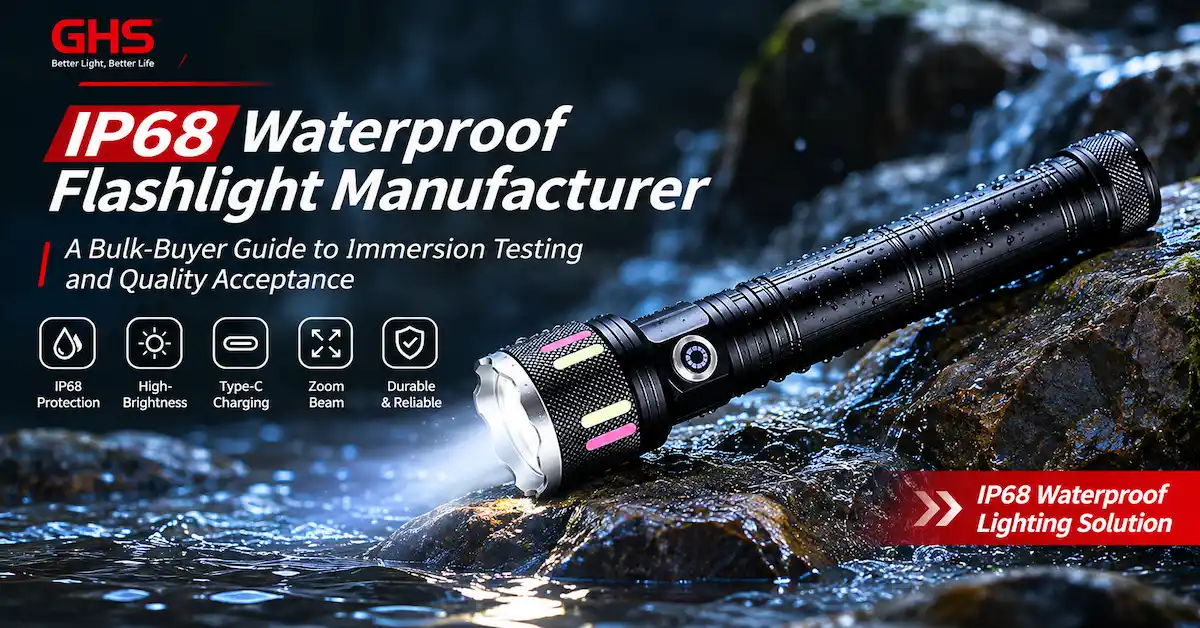
Inspect the lens, switch interface, tailcap, charging-port cover, and moving head components. When ingress protection is required, request test evidence for the exact configuration under the applicable IEC 60529 IP Code. A visually sealed housing or a “waterproof” box label is not enough; a particular IP rating does not imply suitability for every water exposure.
Fail condition: the claimed protection cannot be supported or the sample fails its agreed environmental acceptance conditions.
Test 6 — Does the Housing Remain Functional After Defined Handling Tests?
Inspect bezel fit, threads, lens security, tailcap retention, surface condition, and the charging connector. Conduct appropriate impact or handling tests only under buyer-defined conditions, then repeat function and charging checks. A metal-like exterior is not proof of a particular alloy or verified drop rating.
Fail condition: damage affecting required operation, unacceptable assembly movement, or failure of agreed post-test checks.
Test 7 — Will the Next Production Batch Match the Approved Sample?
Compare critical components and the final assembly across inspected units: LED, driver, battery, charging circuit, switch, optics, and accessories. A product may look identical even after an internal component change. Require controlled revisions, traceable batches, defined defect classifications, and approval of meaningful substitutions.
Fail condition: undocumented variation in a critical part or an unacceptable deviation from the approved reference.
The purchasing rule: a reliable tactical flashlight must pass every mandatory gate; an average score cannot compensate for a failed safety or operational requirement.
4. How Should Buyers Evaluate Materials, Workmanship, and Quality Control?
A flashlight is an integrated optical, electrical, and mechanical system. Reliability depends on the LED and lens working with the driver, battery, thermal pathway, housing, and switches. A supplier should be able to describe the actual components and processes used for the selected model, including any outsourced operations.
For a reliable tactical flashlight, useful quality evidence includes incoming-component checks, assembly inspection, function tests, representative performance sampling, and final packaging checks. Ask whether battery and driver versions are controlled and how defects are investigated. A sample photograph or a generic factory video cannot establish the results for a particular batch.
| Production Stage | Evidence Buyers Can Ask For | Risk Controlled |
|---|---|---|
| Incoming Materials | Approved critical components and inspection records | Wrong batteries, LEDs, or switches |
| In-Process Assembly | Assembly criteria and operator checks | Loose joints, poor alignment |
| Functional QC | Switching, charging, and mode checks | Nonfunctioning finished units |
| Performance Sampling | Output/runtime results under defined conditions | Misleading or inconsistent claims |
| Final Inspection | Cosmetic, label, accessory and carton checks | Retail returns and incomplete kits |
No special law-enforcement, waterproof, or impact certification should be inferred merely because a flashlight looks rugged.
5. Which GHS Rechargeable Models Can Buyers Evaluate?
GHS (Guanghuishi) displays several handheld rechargeable flashlight platforms. They can be considered for sample evaluation of general-purpose utility and tactical-style lighting, but the public pages reviewed do not establish verified police approval, impact rating, measured runtime, or a specific IP grade for these models.
| GHS Model | Publicly Displayed Features | Relevant Reliability Checks |
|---|---|---|
| TC-10120 | Slim rechargeable body, Type-C charging, side switch, adjustable-beam structure | Switch cycles, charging, beam adjustment |
| TC-26130 | Rechargeable format, zoomable head, side control, multiple package presentations | Version control, accessory count, zoom mechanism |
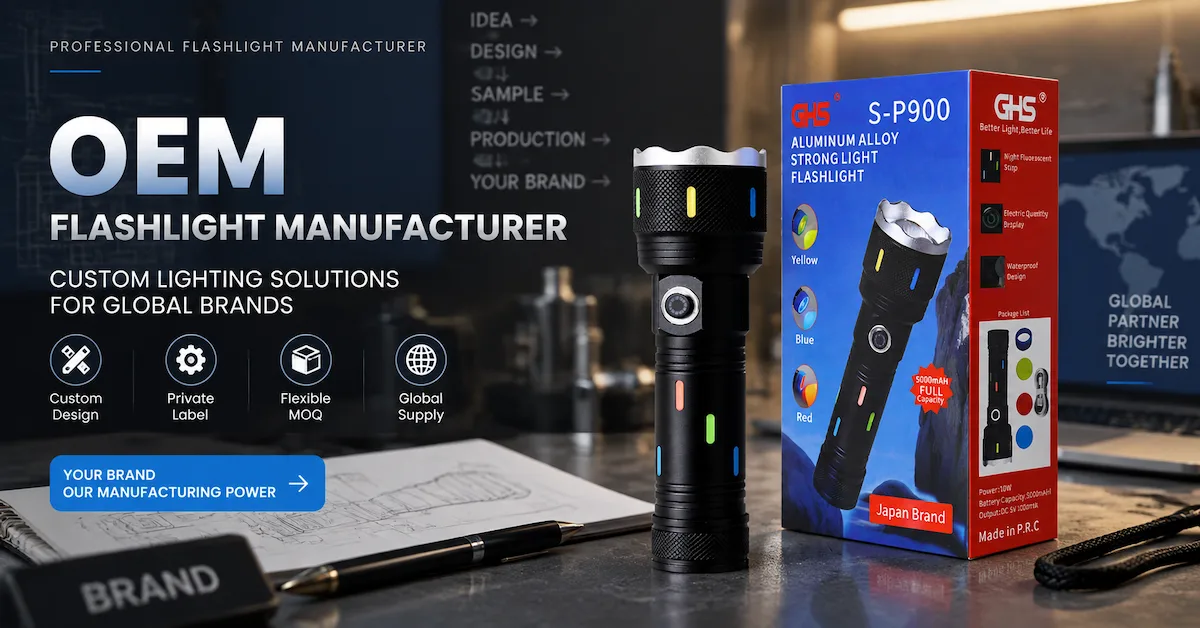
| S-P900 | Rechargeable handheld design, textured grip, visible side switch | Grip, charging, beam and switch performance |
| S-P200W | Larger handheld high-intensity series and adjustable-beam design | Sustained output, thermal behavior, weight, handling |
These are candidate product platforms, not confirmed rankings of reliability. In particular, the S-P200W designation should not be treated as measured electrical wattage, and imagery labeled “white laser” is not proof of a particular laser technology.
A buyer should request current product specifications, exact sample configurations, and relevant test data before making claims or committing to a bulk order.
6. How Do OEM Changes Affect Reliability?
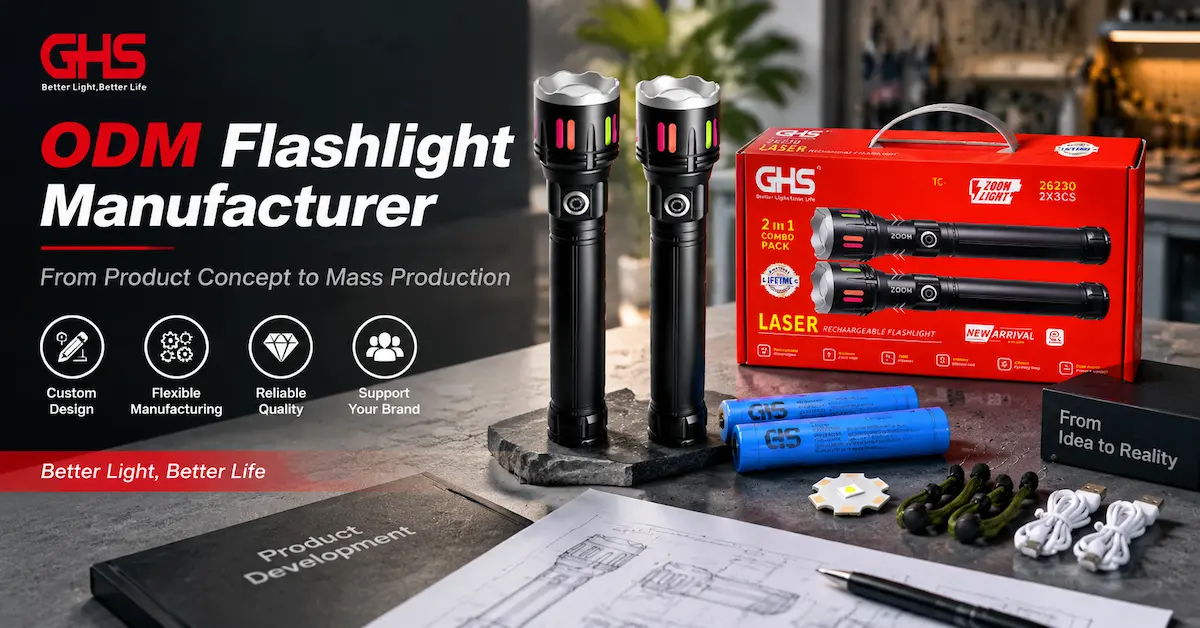
Private-label buyers may ask for logos, retail packaging, accessories, colors, or electronic changes. The more a modification affects components or enclosure interfaces, the more important technical review becomes.
| OEM Change | Possible Reliability Impact | Buyer Action |
|---|---|---|
| Logo or packaging | Usually limited physical effect; may change labeling obligations | Approve correct product information |
| Different battery | Runtime, charge behavior, transport evidence | Review and retest as needed |
| New switch or control logic | Activation consistency | Repeat functional testing |
| Charging-port change | Electrical operation and sealing | Reassess charging and ingress |
| Lens or bezel change | Beam shape, fit, sealing | Revalidate optics and assembly |
A reliable tactical flashlight developed for a private-label customer needs a controlled specification, not just approved artwork. Request an engineering-change procedure before authorizing modifications.
7. What Is a Practical Sample-Acceptance Plan for a Bulk Order?
Before sampling, agree on the test method, operating conditions, acceptance limit, and sample quantity. No universal number of drops, switch presses, hours, or temperature cycles is appropriate for every flashlight project.
A practical buyer checklist is: record the model and revision; verify the power system; complete the seven failure-point tests; inspect the kit and labels; log deviations; approve a reference sample; and confirm how the factory will reproduce it. If a mandatory environmental requirement cannot be supported, do not approve the product for that environment.
Illustrative sourcing decision: A wholesaler comparing two rechargeable samples should reject the one that fails its specified runtime even if that sample has a lower unit price and higher peak output. This is a purchasing example, not an actual GHS customer result.
8. How Do Cost, MOQ, and Repeat Supply Affect the Decision?
The lowest quoted unit price can become expensive if chargers fail, accessories are missing, or batches contain different internal components. Compare the complete configuration, inspection scope, freight terms, and expected replacement exposure.
Commercial evaluation: Total accepted-unit cost should include product, packaging, agreed testing, inspection, logistics, and replacement allowances—rather than the flashlight alone.
MOQ, sample availability, lead time, and OEM options depend on the specific GHS model and buyer requirements; they should be confirmed rather than assumed. Importers seeking a reliable tactical flashlight supply program should ask for production-representative samples, clear component-change rules, and a repeat-order quotation.
GHS describes its work as lighting development, manufacturing, and sales. Its company profile, factory videos, and product videos provide initial background; buyers should still verify claims and obtain model-specific documentation.
Contact GHS to request flashlight samples, specifications, OEM feasibility, and a bulk quotation.
9. Frequently Asked Questions
1. What makes a reliable tactical flashlight?
A reliable tactical flashlight provides task-appropriate light, consistent controls, sufficient usable runtime, suitable durability, and stable production quality. These qualities should be verified under defined conditions rather than inferred from appearance.
2. Is a high-lumen flashlight necessarily more reliable?
No. Peak lumens do not describe sustained output, switching, battery reliability, or handling. Evaluate measured output and runtime together.
3. How can buyers test flashlight switch reliability?
Specify a repeat-activation and mode-control procedure, including glove use when relevant. Record intermittent operation, accidental activation, and other failures against agreed limits.
4. Do USB-C flashlights automatically charge faster?
No. USB-C describes the connector. Charging speed and electrical protections depend on the specific circuit and supported power arrangement.
5. Which is more important: lumens or candela?
Both are relevant but describe different things. Lumens represent total output; candela describes intensity in a direction. The intended use determines the appropriate beam.
6. Can a flashlight be called waterproof without an IP report?
Buyers should not rely on unsupported claims. Any advertised IP classification should be backed by appropriate test evidence for the exact model and configuration.
7. Is an aluminum-looking body proof of impact resistance?
No. The actual material, joints, lens retention, and post-impact function must be evaluated. Appearance alone cannot establish a drop rating.
8. Can tactical-style flashlights be used as certified police equipment?
Not without verification of the organization's specific technical and approval requirements. A tactical-style appearance is not a police certification.
9. How can distributors keep quality consistent between orders?
Maintain an approved sample, controlled specification, critical-component list, inspection plan, and change-approval process for repeat shipments.
10. How do I request a tactical flashlight sample from GHS?
Visit the GHS contact page and share the intended application, preferred model, required tests, packaging and OEM needs, expected quantity, and destination.
Conclusion
A reliable tactical flashlight is defined by verified performance and repeatable construction—not by a dramatic beam photograph, a “tactical” label, or a high initial lumen claim. For B2B buyers, the seven failure-point tests provide a useful way to evaluate output stability, battery operation, controls, beam quality, sealing, mechanical durability, and batch consistency.
GHS provides rechargeable flashlight platforms that can be compared for general professional-style and utility lighting projects, but model-specific claims must be supported by appropriate evidence. Review GHS flashlight models and contact GHS to discuss your technical requirements, representative samples, customized configurations, and bulk sourcing options.