
When importing LED flashlights from China, buyers frequently ask which certifications a manufacturer must provide before shipping products to Europe, North America, or other overseas markets.
The answer depends on the destination market, flashlight design, battery configuration, and intended application.
Some documents demonstrate factory quality management. Others support product compliance, electrical safety, environmental requirements, battery transportation, or performance claims.
Confusing these categories can lead to unnecessary testing costs, customs complications, misleading product descriptions, and avoidable purchasing risks.
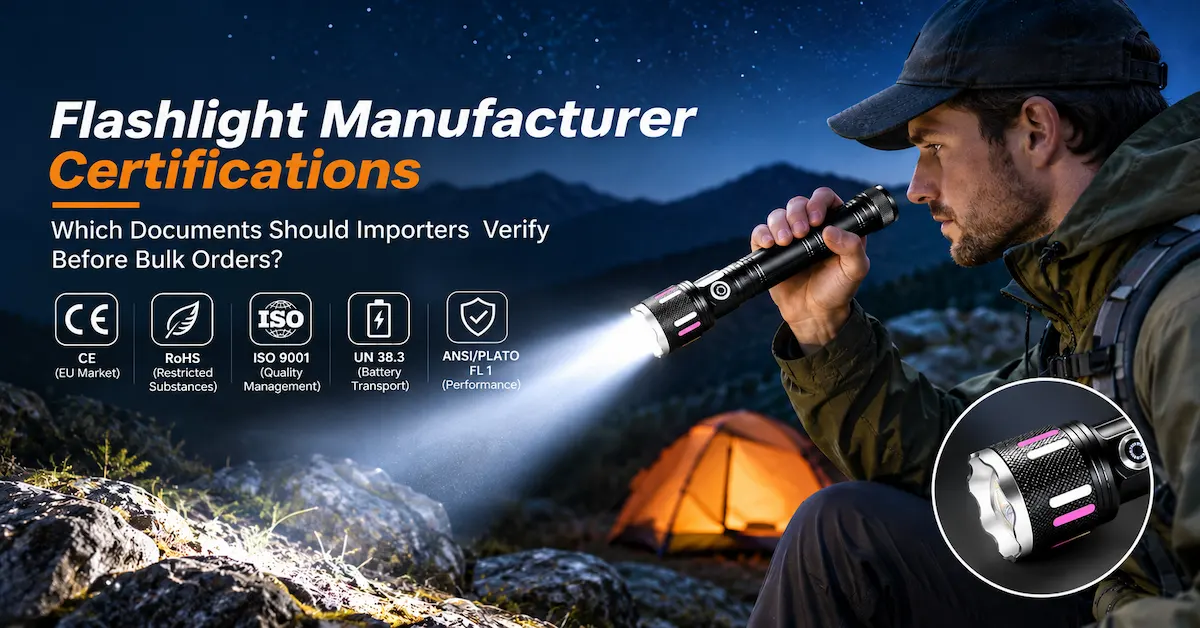
Quick Answer: The most important flashlight manufacturer certifications and supporting documents may include ISO 9001 for quality management, EU conformity documentation supporting applicable CE marking, RoHS compliance evidence, relevant battery safety reports, UN 38.3 transport documentation, and performance tests such as ANSI/PLATO FL 1. However, not every document is legally required for every flashlight or destination. Buyers must verify which requirements apply to their exact product configuration.
This guide provides an evidence-based framework for international flashlight sourcing, including document verification, market-specific requirements, and supplier evaluation.
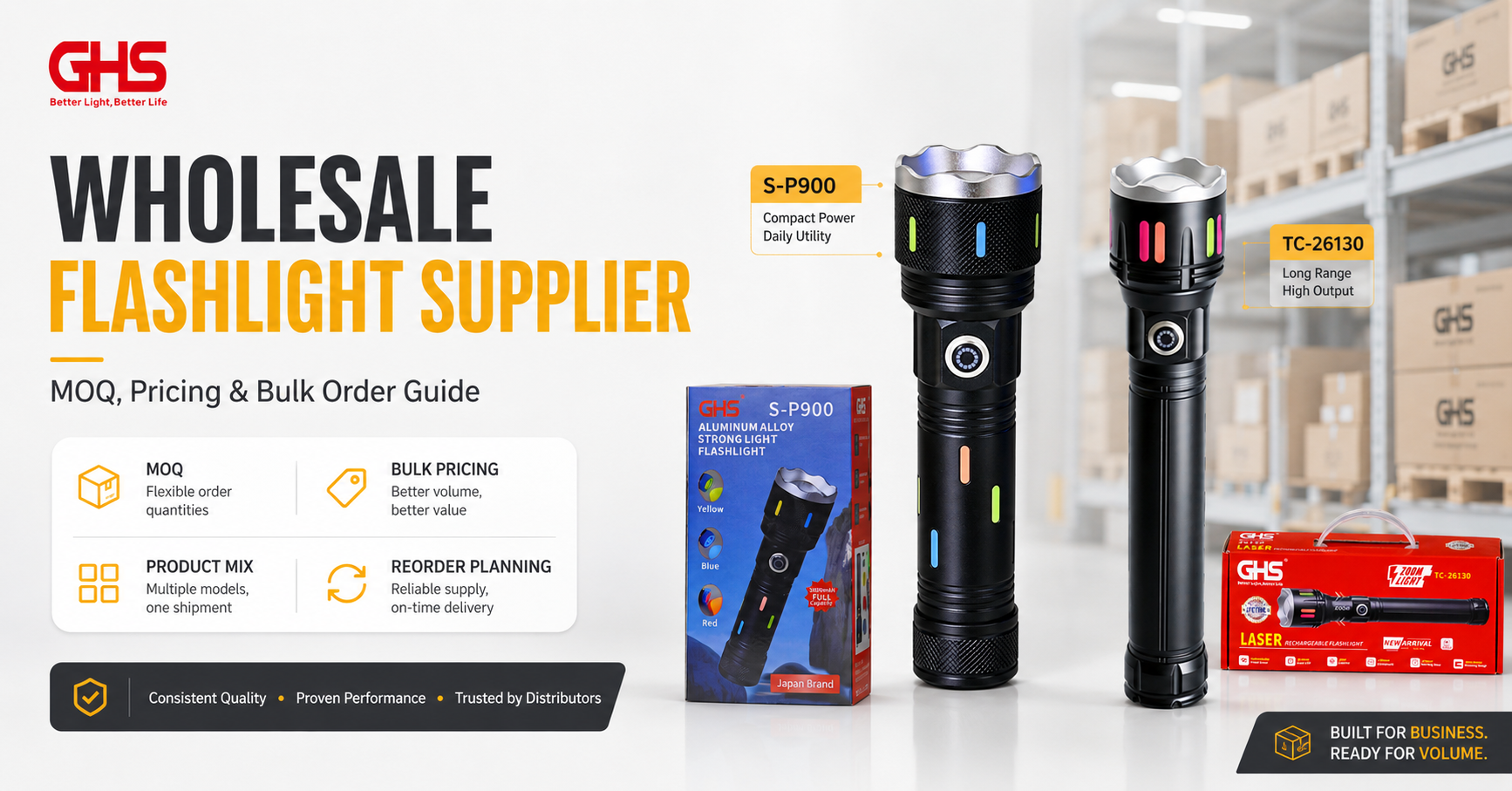
Businesses comparing rechargeable lighting products can start with the GHS LED flashlight product collection.
Key Takeaways
-
There is no single worldwide flashlight certification package. Requirements depend on the product and destination market.
-
ISO 9001 evaluates quality management systems, not the electrical safety or measured performance of an individual flashlight.
-
CE marking is not an EU-issued product certificate. It represents conformity with applicable EU requirements, supported by the necessary technical documentation.
-
RoHS concerns restricted substances, while EMC requirements address electromagnetic compatibility.
-
UN 38.3 relates to lithium battery transport testing, not overall flashlight performance.
-
ANSI/PLATO FL 1 and IEC 60529 support performance claims, but referencing these standards does not automatically establish certification.
-
Every document must match the actual product or component and the claimed scope.
-
OEM modifications may require reassessment when electronics, batteries, materials, or enclosure structures change.
1. Are All Flashlight Manufacturer Certifications Mandatory?
No. One of the most important distinctions in flashlight purchasing is the difference between a legal requirement, a voluntary certification, and a technical test report.
These terms are often used interchangeably in supplier advertising, but they represent different forms of evidence.
Four Types of Compliance Evidence
| Document Type | Main Purpose | Example |
|---|---|---|
| Factory Management Certification | Evaluates a management system | ISO 9001 certification |
| Regulatory Conformity Documentation | Demonstrates applicable legal compliance | EU Declaration of Conformity |
| Technical Test Report | Records results under specified conditions | EMC, battery or ingress-protection testing |
| Performance Standard Report | Supports measurable product claims | ANSI/PLATO FL 1 test results |
A manufacturer might operate an ISO 9001-certified quality management system while supplying a flashlight without the necessary destination-market product documentation.
Conversely, a particular flashlight may have relevant regulatory test evidence even if its manufacturer does not hold ISO 9001 certification.
Buyer takeaway: Do not ask only whether a supplier is “fully certified.” Ask which documents apply to the exact flashlight, what they demonstrate, and whether they satisfy your market requirements.
2. Which Certifications and Test Reports Should Flashlight Importers Request?
The following matrix explains the main documents buyers commonly encounter when sourcing LED and rechargeable flashlights.
Flashlight Compliance and Certification Matrix
| Standard or Requirement | Main Purpose | Typical Purchasing Relevance |
|---|---|---|
| ISO 9001 | Quality management system | Valuable factory qualification evidence |
| CE Marking / EU DoC | Conformity with applicable EU harmonization rules | Relevant to products within applicable EU legislation |
| RoHS | Restriction of hazardous substances | Relevant to in-scope electrical and electronic products in the EU |
| EMC Testing | Electromagnetic compatibility | Depends on electronic design and applicable regulations |
| EU GPSR | General consumer product safety | Relevant to applicable consumer product safety obligations |
| EU Batteries Regulation | Battery safety, sustainability, marking and other obligations | Relevant to batteries within its scope |
| UN 38.3 | Lithium cell and battery transportation testing | Relevant to lithium battery shipping |
| IEC 62133-2 | Safety testing for portable sealed secondary lithium cells and batteries | Useful or required according to market and product specifications |
| ANSI/PLATO FL 1-2025 | Portable lighting performance measurement | Supports output, runtime and durability claims |
| IEC 60529 | Enclosure ingress-protection classification | Supports claimed IP ratings |
| FCC Requirements | Applicable US radio-frequency emissions rules | Depends on product electronics and exemptions |
| UL / ETL / NRTL | Product safety certification where applicable | Depends on product, application and buyer requirements |
| ATEX / IECEx | Equipment for explosive atmospheres | Only for applicable specialized hazardous environments |
This table is a sourcing guide, not a list of universal mandatory certifications.
For a standard USB-C rechargeable flashlight, the practical starting point is to determine the relevant product regulations, battery requirements, and documented performance claims.
3. What Compliance Documents Are Needed for Different Export Markets?
The correct documentation package changes with the destination.
Market-Specific Compliance Comparison
| Export Market | Main Areas to Investigate | Documents Buyers Should Discuss |
|---|---|---|
| European Union | Applicable CE legislation, RoHS, EMC, product safety, batteries and waste obligations | EU DoC, technical documentation, relevant tests and registration evidence |
| United Kingdom | Applicable UK product rules and recognized conformity routes | Relevant declarations, testing and marking documentation |
| United States | Product safety, applicable FCC requirements, battery safety, retailer specifications | Relevant test evidence and applicable approvals |
| Other Markets | Local electrical, battery, labeling and import requirements | Market-specific compliance documents |
| International Battery Shipping | Battery classification and transport requirements | UN 38.3 information and applicable shipping documentation |
European Union: CE, RoHS and Product Safety
For applicable products, CE marking indicates that the manufacturer declares conformity with the relevant EU requirements.
It is not a certificate issued by a central European authority.
The responsible manufacturer must identify applicable legislation, conduct the required conformity assessment, compile technical documentation, and issue an EU Declaration of Conformity where required.
For electrical and electronic products, relevant requirements may include RoHS and EMC legislation.
Consumer flashlights may also be subject to the General Product Safety Regulation (EU) 2023/988, which has applied since December 13, 2024. Its provisions include product safety, traceability and economic-operator responsibilities, subject to the regulation's scope and interaction with sector-specific legislation.
The EU Batteries Regulation (EU) 2023/1542 also establishes requirements for batteries, with different provisions taking effect according to their implementation schedules.
United States: FCC and Product Safety
An ordinary handheld flashlight does not automatically require every certification displayed in a supplier's catalog.
FCC applicability depends on the device's electronic characteristics and the relevant rules or exemptions.
Similarly, UL or other NRTL certification may be important for particular products, workplace applications, buyers, or regulatory circumstances, but should not be presented as a universal requirement for every battery-operated flashlight.
Procurement principle: Identify the product's applicable legal and commercial requirements before purchasing testing services or accepting a generic compliance package.
4. Is ISO 9001 Important When Choosing a Flashlight Manufacturer?
ISO 9001 is an internationally recognized quality management system standard.
It focuses on organizational processes, customer requirements, improvement, and the consistent management of quality-related activities.
For importers considering long-term bulk orders, ISO 9001 certification can provide useful evidence that a manufacturer has implemented an independently assessed management system.
However, it does not establish that a particular flashlight meets its advertised lumen output, charging performance, battery safety or IP rating.
What Should Buyers Verify?
A valid ISO 9001 certificate should be reviewed for:
-
The certified legal entity
-
Certification scope
-
Manufacturing site coverage
-
Certification and expiry information
-
Issuing certification body
-
Accreditation information, where applicable
-
Current certification status
For a flashlight manufacturer, the scope should be relevant to the activities being evaluated.
ISO 9001 vs. Actual Factory Quality Control
| ISO 9001 Certification | Product-Specific Quality Verification |
|---|---|
| Assesses the management system | Evaluates the flashlight or production batch |
| Covers the stated organization and activities | Covers specified models and configurations |
| Supports confidence in process management | Supports confidence in measured performance |
| Does not guarantee zero defects | Uses agreed inspection and acceptance criteria |
Buyers should therefore combine management-system evidence with sample testing, production inspection, and component controls.
5. Does a Rechargeable Flashlight Need Battery Certification?
Battery safety and transportation are particularly important for rechargeable flashlights.
A flashlight containing lithium-ion cells creates different sourcing considerations from a product without a rechargeable battery.
UN 38.3: Transportation Testing
UN 38.3 refers to lithium cell and battery tests contained in the United Nations Manual of Tests and Criteria.
Relevant transport rules require lithium cells and batteries to satisfy applicable testing conditions, with exceptions and special provisions depending on the circumstances.
The 2026 IATA lithium battery guidance also addresses the availability of battery test summaries.
For importers, important questions include:
-
What battery model and chemistry are supplied?
-
Is the applicable UN 38.3 test summary available?
-
Does the document match the actual cell or battery type?
-
Are batteries installed, packed with the flashlight, or shipped separately?
-
What packing, marking and documentation requirements apply?
UN 38.3 is a transport test requirement. It should not be described as proof that the entire flashlight has passed every applicable product safety requirement.
IEC 62133-2: Battery Safety
IEC 62133-2 addresses safety requirements and testing for portable sealed secondary lithium cells and batteries under the standard's scope.
Buyers may request relevant IEC 62133-2 evidence when evaluating rechargeable flashlight battery systems.
Its legal or commercial necessity depends on the destination market, battery configuration, and applicable requirements.
Battery Documentation Checklist
| Document | Purpose |
|---|---|
| Battery Specification | Identifies chemistry, capacity and configuration |
| UN 38.3 Test Summary | Supports applicable transport-test requirements |
| Relevant Battery Safety Report | Addresses specified electrical safety tests |
| Battery and Equipment Identification | Connects documents to supplied components |
| Shipping Classification | Supports correct transportation arrangements |
For bulk rechargeable flashlight orders, battery-related documents should be checked before shipment rather than requested only after a logistics problem occurs.
6. Which Standards Verify Flashlight Brightness, Runtime and Waterproof Claims?
When reviewing flashlight manufacturer certifications, buyers should distinguish legal conformity from the evidence supporting performance claims.
A flashlight may be described as high-intensity, waterproof, rechargeable or impact-resistant, but these claims should be evaluated against appropriate technical criteria.
ANSI/PLATO FL 1-2025
The ANSI/PLATO FL 1-2025 Flashlight Basic Performance Standard provides standardized measurement and reporting methods for portable lighting.
Relevant performance characteristics include:
-
Light output in lumens
-
Peak beam intensity in candela
-
Beam distance
-
Runtime
-
Impact resistance
-
Water and dust protection
The 2025 revision also addresses short-duration elevated brightness, commonly described as Turbo or Boost.
This is important because a high initial brightness value does not necessarily represent the output sustained throughout extended operation.
IEC 60529: Ingress Protection
IEC 60529 provides the classification framework for enclosure ingress protection.
If a supplier advertises an IP rating, buyers should request evidence corresponding to the exact product and claimed protection level.
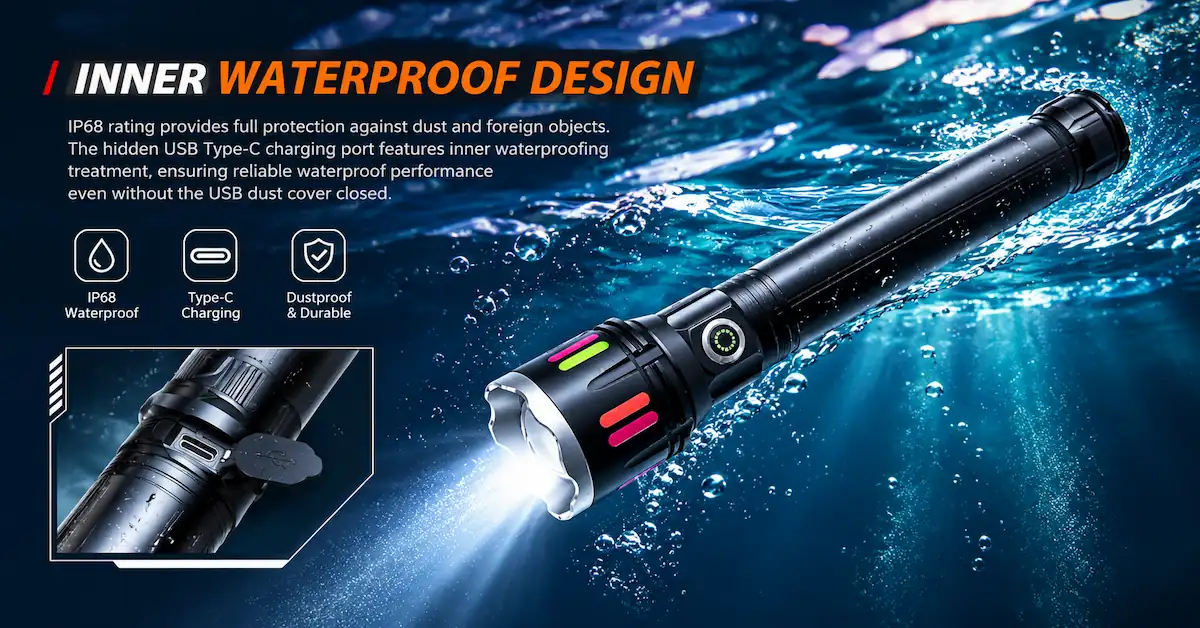
For instance, IP68 does not establish unlimited underwater operation, and the applicable IPX8 immersion conditions must be defined.
Additional Optical Safety Considerations
If a flashlight uses an actual laser-based light source, the buyer should investigate laser-specific safety requirements, including IEC 60825-1 where applicable.
LED-based products may require consideration of relevant photobiological safety standards, such as IEC 62471, depending on their configuration and market.
A package label reading “white laser” is not sufficient evidence of the actual light-source technology or compliance classification.
Important: These standards provide technical evaluation frameworks. Their names should not be presented as product certifications unless appropriate evidence supports the specific claim.
7. How Can Buyers Verify Flashlight Certification Authenticity?
The most valuable part of flashlight manufacturer certifications is not the number of certificate logos displayed on a website.
It is whether the supporting documents are authentic, applicable, current and traceable.
Eight-Step Document Verification Checklist
| Step | Verification Action | Risk Reduced |
|---|---|---|
| 1 | Confirm the manufacturer's legal name | Incorrect company identity |
| 2 | Match the exact model or covered product family | Unrelated certificates |
| 3 | Check the identified regulation or standard | Wrong compliance scope |
| 4 | Review issuing body and laboratory information | Unreliable documentation |
| 5 | Verify certificate status where applicable | Expired or invalid certification |
| 6 | Check relevant test conditions and results | Unsupported claims |
| 7 | Compare the documents with the approved product configuration | Product-version mismatch |
| 8 | Establish procedures for changes and repeat orders | Compliance drift |
Check the Laboratory's Competence
For technical test reports, buyers can review whether the laboratory has relevant competence and appropriate accreditation for the tests performed.
ISO/IEC 17025 accreditation can provide independent assurance of laboratory competence within its stated scope.
However, accreditation should be evaluated against the specific test method; a laboratory's general accreditation does not imply every test is within its accredited scope.
Common Warning Signs
Be cautious when a supplier provides a document that:
-
Does not identify the relevant product
-
Uses an unrelated company name
-
Covers a different model or battery configuration
-
Gives unclear test conditions
-
Cannot be verified through appropriate channels
-
Is presented as proof of a requirement it does not address
A short, relevant documentation package is generally more useful than numerous unrelated certificates.
8. Which Compliance Documents Should GHS Flashlight Buyers Request?
GHS (Guanghuishi) offers several rechargeable LED flashlight platforms suitable for initial product sourcing discussions.
Examples include TC-10120, TC-26130 and S-P200W.
The publicly reviewed product information establishes certain visible product characteristics, but it does not independently verify the complete certification status of these models.
GHS Flashlight Product and Documentation Matrix
| GHS Product | Product Characteristics | Documentation Buyers Should Request |
|---|---|---|
| TC-10120 | Type-C rechargeable design, adjustable beam, handheld structure | Applicable product conformity, battery and performance documents |
| TC-26130 | Rechargeable design, side controls, zoomable head | Exact variant documentation, battery transport evidence, relevant testing |
| S-P200W | Larger rechargeable handheld flashlight format | Measured performance, battery information, applicable market compliance evidence |
This table is a recommended buyer verification checklist, not a declaration that any listed GHS model has obtained specific certifications.
Why Product Version Matters
Different battery arrangements, charging circuits, housings or electronic configurations can change the documentation needed.
For a product sold in multiple versions, buyers should verify that the supplied documentation applies to the selected configuration.
They should not assume that a report for one flashlight automatically covers every related model.
Explore GHS rechargeable flashlight products
9. Do OEM and Private-Label Flashlights Need New Certification Tests?
Customization can affect regulatory obligations and technical documentation.
Some changes may be primarily cosmetic, while others can alter product performance, electrical characteristics, or safety.
OEM Change and Compliance Impact Matrix
| Modification | Potential Compliance Impact | Recommended Action |
|---|---|---|
| Logo and Branding | May affect identification and legal responsibility | Review labeling and responsible-party details |
| Retail Packaging | May affect warnings and market information | Update approved packaging |
| Battery Replacement | Can affect safety and transportation | Review applicable testing and documents |
| Charging Circuit Change | May affect electrical and EMC behavior | Reassess relevant requirements |
| LED or Driver Change | Can alter optical and electrical performance | Review test implications |
| Housing Modification | May affect mechanical and ingress protection | Evaluate changed construction |
| New Laser-Based Light Source | May introduce additional safety requirements | Determine applicable laser standards |
For private-label buyers, additional responsibilities can arise when the product is placed on the market under the buyer's own name or trademark.
The EU General Product Safety Regulation, for example, addresses circumstances in which another economic operator may be treated as the manufacturer.
Therefore, a private-label arrangement should clearly establish responsibility for conformity assessment, technical files, product identification, complaints and corrective action.
OEM customization should be evaluated before final labeling and certification decisions—not after bulk production.
10. How Do Certification Requirements Affect MOQ, Cost and Lead Time?
Compliance requirements can affect sourcing economics.
For example, an existing product with appropriate documentation may require less additional verification than a newly modified flashlight.
Main Cost and Timing Factors
| Factor | Possible Effect |
|---|---|
| Destination Market | Determines applicable requirements |
| Product Electronics | Influences electrical and EMC evaluation |
| Battery Configuration | Affects safety testing and logistics |
| Required Test Reports | May introduce testing expense and scheduling |
| OEM Modifications | May require reassessment or retesting |
| Packaging and Labeling | Adds artwork and compliance review |
| Production Changes | Can affect document validity and consistency |
Buyers should distinguish factory quotations, product testing fees, one-time engineering charges, and recurring production costs.
There is no universal compliance cost or MOQ applicable to every flashlight.
When comparing suppliers, ask whether the quotation includes the relevant tests and documents or whether these are charged separately.
A lower initial product price may be less attractive if mandatory technical documents are missing.
11. Why Consider GHS for Rechargeable Flashlight Sourcing?
GHS (Guanghuishi), operating under the published English name Guangdong Guanghuishi Electrical Appliances Co., Ltd., presents itself as a China-based lighting company integrating product development, manufacturing and sales.
According to its published company information, the business was established in 2009 and operates a manufacturing facility in Zhaoqing, Guangdong, China.
GHS provides rechargeable and high-intensity handheld flashlight platforms and presents OEM/ODM cooperation as part of its business activities.
For international buyers, the available product range provides starting points for discussing application requirements, product specifications, customization and applicable documentation.
Buyers can review the GHS company profile and factory videos during initial supplier evaluation.
However, published manufacturing claims and standards-related promotional materials should be supported by current certificates or reports covering the relevant company, product or production scope.
What Should Importers Ask GHS?
When contacting GHS, request the current product specification, target-market compliance information, applicable testing documentation, battery details, and available OEM options.
The precise requirements should be agreed before confirming the order.
Contact GHS to request product documentation and a quotation
12. Flashlight Certification RFQ Checklist for International Buyers
A detailed RFQ helps suppliers determine which technical documents are relevant to the project.
| RFQ Item | Buyer Should Specify |
|---|---|
| Destination Market | EU country, UK, US or other region |
| Product Type | Basic, rechargeable, high-intensity or custom flashlight |
| Model Reference | Exact model and version |
| Battery Configuration | Battery chemistry, type and supplied arrangement |
| Charging System | USB-C, included adapter or other configuration |
| Intended Application | Retail, outdoor, industrial or specialized |
| Required Performance | Lumens, beam distance, runtime, ingress protection |
| Compliance Requirements | Applicable regulations and test standards |
| Branding | Standard GHS product, OEM or private label |
| Order Quantity | Initial order and expected repeat volume |
| Document Review | Required test reports, declarations and certificates |
| Delivery | Destination, shipping method and planned schedule |
Buyers should confirm which documents are already available and which would require additional testing or assessment.
A complete RFQ also makes supplier quotations easier to compare on an equivalent basis.
Request a model-specific compliance review and bulk quotation from GHS
13. Frequently Asked Questions About Flashlight Manufacturer Certifications
1. What certifications should a flashlight manufacturer have?
The appropriate documentation depends on the flashlight and destination market. Buyers may need evidence related to applicable CE requirements, RoHS, EMC, battery safety and transportation, together with product performance reports. ISO 9001 can provide additional factory quality-management assurance but is not universally mandatory.
2. Is ISO 9001 mandatory for flashlight manufacturers?
No. ISO 9001 is generally a voluntary quality management system certification unless specifically required by a customer or contract. It does not replace product-specific regulatory compliance.
3. Does every flashlight need CE certification?
No. CE marking applies only where relevant EU harmonization legislation requires it. Buyers must identify applicable legislation and ensure the correct conformity assessment, technical documentation and declarations are completed.
4. Is RoHS the same as CE certification?
No. RoHS addresses restricted hazardous substances in applicable electrical and electronic equipment. CE marking indicates conformity with applicable EU legislation requiring the mark. RoHS compliance may form part of that conformity assessment.
5. Do rechargeable flashlights need UN 38.3 documentation?
Lithium-powered flashlight shipments generally require compliance with applicable lithium-battery transport rules, including relevant UN 38.3 testing requirements. The exact documentation and packing obligations depend on the battery configuration and transport arrangements.
6. Does an ANSI/PLATO FL 1 test prove a flashlight is safe?
Not by itself. ANSI/PLATO FL 1 provides methods for measuring and reporting portable lighting performance. It does not replace all applicable electrical, battery, product safety or legal requirements.
7. Are FCC and UL certifications mandatory for all flashlights sold in the US?
No. Applicable FCC requirements depend on the product's electronics and regulatory scope. UL or other NRTL certification requirements depend on the product, intended use, regulatory circumstances and customer specifications.
8. Can a flashlight be advertised as IP68 without a test report?
Buyers should not rely on an unsupported IP68 claim. The rating should be backed by appropriate evidence for the exact product and specified ingress-test conditions.
9. Do OEM modifications require new testing?
Potentially. Changes to batteries, charging electronics, LEDs, drivers, housings or sealing interfaces may affect compliance. The modified product should undergo an appropriate technical and regulatory review.
10. How can I verify GHS flashlight certification documents?
Contact GHS with the exact product model, destination market, order quantity and intended application. Request current model-specific reports or declarations, then verify their scope, issuing organizations, test conditions and relevance to the supplied configuration.
Conclusion
Understanding flashlight manufacturer certifications is essential for importers, distributors and private-label brands purchasing LED flashlights for international markets.
The most important principle is that factory certification, product regulatory compliance, battery transportation testing and performance verification are separate requirements.
ISO 9001 can provide evidence of a manufacturer's quality management system, while CE-related documentation, RoHS requirements and other applicable regulations support market compliance. UN 38.3 addresses lithium battery transportation, and standards such as ANSI/PLATO FL 1 and IEC 60529 help verify technical performance claims.
A reliable purchasing process should identify the exact applicable requirements, confirm document authenticity, match certificates and reports to the product, and control changes during repeat production.
For buyers evaluating Chinese flashlight manufacturers, GHS provides rechargeable LED flashlight platforms that can be reviewed for sourcing, OEM/ODM cooperation and market-specific documentation.
Looking for a rechargeable LED flashlight supplier for international distribution? Explore the GHS flashlight product catalog and contact GHS to discuss product specifications, available compliance documents, samples and bulk-order requirements.