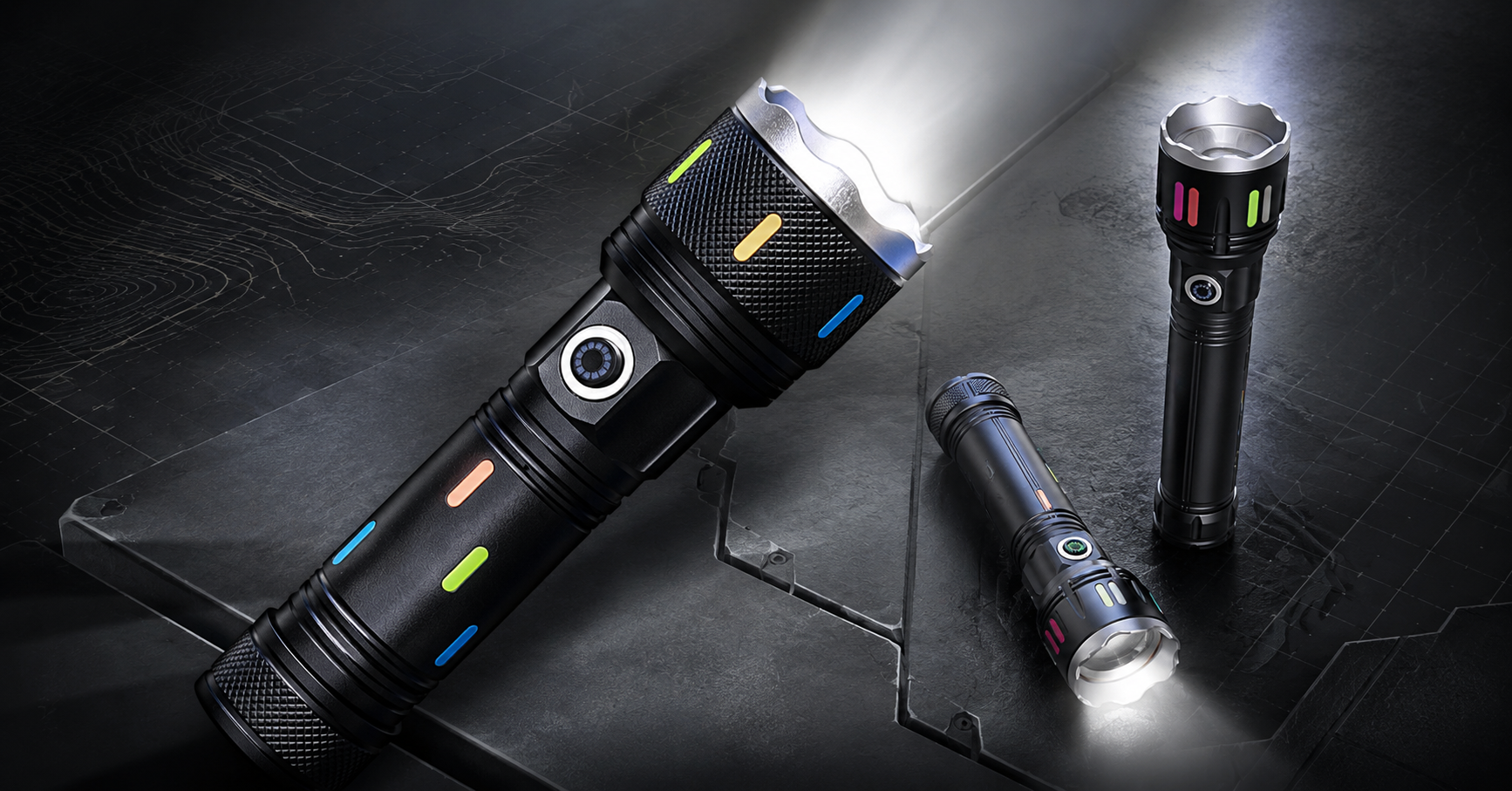

An IP68 flashlight is designed to protect its internal components against dust and water ingress under specified test conditions. It can be valuable in environments where ordinary portable lighting may be exposed to dust, moisture, or accidental immersion.
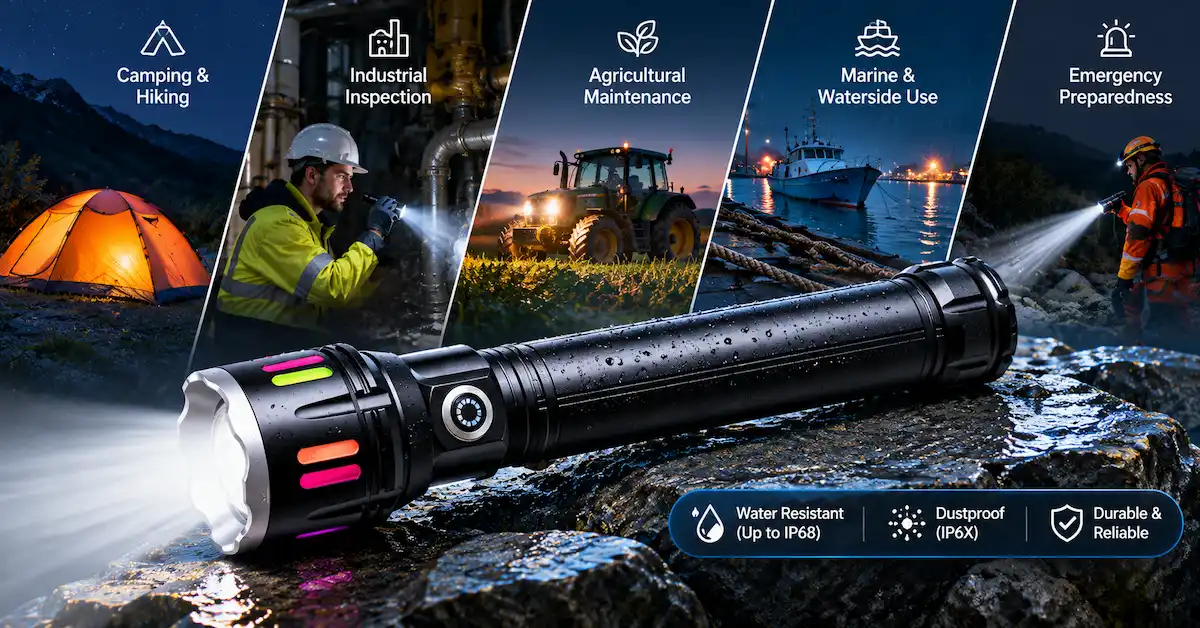
TL;DR: Common IP68 flashlight applications include wet-weather outdoor activities, industrial inspections in dusty or moisture-prone areas, agricultural maintenance, waterside equipment checks, and emergency preparedness. However, IP68 does not automatically mean a flashlight is suitable for diving, high-pressure cleaning, saltwater exposure, or hazardous industrial locations. Buyers should match the tested immersion conditions and other product specifications to the intended environment.
For B2B importers, outdoor equipment brands, and distributors, selecting a waterproof flashlight involves more than identifying the highest IP rating.
The purchasing decision must also consider beam performance, battery runtime, charging reliability, housing construction, application safety, and production consistency.
This article explains how to assess these requirements and select suitable flashlight platforms for wholesale distribution or OEM projects.
Key Takeaways
-
IP68 combines dust-tight protection with specified immersion protection, but the exact immersion conditions must be verified.
-
Outdoor and industrial environments are important application markets, particularly where both dust and water exposure are relevant.
-
IP68 is not automatically necessary for every flashlight. Some applications may be adequately served by other verified protection levels.
-
Immersion resistance is not the same as resistance to powerful water jets, corrosion, or high water pressure.
-
Rechargeable flashlights require careful evaluation of charging-port sealing, battery performance, and mechanical construction.
-
Bulk buyers should verify model-specific documentation rather than assuming every flashlight in a manufacturer's catalog has the same IP rating.
1. What Does IP68 Mean on a Flashlight?
IP68 refers to an ingress-protection classification defined by IEC 60529, Degrees of Protection Provided by Enclosures (IP Code).
The designation contains two characteristic numerals that describe different protective functions.
Understanding the IP68 Rating
| IP Code Element | Meaning | Practical Significance |
|---|---|---|
| IP | Ingress Protection | Classification for enclosure protection |
| First Digit: 6 | Dust-tight protection | Protects against dust ingress under the applicable test |
| Second Digit: 8 | Protection against continuous immersion under specified conditions | Indicates a defined level of resistance to harmful water ingress |
| Complete Rating: IP68 | Combined dust and immersion protection | Relevant to products exposed to dusty or immersion-prone environments |
The important distinction is that IP68 does not define one universal immersion depth or duration.
Under IEC 60529, IPX8 conditions must be established according to the applicable requirements and be more severe than IPX7 conditions.
For example, a manufacturer may claim a particular immersion depth and duration. Those conditions must be supported by appropriate testing of the actual product.
An IP68 flashlight should therefore be evaluated according to its documented test conditions, not just the rating displayed on its packaging.
For the official classification framework, refer to the IEC 60529 enclosure protection standard.
2. Where Are IP68 Flashlights Commonly Used?
The most useful way to assess IP68 flashlight applications is to match the environmental exposure with the lighting task.
Not every wet environment requires immersion protection. Similarly, a flashlight designed for immersion is not automatically suitable for every industrial or marine activity.
IP68 Flashlight Application Matrix
| Application | Typical Environmental Exposure | Why IP68 May Be Relevant | Additional Requirements |
|---|---|---|---|
| Camping and Hiking | Rain, mud, dust, accidental water exposure | Dust and immersion protection | Runtime, weight, beam pattern |
| Industrial Inspection | Dusty equipment areas, moisture, wet surfaces | Protection of internal components | Handling, durability, workplace safety |
| Agricultural Maintenance | Soil, dust, irrigation-related moisture | Protection in dusty and wet conditions | Cleaning requirements, charging reliability |
| Marine and Waterside Activities | Rain, spray, potential accidental immersion | Water-ingress protection | Corrosion resistance, jet resistance |
| Emergency Preparedness | Flood-prone environments, damp storage conditions | Additional environmental protection | Battery readiness, dependable operation |
| Outdoor Facility Maintenance | Dust, rain, damp equipment areas | Practical enclosure protection | Task lighting, impact resistance |
These are potential applications for products with verified IP68 performance. They do not establish suitability for every activity within each category.
3. IP68 Flashlight Applications for Camping and Hiking
Outdoor recreation is an important potential market for waterproof rechargeable flashlights.
Campers and hikers may encounter rain, muddy paths, high humidity, and accidental exposure to water.
A flashlight that has been tested for appropriate ingress protection can provide additional confidence when used within its rated conditions.
Why Is IP68 Useful for Outdoor Activities?
An IP68-rated flashlight may be relevant when buyers anticipate:
-
Dust exposure during hiking or camping
-
Accidental immersion in water
-
Wet equipment storage environments
-
Moisture exposure during outdoor activities
-
Repeated handling in dirty environments
However, environmental protection is only one purchasing factor.
For a hiking flashlight, customers may place greater value on low carrying weight, convenient charging, and an appropriate beam pattern.
For camping, broad illumination and practical runtime may be more important than extreme beam distance.
Should Every Camping Flashlight Be IP68?
No.
A brand serving casual outdoor users should evaluate whether the additional immersion-protection requirement creates meaningful customer value.
For products intended mainly for occasional rain, another verified protection level may meet the application requirements.
B2B purchasing recommendation: Define the actual water-exposure risk before selecting an IP rating. Avoid increasing product complexity solely to advertise a higher number.
4. How Are IP68 Flashlights Used in Industrial Environments?
Industrial buyers may require portable lighting for equipment checks, maintenance, warehouse inspection, and outdoor facility work.
These activities often expose equipment to dust and moisture.
A verified IP68 flashlight may be useful when both dust-tight construction and the specified immersion protection are relevant.
Industrial Maintenance and Equipment Inspection
Portable lighting can help technicians inspect machinery, examine equipment compartments, or illuminate areas where fixed lighting is insufficient.
For these tasks, important considerations include:
Beam control: A suitable beam should illuminate the working area without excessive glare.
Charging reliability: Rechargeable equipment should provide predictable charging and operating behavior.
Housing construction: Switches, joints, and charging interfaces should remain functional under expected handling conditions.
Environmental suitability: The enclosure protection must match the actual workplace exposure.
Important Limitation: Hazardous Locations
An IP68 flashlight is not automatically approved for explosive atmospheres or other hazardous classified locations.
IP68 addresses enclosure ingress protection. It does not independently establish intrinsic safety or explosion protection.
Applications involving flammable gases, combustible dust, or other classified hazards require equipment suitable for the applicable location and verified against the relevant safety requirements.
Procurement takeaway: Industrial buyers should distinguish between an ordinary wet or dusty workplace and a legally classified hazardous environment.
5. Are IP68 Flashlights Suitable for Marine and Waterside Use?
Marine and waterside equipment applications require particularly careful evaluation.
An IP68 flashlight may be useful where accidental immersion is a realistic risk.
However, the rating alone does not establish long-term suitability for seawater or marine environments.
Why Does Saltwater Require Additional Consideration?
Saltwater exposure can create corrosion risks for metal components, electrical contacts, and other susceptible materials.
An IP68 immersion test does not automatically demonstrate resistance to prolonged saltwater exposure or salt-spray corrosion.
Likewise, a flashlight that resists immersion is not automatically approved for powerful water jets.
Marine Application Checklist
| Requirement | Why It Matters |
|---|---|
| Verified Immersion Protection | Addresses defined water-ingress risks |
| Corrosion Resistance | Important for saltwater and coastal exposure |
| Suitable Housing Material | Influences environmental durability |
| Charging-Port Protection | Helps protect the electrical interface |
| Beam Performance | Determines suitability for the intended task |
| Battery Runtime | Supports the required operating period |
| Appropriate Accessories | Supports carrying and equipment retention |
For marine distributors, it may be necessary to specify several independent environmental requirements rather than relying on one IP rating.
An IP68 flashlight is not automatically a diving flashlight or a dedicated marine safety light.
6. Can IP68 Flashlights Be Used for Agricultural Work?
Agricultural environments create a combination of dust, soil, moisture, and routine equipment maintenance requirements.
Examples include checking irrigation-related equipment, inspecting agricultural machinery, and conducting general facility maintenance.
A flashlight with suitable dust and water protection may be beneficial where these exposure conditions are expected.
Agricultural Purchasing Considerations
Dust protection: The first numeral 6 in IP68 addresses dust-tight enclosure protection under the relevant test conditions.
Moisture protection: The required water resistance should reflect the actual irrigation or cleaning exposure.
Mechanical durability: Equipment may experience frequent handling, so buyers should evaluate relevant impact and assembly performance.
Charging and maintenance: Rechargeable products should be easy to maintain according to the manufacturer's instructions.
What About Pressure Washing?
This is an important limitation.
IP68 does not automatically establish resistance to high-pressure water jets.
If a flashlight is intended to remain in an area exposed to powered washdown equipment, the buyer should specify the appropriate water-jet protection requirement separately.
Choosing a product based only on IP68 may leave a gap between the claimed protection and the actual working environment.
7. Are IP68 Flashlights Useful for Emergency Preparedness?
Emergency preparedness equipment may be stored for long periods and used when ordinary lighting is unavailable.
Water-resistant construction can be relevant in flood-prone or damp environments, but storage readiness and electrical reliability are equally important.
For an emergency equipment kit, buyers should evaluate:
-
Appropriate illumination for the intended task
-
Verified runtime
-
Battery storage and maintenance requirements
-
Charging options
-
Complete accessories
-
Environmental protection
-
Product identification and instructions
Why Battery Readiness Matters
An emergency flashlight may remain unused for extended periods.
The condition of its battery, charging system, and electrical contacts can affect whether it works when needed.
IP68 protection does not guarantee that the battery will remain adequately charged during storage.
A good emergency product program should therefore include clear inspection and maintenance instructions.
For professional rescue or critical operations, equipment must also meet the organization's specific operational requirements.
8. IP65 vs. IP67 vs. IP68: Which Is Better for Your Application?
Different IP ratings address different water-exposure conditions.
The correct selection should depend on the application rather than simply choosing the highest available numeral.
IP Rating Comparison
| Rating | General Protection Description | Example Purchasing Consideration |
|---|---|---|
| IP65 | Dust-tight and protected against water jets | Outdoor exposure where relevant jet protection is required |
| IP66 | Dust-tight and protected against powerful water jets | More demanding water-jet environments |
| IP67 | Dust-tight and protected against temporary immersion | Defined accidental-immersion conditions |
| IP68 | Dust-tight and protected against specified continuous immersion | Applications requiring documented more-demanding immersion protection |
Is IP68 Better Than IP67?
For their respective immersion classifications, IPX8 conditions are more severe than IPX7.
However, actual IPX8 depth and duration need to be specified.
Does IP68 Include IP66?
Not automatically.
The immersion and water-jet classifications address different exposures. If the intended environment includes both, buyers should require evidence for each relevant test.
Which Rating Should a Distributor Choose?
For general outdoor retail, evaluate the actual expected exposure.
For immersion-prone applications, IP68 may provide a useful specification when the documented test matches the intended conditions.
For frequent washdown or powerful spray exposure, water-jet performance may be more important.
The right choice is the lowest protection specification that fully satisfies the defined application and its risks, rather than the highest number available.
9. What Technical Specifications Matter Beyond IP68?
Waterproof protection does not determine flashlight quality on its own.
For B2B purchasing, an IP-rated flashlight should also be evaluated as a complete lighting system.
Waterproof Flashlight Technical Selection Checklist
| Technical Parameter | What Buyers Should Evaluate |
|---|---|
| Light Output | Measured lumens at relevant operating modes |
| Beam Intensity | Candela and focused illumination |
| Beam Distance | Standardized distance measurement |
| Runtime | Useful operating duration |
| Battery System | Type, capacity, configuration and protection |
| Charging | Interface and charging behavior |
| Housing | Material, weight, structure and finish |
| Ingress Protection | Valid model-specific IP rating and test conditions |
| Impact Resistance | Relevant durability evidence |
| Switches and Seals | Functional and assembly reliability |
Why Is Runtime Important?
A flashlight with excellent water protection may still be unsuitable if its illumination does not last long enough for the intended task.
Battery configuration, LED driver performance, output settings, and thermal behavior all affect usable runtime.
The ANSI/PLATO FL 1-2025 performance framework provides standardized methods for evaluating portable lighting performance and includes updated approaches to dust protection and IPX8 testing.
Buyers should use appropriate test evidence rather than rely only on packaging claims.
Referencing the standard does not establish that a particular product has passed the test.
10. How Do Materials and Design Affect Waterproof Reliability?
The waterproof performance of a flashlight depends on its complete enclosure construction.
Important components can include:
Housing joints: Connections between the head, body, and tailcap.
O-rings and gaskets: Sealing components used at relevant enclosure interfaces.
Lens and bezel: The front optical assembly and its sealing structure.
Switch interfaces: Control components that must operate while maintaining protection.
Charging ports: Electrical interfaces that may require specialized sealing.
Mechanical assembly: Dimensions, component fit, and installation consistency.
Even a correctly designed sealing system may be compromised if its components are damaged, incorrectly assembled, or modified.
Does a USB-C Flashlight Remain Waterproof While Charging?
Not necessarily.
A product's IP rating applies to its tested configuration.
If the testing was conducted with the charging-port cover closed, the result should not automatically be extended to operation with the cover open.
Buyers should verify the exact intended operating conditions and follow the product's charging instructions.
11. How Should B2B Buyers Select a Suitable IP68 Flashlight?
The most effective purchasing approach is to turn the application into a written product requirement.
Five-Step Application Selection Framework
Step 1: Identify the Environment
Determine whether the product will encounter dust, rain, splashing, water jets, accidental immersion, or other exposure.
Step 2: Define the Required Protection
Specify the appropriate IP rating and any additional environmental requirements.
Step 3: Establish Lighting Performance
Define beam pattern, required illumination, operating duration, and charging expectations.
Step 4: Review Product Evidence
Request model-specific specifications, test reports, and representative samples.
Step 5: Confirm Commercial Suitability
Evaluate packaging, accessories, customization requirements, quantity, lead time, and quality-control arrangements.
Example: Selecting Flashlights for Agricultural Equipment Distributors
Consider a hypothetical distributor supplying rechargeable flashlights to agricultural maintenance customers.
The expected use includes dusty machinery areas, routine outdoor inspection, and occasional exposure to irrigation-related moisture.
The buyer might establish a dust-protection requirement, select an appropriate water-exposure rating, and define minimum runtime and charging needs.
If immersion is not a credible exposure scenario, specifying IP68 may offer limited additional value.
If accidental immersion is a genuine risk, a model with verified immersion protection may be more appropriate.
This example illustrates a purchasing method rather than a real customer project or a GHS test result.
12. Which GHS Flashlight Models Can Buyers Evaluate?
GHS (Guanghuishi) offers rechargeable LED flashlight platforms that overseas buyers can investigate when evaluating outdoor, industrial, and general-purpose lighting requirements.
However, the public product information reviewed does not establish a verified IP68 rating for the following models.
They should be treated as product references for technical discussion, not as confirmed IP68 flashlights.
GHS Rechargeable Flashlight Comparison
| GHS Model | Displayed Features | Potential Application Discussion | Information to Verify |
|---|---|---|---|
| TC-10120 | Type-C charging, handheld design, adjustable beam | Outdoor utility and inspection lighting | IP rating, charging-port sealing, runtime |
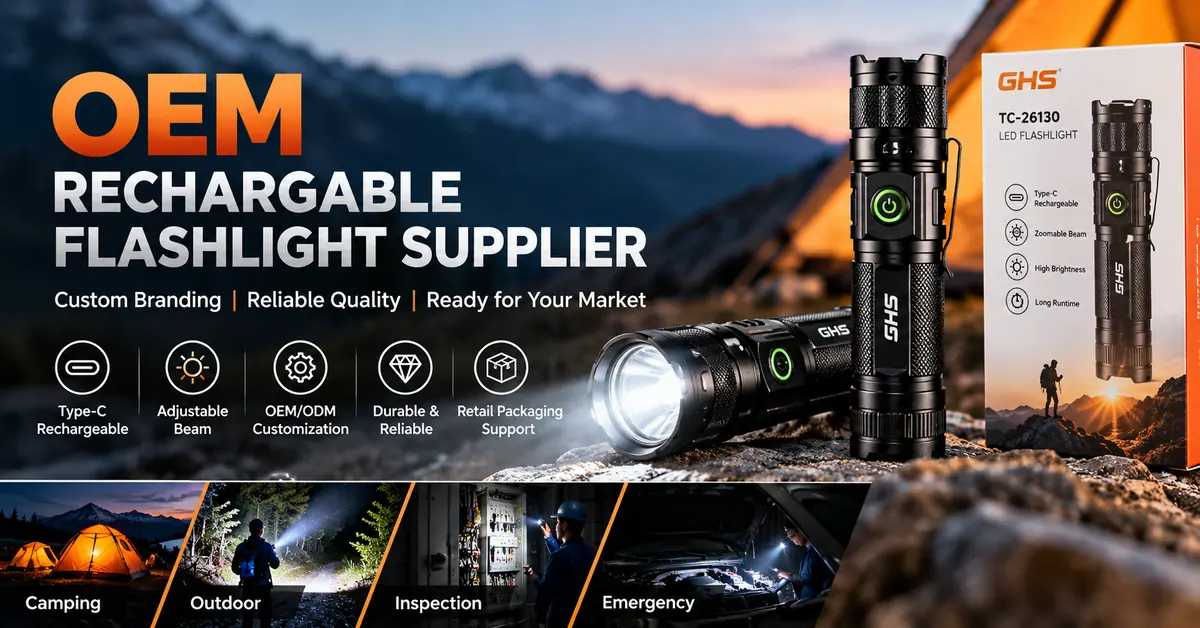
| TC-26130 | Rechargeable design, zoomable head, side control | General-purpose outdoor and equipment lighting | Environmental testing, model version, battery |
| S-P200W | Larger handheld format, adjustable beam | Higher-intensity outdoor lighting evaluation | IP rating, measured performance, thermal behavior |
What Should Buyers Ask GHS?
Importers seeking a verified IP68 product should ask whether an existing model has relevant test evidence or whether an alternative design is available.
If the requirement involves a new housing or modified charging interface, additional engineering evaluation and testing may be necessary.
Explore GHS rechargeable flashlight models
13. What Should Importers Verify Before Ordering Waterproof Flashlights in Bulk?
A product may meet the buyer's intended technical requirements in a sample but still require production controls to maintain consistent assembly quality.
Bulk Procurement Checklist
| Purchasing Requirement | Recommended Verification |
|---|---|
| Intended Application | Clearly defined environment and user |
| IP Protection | Model-specific test evidence |
| Immersion Requirements | Documented depth, duration, and conditions |
| Light Performance | Measured output and runtime |
| Battery and Charging | Approved configuration and documents |
| Housing and Seals | Controlled construction and materials |
| Sample Approval | Written acceptance record |
| Quality Control | Agreed inspection and defect criteria |
| OEM Customization | Technical feasibility and change assessment |
| Packaging | Accurate claims and complete accessories |
| MOQ and Lead Time | Project-specific quotation |
| Repeat Orders | Version control and critical-component consistency |
Can OEM Customization Affect Waterproof Performance?
Yes.
Changes involving the housing, charging port, switches, lens, or tailcap may affect enclosure sealing.
A customized flashlight should not automatically inherit the original model's IP rating without appropriate technical review.
What Determines Waterproof Flashlight Cost?
Cost depends on the required construction, materials, sealing components, engineering changes, testing, quality controls, packaging, and order quantity.
An existing suitable platform may require less development than a new structure designed around a different immersion specification.
For importers, comparing total procurement cost and verified performance is more useful than comparing unit price alone.
14. Why Consider GHS for Waterproof Flashlight Sourcing?
GHS (Guanghuishi), operating under the published English name Guangdong Guanghuishi Electrical Appliances Co., Ltd., is a China-based lighting company involved in product development, manufacturing, and sales.
According to its company profile, GHS was established in 2009 and operates a manufacturing facility in Zhaoqing, Guangdong, China.
The company offers rechargeable handheld LED flashlight products and presents OEM/ODM cooperation as part of its business activities.
For overseas distributors and brands researching IP68 flashlight applications, GHS provides existing rechargeable lighting platforms that can be discussed against different environmental and performance requirements.
However, the actual waterproof rating, supported test conditions, customization options, MOQ, and delivery terms must be confirmed for each selected product.
Buyers can review the GHS company profile, factory videos, and product range during their initial evaluation.
Request a Technical and Commercial Review
To receive a relevant quotation, provide your target application, water-exposure conditions, required IP rating, lighting specifications, estimated order quantity, and destination market.
15. Frequently Asked Questions About IP68 Flashlight Applications
1. What is an IP68 flashlight used for?
An IP68 flashlight is used in applications requiring dust-tight protection and resistance to specified immersion conditions. Potential environments include outdoor activities, industrial maintenance, agricultural work, waterside tasks, and emergency preparedness, subject to additional product requirements.
2. Can I use an IP68 flashlight in heavy rain?
A verified IP68 flashlight provides specified immersion protection, but buyers should still confirm suitability for the actual rain exposure and intended operating conditions. The rating does not automatically prove every other water-exposure classification.
3. Is an IP68 flashlight suitable for camping?
It can be, especially when dust and accidental immersion are relevant. However, weight, beam distribution, runtime, and charging convenience also determine whether it is a good camping flashlight.
4. Can an IP68 flashlight be used underwater?
Only within its documented operating and test conditions. IP68 does not automatically establish suitability for diving, unlimited depth, or continuous underwater operation with controls being used.
5. Are IP68 flashlights suitable for industrial maintenance?
They may be suitable for general wet or dusty maintenance environments when their verified specifications match the task. Hazardous classified locations require separate equipment suitability and approval.
6. Is IP68 better than IP67 for outdoor flashlights?
IP68 provides an immersion classification based on conditions more severe than IPX7, but the actual depth and duration must be defined. The better choice depends on expected exposure and other product requirements.
7. Does IP68 protect against saltwater corrosion?
No. IP68 is an ingress-protection classification and does not automatically prove saltwater corrosion resistance. Marine applications may require separate material and corrosion evaluations.
8. Can an IP68 flashlight withstand pressure washing?
Not automatically. High-pressure water exposure is different from immersion testing. Buyers should specify and verify the relevant water-jet or washdown requirements separately.
9. What should wholesalers check before buying IP68 flashlights?
Wholesalers should review model-specific IP test reports, immersion conditions, battery and charging specifications, sample performance, assembly quality, packaging claims, and production consistency.
10. Does GHS offer IP68 waterproof flashlights?
GHS offers rechargeable flashlight products and can be contacted about waterproof lighting requirements. However, IP68 status for the referenced models has not been independently verified from the publicly reviewed product information. Buyers should contact GHS for current product-specific documentation and available options.
Conclusion
Understanding IP68 flashlight applications helps distributors, importers, and equipment brands make better decisions about environmental protection, product performance, and sourcing costs.
An IP68-rated flashlight can provide valuable dust and immersion protection for suitable outdoor, industrial, agricultural, waterside, and emergency applications. However, the actual level of protection depends on the tested conditions and the specific product configuration.
For B2B buyers, the most important principle is to match the protection rating to the intended environment.
A higher IP rating is not automatically the best choice when the application also requires resistance to powerful water jets, saltwater corrosion, mechanical impact, or specialized safety hazards.
GHS offers rechargeable LED flashlight platforms that buyers can evaluate against different application requirements. Any IP68 claims must be supported by valid test evidence for the exact selected model.
Looking for rechargeable waterproof lighting products for your brand or distribution business? Explore the GHS LED flashlight collection and contact GHS to discuss product selection, environmental specifications, OEM/ODM feasibility, sample evaluation, and bulk purchasing requirements.