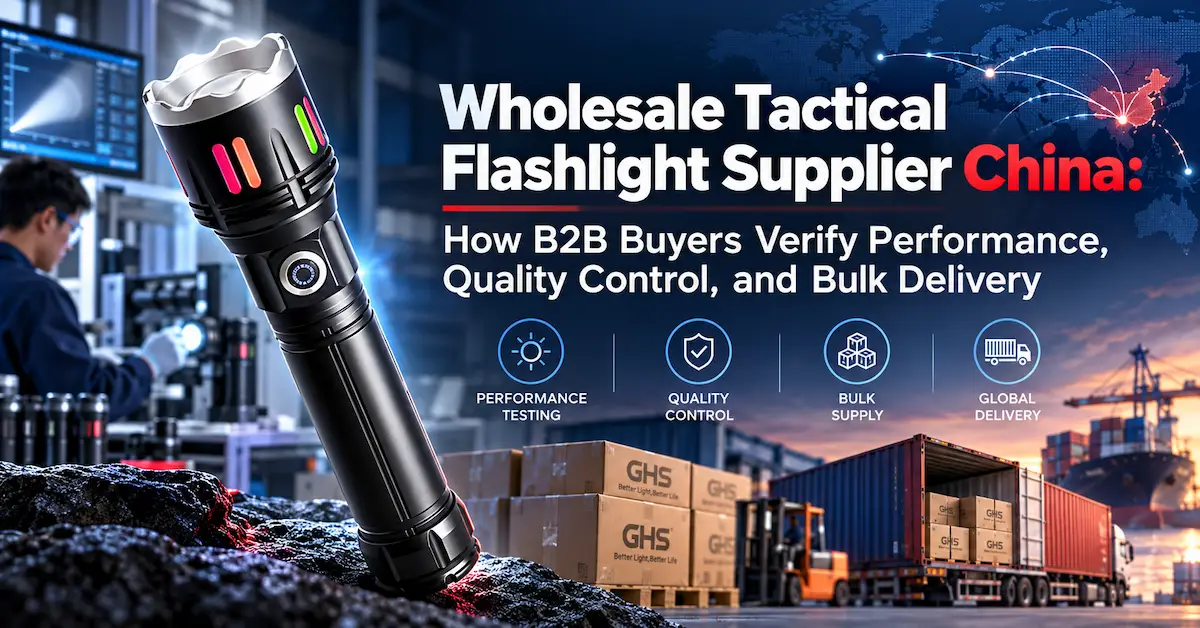

Choosing a tactical flashlight manufacturer is not simply about finding a supplier offering high brightness, attractive product designs, or competitive wholesale prices.
For lighting distributors, hardware wholesalers, outdoor equipment brands, and professional equipment retailers, the greater challenge is building a product range that customers can understand, dealers can sell confidently, and purchasing teams can replenish consistently.
A flashlight with impressive advertised specifications may generate customer complaints if its actual runtime is unclear, charging accessories are incompatible, or replacement products differ from earlier shipments.
TL;DR: A successful tactical flashlight distribution program requires differentiated product models, verified lighting specifications, reliable battery and charging systems, accurate sales documentation, consistent accessories, and clear after-sales arrangements. Distributors should evaluate representative samples and agree on product configurations before purchasing in bulk.
This guide explains how to connect flashlight manufacturing capabilities with commercial distribution requirements, helping buyers develop a practical product portfolio without introducing unnecessary inventory and service risks.
Businesses evaluating rechargeable handheld lighting products can begin by reviewing the GHS LED flashlight collection.
Key Takeaways
-
Select flashlight models with clearly differentiated commercial purposes rather than minor cosmetic differences.
-
Compare measured light output, beam characteristics, and usable runtime instead of headline brightness alone.
-
Standardize product specifications, accessory information, and retail claims across distribution channels.
-
Verify battery and charging compatibility before promising interchangeable accessories.
-
Establish product identification, defect reporting, and replacement procedures before bulk purchasing.
-
Use OEM/ODM customization to create meaningful customer value without unnecessary engineering complexity.
1. What Should a Tactical Flashlight Manufacturer Provide to Distributors?
A manufacturer supplying tactical-style flashlights to international distributors should be evaluated on its ability to support a complete commercial product program.
This includes product selection, technical specifications, samples, branding, manufacturing consistency, packaging, and repeat-order coordination.
Distribution-Oriented Manufacturing Requirements
| Manufacturing Area | Distributor Requirement | Commercial Benefit |
|---|---|---|
| Product Development | Distinct flashlight platforms | Clear product differentiation |
| Technical Documentation | Verified model specifications | Accurate sales information |
| Battery and Charging | Defined electrical configurations | Fewer compatibility complaints |
| Quality Control | Repeatable inspection criteria | Reduced avoidable product failures |
| OEM/ODM Services | Feasible branding and configuration options | Brand differentiation |
| Packaging | Consistent retail-ready configurations | Easier warehouse and retail management |
| Repeat Supply | Controlled product revisions | More predictable replenishment |
| After-Sales Coordination | Defined defect and replacement procedures | Better service-cost management |
The term tactical flashlight does not represent a universal certification category. Manufacturers and distributors should describe products according to their verified characteristics and intended applications.
For a broader supplier evaluation framework, buyers can also review the GHS guide to choosing a tactical flashlight manufacturer for professional applications.
2. Which Businesses Should Source Tactical-Style Flashlights?
Different distribution channels require different product combinations, technical information, and commercial arrangements.
| Target Buyer | Main Application | Purchasing Priority |
|---|---|---|
| Outdoor Equipment Distributors | Camping, hiking and nighttime outdoor activities | Portability and practical runtime |
| Hardware Wholesalers | Maintenance and general utility lighting | Competitive pricing and repeat supply |
| Industrial Equipment Suppliers | Routine equipment inspection | Functional reliability |
| Security Equipment Retailers | General inspection and supplementary lighting | Handling and verified beam performance |
| Automotive Accessory Distributors | Vehicle emergency kits | Storage and accessory compatibility |
| Private-Label Lighting Brands | Branded retail product collections | Customization and consistent specifications |
| Emergency Preparedness Suppliers | Household and general preparedness kits | Battery readiness and ease of operation |
Applications Requiring Additional Qualification
Ordinary tactical-style flashlights should not automatically be marketed as certified police equipment, professional rescue devices, diving lights, or explosion-proof lighting.
Specialized applications may require additional testing, documented approvals, and equipment qualification.
A rugged appearance alone does not establish suitability for hazardous or safety-critical environments.
3. How Can Distributors Build a Product Range Without Overlapping SKUs?
A common purchasing mistake is adding several visually similar flashlights to a catalog without defining why customers should select one model over another.
This creates unnecessary inventory complexity and makes sales teams more dependent on price comparisons.
Ask a tactical flashlight manufacturer to provide product options that can be differentiated through measurable performance, form factor, power configuration, and customer needs.
Tactical Flashlight Product Portfolio Matrix
| Product Position | Target Sales Channel | Main Differentiator | Information Required |
|---|---|---|---|
| Portable Utility | Hardware and general retail | Manageable size and simple operation | Dimensions, weight, charging |
| Adjustable-Beam | Outdoor and maintenance equipment | Flexible illumination | Beam pattern and zoom operation |
| High-Intensity | Higher-positioned lighting ranges | Verified focused illumination | Candela, output and runtime |
| Multifunctional | Emergency and vehicle accessory channels | Additional utility functions | Charging output and compatibility |
The purpose of this matrix is not to rank products by maximum brightness.
It helps distributors establish distinct commercial roles for each product.
Avoid Purchasing Products With Indistinguishable Features
If two flashlight models offer nearly identical dimensions, charging configurations, operating modes, and customer benefits, maintaining both may add limited value.
Before approving another SKU, ask:
-
Does it serve a different customer group?
-
Does it offer a measurable performance difference?
-
Does it support a different retail price position?
-
Does it require different batteries or accessories?
-
Can the sales team explain its value clearly?
An additional product should create meaningful customer choice rather than increase catalog size alone.
4. Which GHS Flashlight Models Can Distributors Evaluate?
GHS (Guanghuishi) offers rechargeable handheld flashlights and high-intensity product platforms that international distributors can evaluate for general-purpose portable lighting programs.
GHS Tactical-Style Flashlight Platform Comparison
| GHS Model | Publicly Displayed Features | Potential Distribution Position | Key Verification Requirements |
|---|---|---|---|
| S-P161 | Textured grip, side switch, adjustable-beam design; USB output shown for a related version | Portable utility and multifunctional lighting | Exact version, battery, charging and USB output |
| TC-26130 | Rechargeable design, Type-C charging, zoomable head, side controls | Adjustable-beam retail and wholesale lighting | Model variant, accessories, runtime and beam performance |
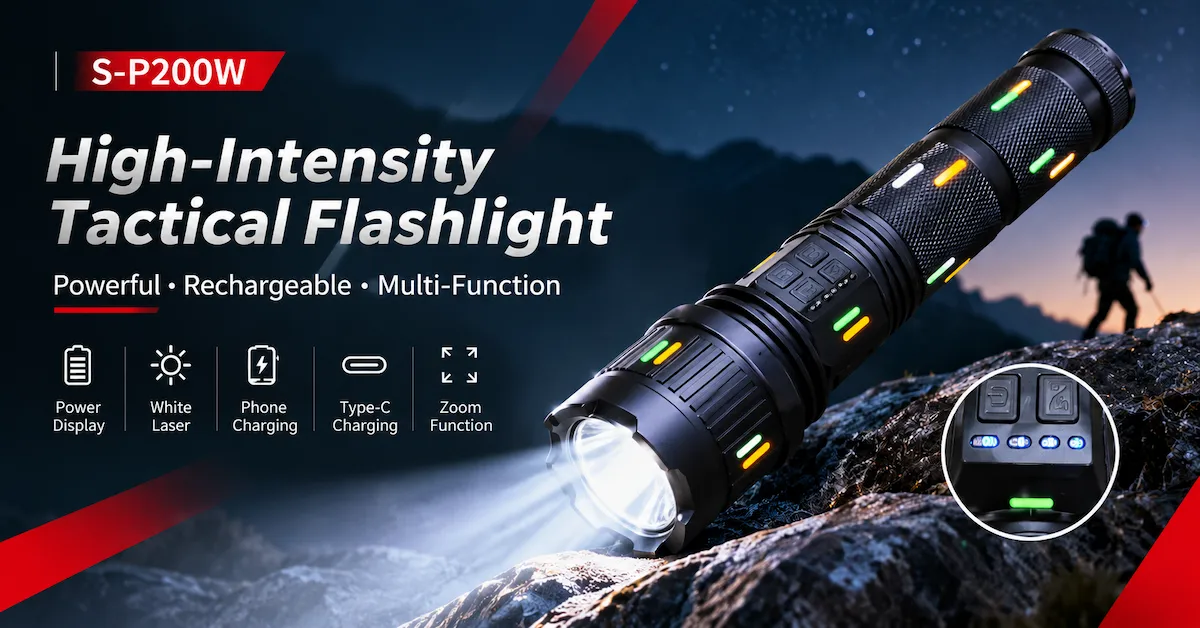
| S-P200W | Larger rechargeable handheld format, textured grip, adjustable beam | High-intensity lighting product range | Sustained output, battery configuration, heat management |
| S-P300W (S-P Series) | Larger-head design, side controls, charging and phone-charging features shown for certain versions | Multifunctional and higher-positioned handheld lighting | Exact functions, battery, dimensions, measured performance |
These are existing product platforms for initial sourcing discussions, not independently verified performance rankings.
The S-P200W and S-P300W model names should not be interpreted as confirmed electrical wattage.
S-P161 vs. TC-26130
These products provide alternative handheld formats for general-purpose and adjustable-beam lighting.
Distributors should compare their dimensions, actual battery systems, operating controls, available accessories, and retail packaging before deciding whether both models are necessary.
S-P200W vs. S-P300W
Both belong to GHS's high-intensity flashlight product direction.
Before positioning one as a higher-performance alternative, buyers should request comparable light output, beam intensity, runtime, weight, and charging information.
A higher model number does not automatically establish higher verified performance.
Explore GHS rechargeable and high-intensity flashlight products
5. What Technical Specifications Should Distributors Include in Product Catalogs?
A tactical flashlight manufacturer should help buyers establish a consistent product specification that can be used for purchasing, dealer training, retail packaging, and online product listings.
Dealer-Ready Flashlight Specification Table
| Technical Parameter | Unit or Description | Required Information |
|---|---|---|
| Light Output | Lumens (lm) | Verified output by operating mode |
| Peak Beam Intensity | Candela (cd) | Measured luminous intensity |
| Beam Distance | Meters (m) | Standardized distance measurement |
| Runtime | Hours or minutes | Duration at specified operating modes |
| Battery Configuration | Cell type, mAh, Wh | Exact approved power system |
| Charging Interface | USB-C or other interface | Connector and electrical requirements |
| Charging Duration | Hours | Defined charging conditions |
| Housing Material | Confirmed material and finish | Actual construction information |
| Product Dimensions | mm or cm | Length, head diameter and body diameter |
| Product Weight | Grams (g) | State whether battery is included |
| Ingress Protection | IP Code, if applicable | Model-specific test evidence |
| Impact Resistance | Defined test conditions | Relevant mechanical test results |
| Included Accessories | Itemized list | Exact contents of each retail package |
Missing specifications should be treated as information requiring confirmation, not estimated from product photographs.
Why Are Lumens and Candela Different?
Lumens describe the total visible light emitted by a flashlight.
Candela describes luminous intensity in a particular direction.
A flashlight producing a broad beam may distribute light differently from a flashlight with concentrated illumination, even when both have similar total light output.
Distributors should therefore explain the beam's practical application rather than promote brightness numbers without context.
6. How Should Tactical Flashlight Performance Claims Be Presented?
Incorrect or incomplete performance claims can create customer dissatisfaction and commercial risk.
A flashlight advertised using only its maximum brightness may give customers an inaccurate impression of sustained performance.
Peak Brightness vs. Usable Brightness
Rechargeable flashlights may reduce their light output during extended operation because of thermal management or changing battery conditions.
The ANSI/PLATO FL 1-2025 product marking guidance distinguishes short-duration elevated brightness modes from standard operating modes and requires runtime to accompany short-duration performance claims when reported under that framework.
For distributors, this provides a useful basis for presenting lighting specifications more transparently.
Common Marketing Claims That Require Verification
| Marketing Claim | Evidence to Request |
|---|---|
| High Brightness | Measured lumen output and mode |
| Long-Range Beam | Candela and standardized beam-distance results |
| Extended Runtime | Runtime test conditions and output behavior |
| Waterproof | Applicable model-specific ingress-protection evidence |
| Impact Resistant | Documented mechanical test results |
| Fast Charging | Verified charging characteristics |
| Phone Charging | Actual USB output and device compatibility |
For products sold in the United States, the Federal Trade Commission's advertising substantiation policy establishes the importance of having a reasonable basis for objective advertising claims before they are communicated to customers.
The commercial principle is straightforward: product descriptions should reflect verified performance.
Neither reference establishes that GHS products have passed a specific test or obtained a particular certification.
7. How Can Battery and Accessory Compatibility Reduce After-Sales Problems?
A flashlight portfolio becomes more difficult to manage when every model requires different accessories, charging arrangements, or replacement components.
Distributors should evaluate the complete product configuration rather than the flashlight alone.
Accessory Compatibility Matrix
| Component | What Buyers Should Confirm | Potential Service Risk |
|---|---|---|
| Rechargeable Battery | Approved type and electrical configuration | Incorrect replacement cells |
| Charging Cable | Connector type and compatibility | Charging complaints |
| Power Adapter | Supported electrical input | Unsuitable charging equipment |
| Charging-Port Cover | Exact model compatibility | Incorrect replacement parts |
| Lanyard or Strap | Attachment compatibility | Missing or unsuitable accessories |
| Carrying Case | Physical dimensions and fit | Product retention problems |
| User Manual | Correct model and control instructions | Customer operating confusion |
A common USB-C connector does not establish universal charger compatibility, fast-charging support, or battery interchangeability.
Likewise, similar-looking flashlights may use different internal battery arrangements.
Distributors should request an approved compatibility list before selling replacement batteries or accessories.
8. What Manufacturing and Quality Controls Support Dealer-Ready Products?
A distributor needs consistency between approved samples, marketing materials, and delivered inventory.
The reliability of that relationship depends on component selection, manufacturing workmanship, inspection, and revision control.
Critical Flashlight Components
The main systems typically include the LED, optics, driver electronics, battery, charging circuit, switches, housing, seals, and mechanical connections.
Changes to any of these components may influence lighting performance, charging behavior, heat management, or durability.
When a tactical flashlight manufacturer proposes a critical component substitution, distributors should evaluate whether specifications or sales claims need to be updated.
Recommended Production Quality Controls
| Production Stage | Inspection Focus | Distributor Benefit |
|---|---|---|
| Incoming Materials | LEDs, batteries, drivers, housing components | Configuration consistency |
| Mechanical Assembly | Component fit, threads and switch installation | Reduced workmanship issues |
| Functional Inspection | Lighting modes, charging and controls | Fewer nonfunctioning products |
| Performance Sampling | Agreed output, runtime and durability tests | Supported product claims |
| Final Inspection | Accessories, labels, packaging and appearance | Retail-ready inventory |
| Batch Identification | Model revision and shipment records | Easier defect investigation |
These are recommended purchasing controls. The actual GHS inspection process and available reports should be confirmed for the specific order.
9. How Should Distributors Approve Samples Before Bulk Purchasing?
A sample approval process should confirm more than whether the flashlight turns on.
Recommended Product Approval Sequence
-
Confirm the exact model, version, battery and accessories.
-
Review relevant technical specifications and product documentation.
-
Test switching, charging, lighting modes and beam adjustment.
-
Evaluate runtime and other mandatory performance requirements.
-
Inspect housing finish, mechanical fit and packaging.
-
Approve product photographs, instructions and retail claims.
-
Record accepted specifications and applicable inspection criteria.
A physical reference sample should be supported by written technical information.
This is particularly important when internal components cannot be verified from external appearance.
For a tactical flashlight manufacturer, an approved reference provides a useful basis for reproducing the agreed product configuration in later production batches.
10. How Can Distributors Reduce Tactical Flashlight Returns?
Product returns do not always result from manufacturing defects.
They may also arise from incorrect product descriptions, unsuitable accessories, misunderstood charging requirements, or expectations that the product was never designed to meet.
Flashlight Return-Cause Analysis
| Customer Complaint | Possible Cause | Preventive Action |
|---|---|---|
| Flashlight Will Not Charge | Connector, cable or electrical problem | Verify compatible charging equipment |
| Runtime Is Too Short | Unclear mode-specific performance claims | Provide accurate runtime information |
| Beam Is Not as Expected | Product description does not explain beam type | Use verified optical specifications |
| Missing Accessories | Packaging configuration mismatch | Approve exact package contents |
| Water Damage | Unsupported waterproof claim or unsuitable use | State verified protection and limitations |
| Inconsistent Replacement Product | Unapproved model or component revision | Establish version control |
Illustrative Distributor Case
Consider a hypothetical hardware distributor preparing a rechargeable flashlight program.
The buyer initially plans to purchase four similar models. However, a sample review reveals that two models serve almost identical customer needs.
Instead of stocking all four, the distributor selects a smaller assortment with clearly differentiated features and creates one controlled product specification for each SKU.
The distributor also confirms package contents and establishes a process for recording customer complaints by model and batch.
This example illustrates a purchasing strategy, not an actual GHS customer project or measured reduction in returns.
The important lesson is that product documentation and assortment planning can help address service problems before they occur.
11. What Determines Tactical Flashlight Wholesale Cost and OEM Feasibility?
Distributors should evaluate the complete commercial cost of a product rather than compare factory quotations alone.
Wholesale Cost Evaluation
| Cost Factor | Commercial Impact |
|---|---|
| Product Configuration | Determines base unit cost |
| Battery and Electronics | Influences performance and replacement costs |
| Housing and Finish | Affects appearance and manufacturing expense |
| OEM Branding | May require artwork and setup costs |
| Accessories | Influences complete kit pricing |
| Packaging | Affects retail presentation and freight |
| Testing and Inspection | Adds verification costs |
| Inventory and Returns | Influences long-term distribution profitability |
MOQ and Production Lead Time
Minimum order quantity and production schedules depend on the actual product, packaging, components, customization requirements, and factory workload.
Distributors should request model-specific quotations rather than assume all products have identical terms.
OEM/ODM Customization
Possible customization discussions include logos, packaging, approved accessories, finishes, and selected product configurations.
More extensive changes to optics, electronics, batteries, or housing structures may require additional engineering and testing.
The available options should be confirmed with the manufacturer before commercial commitments are made.
12. Why Consider GHS for Tactical-Style Flashlight Distribution?
GHS, operating under the published English company name Guangdong Guanghuishi Electrical Appliances Co., Ltd., is a China-based lighting business engaged in product development, manufacturing, and sales.
According to its company profile, GHS was established in 2009, operates a 1,300-square-meter manufacturing facility in Zhaoqing, Guangdong, and established a Dubai branch in 2017.
The company offers multiple rechargeable flashlight platforms, including general-purpose and high-intensity handheld products.
For international distributors, these platforms provide opportunities to discuss product selection, wholesale supply, retail configurations, and potential OEM/ODM cooperation.
What Should Buyers Request From GHS?
A complete sourcing inquiry should include the following information:
| RFQ Item | Buyer Requirements |
|---|---|
| Distribution Channel | Hardware, outdoor, industrial or general retail |
| Preferred Models | Selected GHS product references |
| Technical Requirements | Output, beam, runtime and charging |
| Product Position | Target customers and retail price range |
| Accessories | Approved battery, cable and package contents |
| Branding | Logo, packaging and instructions |
| Order Quantity | Initial volume and repeat-order forecast |
| Quality Requirements | Sample approval and inspection criteria |
| After-Sales Needs | Defect handling and replacement arrangements |
| Destination Market | Applicable documentation and delivery requirements |
Buyers can also review the GHS factory videos and product demonstration videos during initial supplier evaluation.
Contact GHS to request model specifications, samples, OEM options and a distributor quotation.
13. Frequently Asked Questions About Tactical Flashlight Manufacturing
1. What should buyers look for in a tactical flashlight manufacturer?
Buyers should evaluate product differentiation, measurable lighting performance, battery and charging reliability, manufacturing consistency, technical documentation, customization options, and repeat-order support.
2. What is the difference between a tactical flashlight and a standard flashlight?
Tactical-style flashlights are commonly positioned around demanding portable lighting applications, handling, and durability. However, actual differences depend on verified product specifications rather than the marketing category alone.
3. Can distributors buy rechargeable tactical flashlights in bulk?
Yes. Distributors can discuss model selection, order quantities, approved configurations, packaging, and commercial terms with manufacturers. Availability and MOQ must be confirmed for the selected product.
4. Are higher-lumen tactical flashlights always better?
No. Beam distribution, sustained output, runtime, weight, and intended application are equally important. Maximum brightness alone does not determine overall product suitability.
5. Are tactical flashlights automatically waterproof?
No. Waterproof performance depends on the enclosure design and relevant testing. Buyers should request model-specific evidence for any advertised IP rating.
6. Can different flashlight models share rechargeable batteries?
Only when the manufacturer confirms electrical and mechanical compatibility. Similar external dimensions do not establish safe battery interchangeability.
7. Which GHS models can distributors compare?
Distributors can evaluate S-P161, TC-26130, S-P200W, and S-P300W as existing rechargeable flashlight platforms. Exact specifications, available features, and intended applications should be confirmed.
8. Can a tactical flashlight manufacturer provide private-label products?
Manufacturers may support custom logos, packaging, accessories, and selected product configurations. Actual customization capabilities depend on the chosen model and project requirements.
9. How can distributors reduce flashlight warranty and return costs?
Use accurate product specifications, approved accessories, representative sample testing, controlled production revisions, clear instructions, and agreed defect-handling procedures.
10. How can I request a wholesale tactical flashlight quotation from GHS?
Visit the GHS Contact Us page and provide your distribution channel, preferred models, technical requirements, estimated quantity, customization needs, and destination market.
Conclusion
Selecting a reliable tactical flashlight manufacturer involves more than comparing flashlight appearance, maximum brightness, and wholesale prices.
For international distributors, the most effective sourcing strategy is to build a differentiated product portfolio supported by verified specifications, accurate sales information, compatible accessories, consistent manufacturing, and clearly defined after-sales arrangements.
GHS offers several rechargeable LED flashlight platforms that buyers can evaluate for utility lighting, outdoor products, adjustable-beam flashlights, and high-intensity handheld lighting ranges.
By selecting appropriate models, approving complete product configurations, verifying performance claims, and controlling repeat-order quality, distributors can reduce avoidable purchasing risks and develop more sustainable lighting product programs.
Looking for a China-based tactical-style flashlight manufacturing partner for your distribution business?
Explore the GHS rechargeable flashlight collection and contact GHS to discuss product selection, technical specifications, OEM/ODM feasibility, samples, and project-specific bulk quotations.