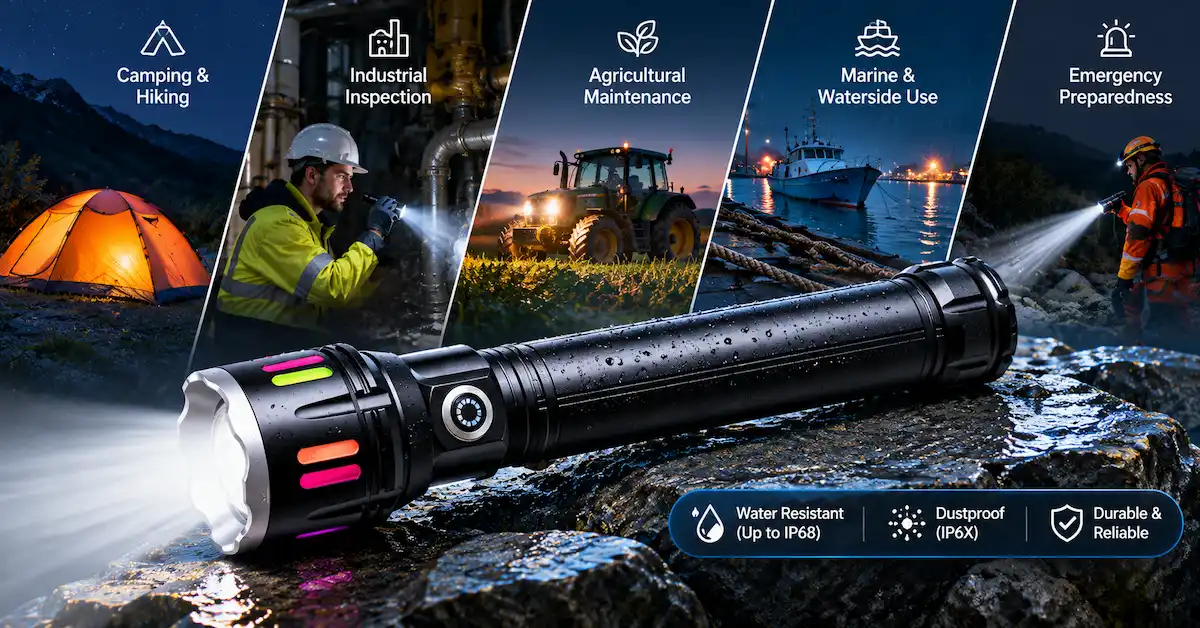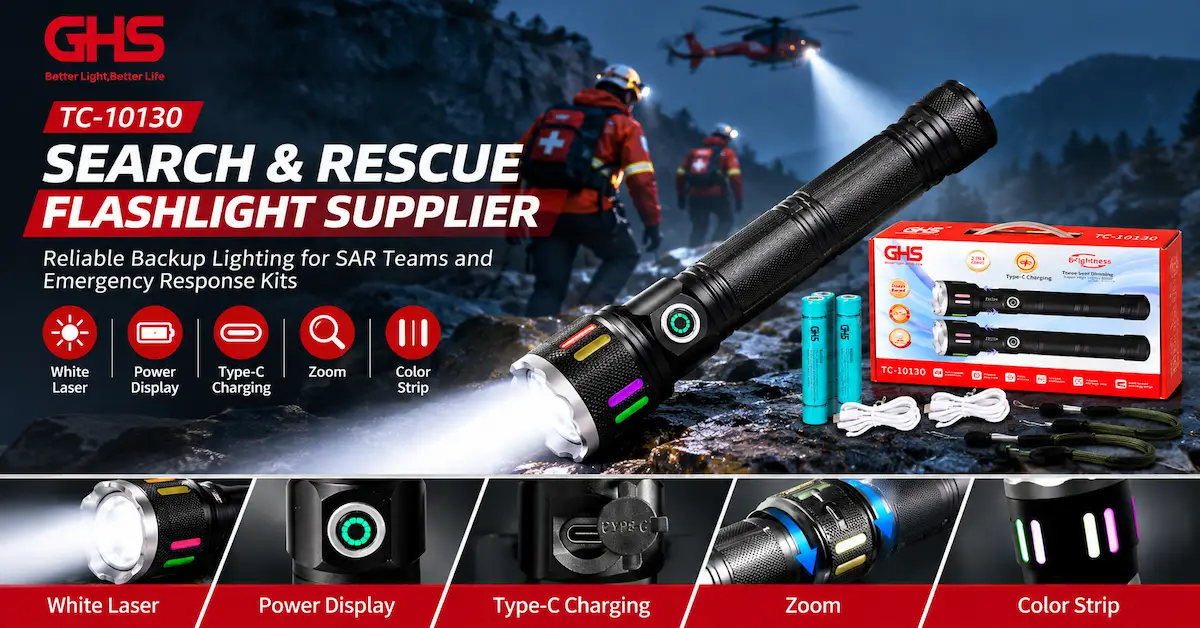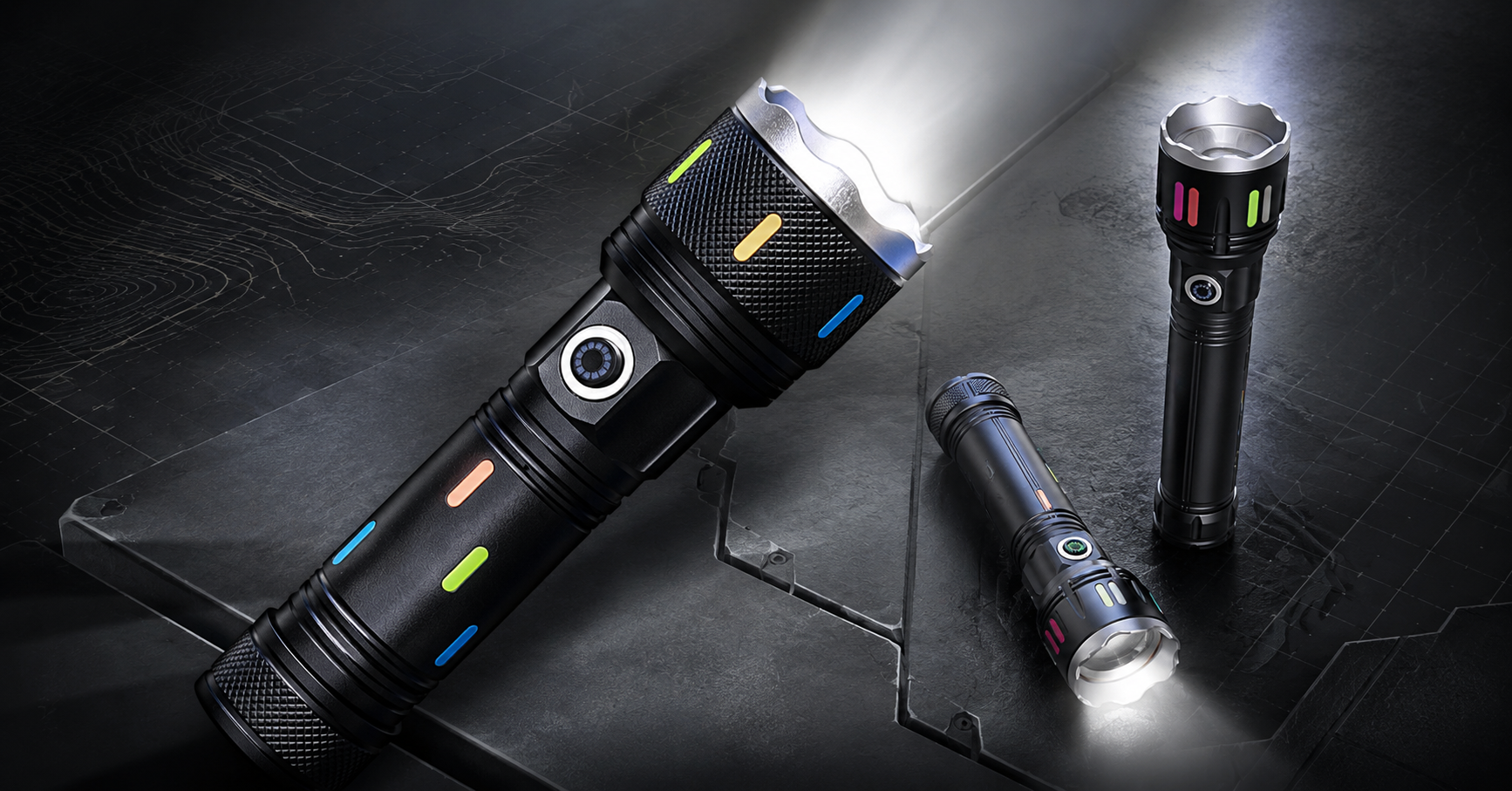

An OEM rechargeable flashlight supplier should do more than provide a rechargeable torch with a customized logo. For importers, distributors, and private-label brands, successful sourcing depends on selecting a suitable product platform, confirming measurable performance, approving the complete product configuration, and maintaining consistency across production orders.
A flashlight that looks attractive in a sample photograph may still create problems if its charging circuit, battery configuration, sustained brightness, packaging, or critical components differ from the approved specification.
The most practical approach is to manage an OEM flashlight project through four purchasing approval gates:
-
Product Fit: Define the application, target customer, and required specifications.
-
Sample Approval: Validate the battery, charging, optics, structure, and branding.
-
Production Readiness: Establish quality checks and applicable documentation before shipment.
-
Repeat-Order Control: Maintain specifications, cost transparency, and supplier accountability.
This framework helps purchasing teams reduce uncertainty before placing larger orders.
For businesses considering a China-based lighting partner, GHS rechargeable flashlight products provide several existing product platforms that can be evaluated for potential OEM cooperation.
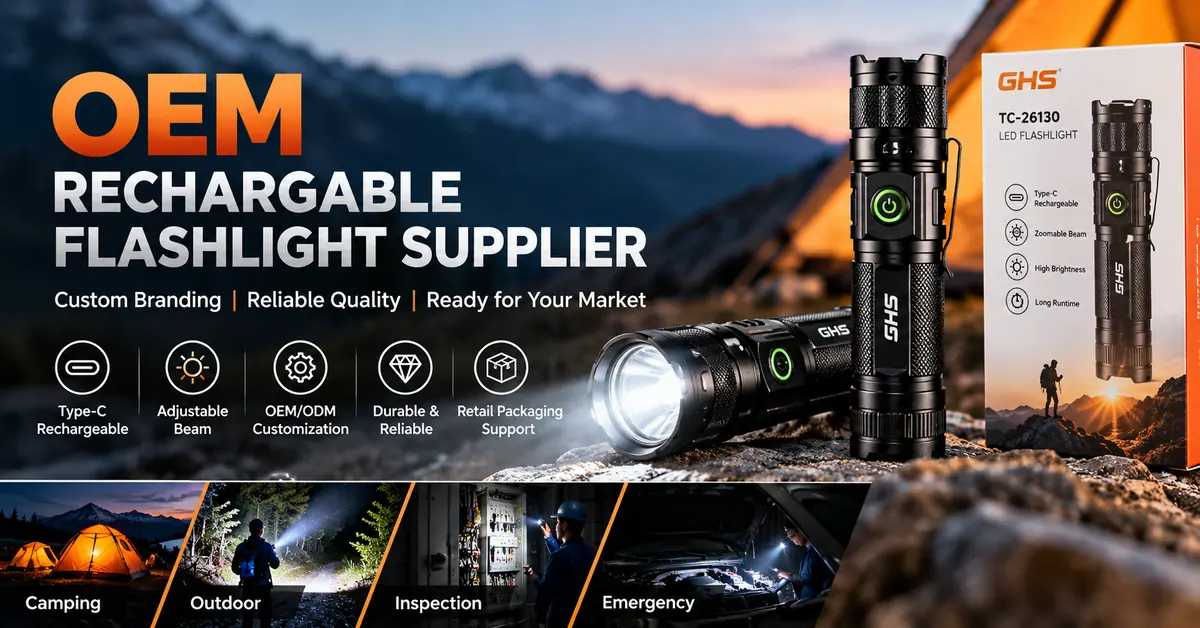
1. What Does an OEM Rechargeable Flashlight Supplier Provide?
An OEM rechargeable flashlight supplier manufactures or supplies rechargeable lighting products based on a buyer's agreed technical, branding, and packaging requirements.
Depending on the product platform and the supplier's actual capabilities, an OEM project may involve:
-
Brand logo printing or laser marking
-
Customized retail packaging and instructions
-
Product colors or surface finishes
-
Selected accessories and charging cables
-
Battery or lighting configuration evaluation
-
Product labeling and carton identification
-
Sample preparation and production coordination
-
Quality requirements for bulk orders
However, OEM customization is not necessarily the same as developing an entirely new flashlight.
OEM vs. Private Label vs. ODM
| Supply Model | Main Purpose | Typical Buyer Requirement |
|---|---|---|
| Private Label | Sell an existing product under a buyer's brand | Logo, packaging, labels, manuals |
| OEM | Produce an agreed product configuration | Branding, accessories, selected specifications |
| ODM | Develop or significantly modify a product | Engineering, electronics, structure, tooling |
For many distributors, an existing rechargeable flashlight platform with carefully selected branding and packaging can be more commercially practical than starting with a completely new design.
The appropriate approach depends on the target market, differentiation requirements, available development budget, and expected order volume.
2. Who Should Work With an OEM Rechargeable Flashlight Supplier?
OEM sourcing is particularly relevant to companies that intend to sell rechargeable flashlights through established distribution channels or under their own brands.
Suitable B2B Buyers
Importers and Wholesalers
These buyers typically prioritize stable specifications, consistent packaging, competitive landed costs, and repeat-order availability.
Private-Label Lighting Brands
Brand owners need recognizable product presentation, suitable charging systems, clear technical claims, and reliable product consistency.
Outdoor Equipment Distributors
Camping and outdoor retail channels may prioritize portability, adjustable beams, convenient charging, and practical runtime.
Hardware and Industrial Supply Companies
These buyers often focus on functional reliability, durable handling, straightforward operation, and suitability for routine inspection or maintenance.
Emergency Equipment Kit Suppliers
Emergency kit suppliers generally need products that are practical to store, easy to operate, and suitable for their intended kit configuration.
When a Standard OEM Flashlight May Not Be Suitable
A standard rechargeable flashlight should not automatically be selected for explosive atmospheres, underwater operation, or other specialized environments requiring documented equipment approval.
Such applications need verified product specifications, relevant testing, and any market-specific approvals before sourcing decisions are made.
3. Gate One: Match the Flashlight Platform to the Target Market
Before requesting OEM pricing, define what the flashlight must do for its intended users.
A supplier cannot provide a meaningful technical quotation when the purchasing brief contains only terms such as “super bright,” “large battery,” or “premium quality.”
Match Application Requirements to Product Features
| Target Application | Important Product Features | Main Procurement Consideration |
|---|---|---|
| Hardware retail | Practical brightness, rechargeable power, simple controls | Cost and retail packaging |
| Camping and outdoor | Portable design, adjustable beam, usable runtime | Battery performance and handling |
| Industrial inspection | Reliable switching, suitable beam pattern, comfortable grip | Functional consistency |
| Security patrol | Focused illumination, practical runtime, single-hand operation | Sustained output and durability |
| Automotive emergency kits | Convenient storage, charging, complete accessories | Package configuration and storage conditions |
| Promotional merchandise | Brand appearance, compact format, customized packaging | Customization cost and presentation |
The goal is to select a product architecture that already matches most of the market requirement.
This reduces the number of modifications needed before production.
Build a Technical Specification Before Requesting a Quote
The following table is a recommended purchasing specification template, not a statement of measured GHS model performance.
| Specification | What Buyers Should Define | Verification Method |
|---|---|---|
| Light Output | Target lumens at specified modes | Agreed photometric testing |
| Beam Performance | Required beam pattern, intensity, and distance | Beam measurements and field evaluation |
| Runtime | Minimum runtime at relevant output modes | Controlled runtime test |
| Battery System | Chemistry, configuration, capacity, protection | Battery specification and inspection |
| Charging | USB-C or other interface, input requirements, charging time | Charging and connector tests |
| Housing | Material, dimensions, weight, finish | Sample and dimensional inspection |
| Beam Adjustment | Fixed beam or adjustable zoom | Functional sample inspection |
| Water Resistance | Required protection level, if applicable | Suitable documented ingress testing |
| Branding | Logo method, color, placement | Approved physical sample |
| Packaging | Retail box, accessories, labels, manual | Packaging approval |
| Documentation | Applicable technical and transport documents | Document review |
Buyers should assign measurable acceptance limits wherever a requirement affects safety, functionality, or customer expectations.
Procurement principle: Select the application first, define the performance second, and finalize branding after the product platform has been evaluated.
4. Compare GHS Rechargeable Flashlight Platforms Before Customization
GHS (Guanghuishi) lists several rechargeable flashlight models that can serve as starting points for product evaluation.
Instead of choosing a model based entirely on its appearance, buyers should compare available features with the intended application.
GHS Product Platform Comparison
| Model | Documented or Displayed Features | Potential Buyer Application | Key Items to Verify |
|---|---|---|---|
| TC-10120 | Rechargeable handheld design, Type-C charging, adjustable beam, side switch | Outdoor retail, utility lighting, emergency kits | Runtime, battery configuration, exact operating modes |
| TC-26130 | Type-C charging, zoomable head, side controls, single/twin-pack presentations | Hardware distributors, utility lighting, packaged retail sets | Final model version, accessories, battery and packaging |
| S-P200W | Rechargeable high-intensity series, adjustable beam, larger handheld structure | Outdoor equipment, inspections, portable high-intensity lighting | Sustained output, optical performance, runtime, weight |
| S-P900 | Rechargeable handheld format, textured grip, side-button design | General utility, outdoor retail, emergency supplies | Exact variant, packaging claims, battery and durability |
These are model-selection starting points, not a declaration that every OEM modification is available for every model. Actual customization options and confirmed specifications must be checked with GHS.
How Should Buyers Select Between These Models?
For retail brands focused on convenience and product presentation, TC-10120 or TC-26130 may be useful starting points.
Buyers seeking a larger handheld flashlight with more emphasis on focused illumination can evaluate the S-P200W series.
For portable everyday utility positioning, the S-P900 offers another product format to examine.
A useful shortlist should normally include two or three relevant models rather than every model in a manufacturer's catalog.
This makes sample evaluation, pricing comparisons, and eventual inventory management easier.
Explore GHS flashlight models and available configurations
5. Gate Two: Validate the Technical Design and Approve a Reference Sample
Sample approval is one of the most important steps in an OEM rechargeable flashlight project.
A visually attractive sample does not automatically demonstrate acceptable electrical performance or repeatable manufacturing quality.
Evaluate the Complete Rechargeable Lighting System
A rechargeable flashlight typically combines several interacting components:
LED and Optical Components
The LED, reflector or lens, and beam-adjustment mechanism influence light distribution, beam intensity, and useful illumination.
Driver Electronics
The driver manages electrical power delivered to the LED. Driver design can influence brightness regulation, operating modes, and heat generation.
Battery and Protection System
Battery characteristics influence product size, energy capacity, runtime, discharge capability, and charging behavior.
Charging Circuit
The charging electronics determine how the battery receives and manages charging power.
A USB-C connector should not be interpreted as proof of a particular charging speed, USB Power Delivery capability, or battery protection function.
Housing and Thermal Design
Housing construction influences grip, weight, assembly quality, and the removal or management of heat produced during operation.
Long-duration performance therefore depends on more than the initial brightness specification.
Confirm Light Output and Runtime with Comparable Tests
A common purchasing mistake is comparing the maximum brightness printed on two different packages.
The relevant purchasing question is:
How much useful light does each flashlight deliver, and for how long, under defined conditions?
The ANSI/PLATO FL 1-2025 portable lighting standard provides methods for reporting performance attributes such as light output, runtime, beam distance, peak beam intensity, and durability. The revision also addresses short-duration elevated brightness modes.
Buyers can use this framework to request comparable test methods and distinguish brief peak output from sustained performance.
Referencing this standard does not establish that a particular GHS model has been tested or certified to it.
Approve More Than Appearance
A useful OEM sample-approval record should cover:
-
Correct model and final configuration
-
Agreed LED, battery, and charging components
-
Output modes and switching sequence
-
Charging operation and status indication
-
Beam pattern and zoom mechanism
-
Housing finish, dimensions, and assembly
-
Logo position and visual quality
-
Accessories, cables, and straps
-
Retail packaging, manual, and labels
-
Agreed performance and quality acceptance criteria
The approved physical sample should be supported by a written specification and a controlled list of critical components.
This creates a clear reference for subsequent production.
6. Gate Three: Establish Quality Control Before Mass Production
For OEM rechargeable flashlights, quality assurance should address electrical performance, mechanical assembly, appearance, and packaging.
A buyer should request evidence of the supplier's relevant inspection processes rather than assume that every listed inspection is performed on every unit.
Recommended OEM Flashlight Inspection Stages
| Inspection Stage | Recommended Checks | Risk Controlled |
|---|---|---|
| Incoming Components | Battery, LED, driver, charging components, housing, packaging | Incorrect or inconsistent materials |
| In-Process Assembly | Switch assembly, wiring, connector installation, housing fit | Assembly defects |
| Functional Inspection | Light modes, charging indication, switch operation, beam adjustment | Product malfunction |
| Performance Sampling | Output, runtime, charging, temperature where specified | Failure to meet performance claims |
| Final Inspection | Appearance, branding, accessories, manuals, labels, cartons | Shipping and retail defects |
For critical performance requirements, define the testing conditions and pass/fail criteria before placing the order.
Define Defect Severity Clearly
A useful quality agreement should distinguish between:
-
Critical defects: Conditions involving serious safety or regulatory concerns.
-
Major defects: Problems such as charging failure, incorrect product configurations, or essential components missing.
-
Minor defects: Cosmetic deviations within or outside agreed visual tolerances, depending on severity.
Sampling plans, defect classifications, and acceptance thresholds must be agreed for the actual order.
No single inspection percentage automatically guarantees product quality.
Verify Documentation for Rechargeable Batteries
Lithium-powered flashlight orders may require additional attention during international transportation.
Depending on the battery and shipping configuration, buyers should confirm applicable documentation and packaging requirements with the supplier and freight forwarder.
The International Air Transport Association's 2026 lithium battery guidance explains transportation classification and documentation considerations, including UN 38.3-related test-summary requirements.
The precise obligations depend on whether batteries are installed in equipment, packed with equipment, or shipped separately, as well as the transport route and applicable rules.
Importers should request documents relevant to their actual product configuration rather than accept a generic “all certificates available” statement.
7. Gate Four: Control Production, Lead Time, and Repeat-Order Consistency
Selecting an OEM rechargeable flashlight supplier is particularly important when the buyer plans to sell the same flashlight repeatedly.
An approved first order has limited commercial value if later batches arrive with different batteries, charging circuits, operating modes, or packaging.
Separate Lead Time into Real Production Stages
A practical schedule should distinguish:
-
Product and specification review
-
Sample preparation and revision
-
Branding and packaging approval
-
Component procurement
-
Production preparation and assembly
-
Inspection and corrective actions
-
Packaging, documentation, and shipping
This structure allows buyers to identify which stages drive the delivery schedule.
For example, customized packaging may have a different preparation requirement from the flashlight itself.
The supplier should confirm the schedule based on the actual model, order quantity, and requested modifications.
Control Critical Component Substitutions
Before approving repeat orders, identify the components that must remain consistent.
These may include the LED, driver, battery type, PCB, charging circuit, optics, switches, and other functional components.
If a critical component becomes unavailable, the buyer should require a documented review before accepting a substitute.
Changes can affect runtime, brightness, charging behavior, heat generation, or customer experience even when the exterior remains identical.
Create a Repeat-Order Reference Package
A practical purchasing record includes the approved product specification, reference sample, branding artwork, packaging files, critical component requirements, QC criteria, and any approved changes.
This allows the importer to compare future shipments against the original agreed configuration.
For established distributors, this level of control is often more valuable than repeatedly choosing the lowest initial quotation.
8. What OEM/ODM Customization Should Buyers Prioritize?
Not every customization adds equal value.
For many private-label rechargeable flashlight projects, the most efficient differentiation comes from branding, product presentation, and a carefully selected existing flashlight platform.
Branding and Packaging
Potential options to discuss include product logos, retail box designs, manuals, labels, barcodes, and carton markings.
Product Configuration
Depending on model feasibility, buyers may discuss accessories, charging configurations, selected lighting functions, and finish requirements.
Advanced Product Development
Changes to optics, electronics, battery arrangements, or housing structures may require additional engineering, samples, testing, or tooling.
These requests should be evaluated individually rather than assumed to be standard OEM services.
A buyer who only requires a custom logo and retail box should not automatically commit to an expensive structural redesign.
For further information about the company's background and technical positioning, explore GHS manufacturing and company information.
9. How Do MOQ, Packaging, and Quality Risk Affect Total Procurement Cost?
For bulk purchasing, the cheapest quoted unit price is not necessarily the lowest commercial cost.
An appropriate comparison should include more than the ex-factory product price.
Key Cost Drivers
| Cost Factor | Possible Financial Impact | Buyer Action |
|---|---|---|
| Battery configuration | Affects component cost and performance | Confirm exact battery requirements |
| LED and driver | Influences output and consistency | Request equivalent specifications |
| Housing and finish | Affects durability and appearance | Approve material and finish |
| OEM logo and packaging | May add setup, printing, and material costs | Confirm artwork and packaging MOQ |
| Accessories | Changes the package cost | Define included items |
| Testing and inspection | Adds verification costs but can reduce uncertainty | Specify required checks |
| Shipping configuration | Influences freight and documentation | Review battery logistics early |
| Defects and returns | Can reduce actual profit margin | Establish quality acceptance criteria |
A useful cost comparison is:
Landed Cost per Accepted Unit = (Product Cost + Packaging + Allocated Setup Costs + Inspection + Freight + Duties and Applicable Charges) ÷ Accepted Units
This formula makes it easier to compare suppliers and configurations with different commercial terms.
Why OEM MOQ Cannot Be Assumed
Minimum order quantity may depend on logo processes, product colors, packaging production, battery requirements, and component procurement quantities.
A standard model with branded packaging may have different quantity requirements from a product needing new tooling or electronic modification.
For accurate pricing, an OEM rechargeable flashlight supplier should receive the same complete specification used by the buyer to compare quotations.
Request a model-specific OEM quotation from GHS
10. Why Consider GHS for Rechargeable Flashlight OEM Sourcing?
GHS (Guanghuishi), operating under the company name Guangdong Guanghuishi Electrical Appliances Co., Ltd., presents itself as a China-based lighting manufacturer integrating product development, manufacturing, and sales.
According to its published company profile, the business was established in 2009, operates a manufacturing base in Zhaoqing, Guangdong, and has maintained a Dubai branch since 2017 to support its Middle Eastern business activities.
GHS displays multiple product platforms, including basic rechargeable flashlights, newer portable LED flashlights, and high-intensity handheld lighting models.
For importers and private-label brands, these product platforms can provide practical starting points for discussing product selection, branding, packaging, and potential OEM/ODM cooperation.
Buyers can review the GHS factory videos and product demonstration videos as part of their initial supplier research.
However, specific customized functions, performance specifications, certifications, MOQ, and delivery conditions should be confirmed for each project.
Prepare an Effective OEM Inquiry
To receive a more relevant technical and commercial response, provide:
-
Target country or region
-
Intended application and sales channel
-
Preferred flashlight model or product reference
-
Estimated first-order and repeat-order quantities
-
Required battery, charging, and lighting functions
-
Logo, color, and packaging requirements
-
Applicable testing or documentation requirements
-
Expected launch schedule and delivery destination
A detailed inquiry enables the supplier to assess product compatibility and customization feasibility before discussing final pricing.
Contact GHS to discuss your OEM rechargeable flashlight project
11. Frequently Asked Questions About OEM Rechargeable Flashlight Suppliers
1. What is an OEM rechargeable flashlight supplier?
An OEM rechargeable flashlight supplier provides rechargeable lighting products manufactured or configured according to a buyer's agreed specifications. Services may include branding, packaging, selected product modifications, production coordination, and quality requirements.
2. Can I sell rechargeable flashlights under my own brand?
Yes, private-label cooperation can allow buyers to sell suitable flashlight models with their branding and packaging. The available logo methods, packaging formats, and minimum quantities should be confirmed for the selected product.
3. What is the MOQ for OEM rechargeable flashlights?
There is no universal MOQ. It depends on the model, order configuration, logo process, packaging requirements, components, and any engineering changes. Request a quotation based on your actual specifications and quantity.
4. Can USB-C rechargeable flashlights be customized?
Some models may support customized branding or accessory configurations. Changes to charging electronics, connectors, or battery systems require technical feasibility assessment and may involve additional testing.
5. How should importers verify flashlight runtime?
Buyers should request runtime data measured under defined operating modes and conditions. Battery capacity alone does not establish usable runtime because output, electronics, and temperature also influence performance.
6. What is the difference between OEM and ODM flashlight manufacturing?
OEM generally involves manufacturing or adapting a product according to agreed requirements. ODM usually involves more substantial product-design or engineering participation. The actual scope should be documented in the project agreement.
7. Which documents may be needed when importing rechargeable flashlights?
Document needs depend on the destination market, battery configuration, and transport method. Buyers should verify applicable product requirements and lithium-battery transportation documentation before shipment.
8. Why should buyers approve a physical sample before bulk production?
A sample helps confirm appearance, charging, operating modes, assembly, accessories, and packaging. It should be supported by written specifications and relevant test results, especially for internal components that cannot be verified visually.
9. How can distributors maintain consistent quality across repeat orders?
Maintain a controlled specification, approved reference sample, critical component list, packaging artwork, and inspection criteria. Require review of material changes before subsequent production.
10. How can I request an OEM rechargeable flashlight quotation from GHS?
Visit the GHS contact page and provide the target application, preferred model, expected quantity, destination market, branding needs, and technical requirements. GHS can then review the project and discuss available product and customization options.
Conclusion
Working with an OEM rechargeable flashlight supplier is not simply a matter of choosing a flashlight and adding a brand logo. A successful private-label sourcing program requires alignment between product applications, measurable technical performance, approved samples, quality expectations, and repeat-order controls.
For importers, distributors, and brand owners, the four-gate approach provides a practical purchasing framework: define the product, approve the complete configuration, establish production and documentation requirements, and control consistency across future orders.
GHS offers several rechargeable LED flashlight platforms that buyers can explore when developing wholesale and private-label product ranges. By starting with an appropriate existing model and clearly documenting the required configuration, buyers can make more informed sourcing decisions and reduce avoidable purchasing uncertainty.
Looking for an OEM rechargeable flashlight supplier for your next product line? Explore the GHS flashlight range or contact GHS to request product information, discuss customization, and obtain a project-specific quotation.