
A reliable flashlight manufacturer for outdoor brands should help buyers create more than a collection of attractive handheld lights. Outdoor equipment brands need flashlight products that match specific customer activities, deliver measurable performance, and maintain consistent quality across retail orders.
A flashlight suitable for an occasional campsite task may not be the best choice for night hiking or long-distance spotting. Similarly, a product with impressive advertised brightness may disappoint customers if its beam is unsuitable, battery runtime is limited, or charging performance is inconsistent.
For camping brands, outdoor distributors, and private-label equipment companies, a practical sourcing strategy is to develop three complementary product tiers:
-
Compact Trail Flashlights: Portable, convenient lighting for hiking and personal use.
-
Everyday Camping Flashlights: Versatile rechargeable lights for campsite tasks and general outdoor activities.
-
High-Intensity Outdoor Flashlights: Larger handheld models for applications requiring more concentrated illumination.
This article explains how to evaluate these categories, identify the right technical specifications, compare existing product platforms, and work with an OEM/ODM manufacturing partner.
Companies researching rechargeable outdoor lighting products can begin by reviewing the GHS LED flashlight product range.
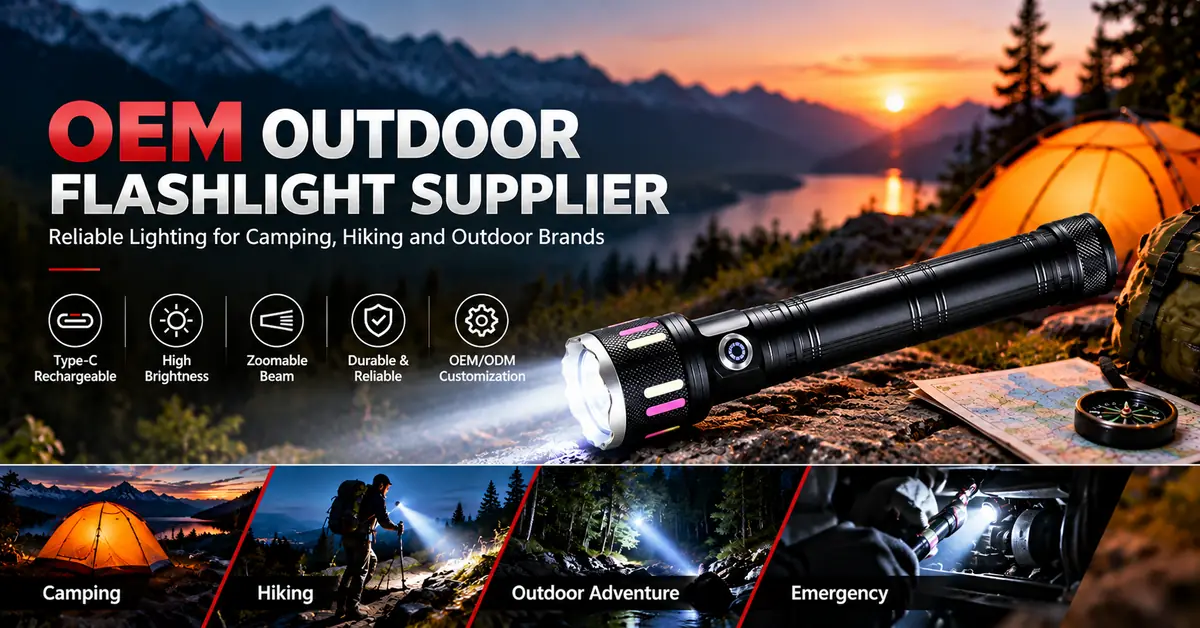
1. Why Do Outdoor Brands Need a Specialized Flashlight Manufacturer?
Outdoor lighting products face different purchasing expectations from ordinary household flashlights.
Customers may use them on unfamiliar terrain, during rainy weather, around campsites, or while carrying other outdoor equipment. Their satisfaction depends on how well the flashlight performs during the intended activity.
For outdoor brands, this creates three important sourcing requirements.
Application-Based Product Selection
A product should be selected according to actual user needs rather than the highest advertised lumen value.
Hikers may prioritize carrying weight and convenient operation. Campers may prefer adjustable beams and practical battery runtime. Users performing distance spotting may require a more concentrated beam.
Reliable Product Specifications
An outdoor flashlight supplier should be able to discuss relevant product characteristics, including light output, beam distance, runtime, charging configuration, housing construction, and environmental protection.
These specifications should be supported by appropriate documentation or testing when they are used in commercial product claims.
Consistent Brand Experience
When customers purchase a flashlight under an outdoor brand's name, they associate the product's performance and reliability with that brand.
Inconsistent accessories, unexpected charging behavior, defective switches, or inaccurate product descriptions can lead to complaints and returns.
Therefore, choosing a flashlight manufacturer for outdoor brands involves both technical product evaluation and long-term supply management.
2. Which Outdoor Businesses Benefit Most From OEM Flashlight Manufacturing?
Different outdoor buyers require different levels of product customization and manufacturing support.
| Outdoor Buyer Type | Main Purchasing Goal | Recommended Product Direction |
|---|---|---|
| Camping Equipment Brands | Expand camping accessory collections | Rechargeable flashlights with practical beam adjustment |
| Hiking Gear Brands | Offer portable trail lighting | Compact, easy-to-carry handheld flashlights |
| Outdoor Retail Distributors | Build competitive multi-model ranges | Entry-level, mid-range, and higher-intensity products |
| Private-Label Outdoor Brands | Launch branded lighting products | Existing flashlight platforms with custom branding |
| Adventure Equipment Wholesalers | Supply multiple retailers | Consistent bulk products and packaging |
| Emergency Preparedness Suppliers | Add portable lighting to outdoor kits | Rechargeable utility flashlights |
| Outdoor Promotional Brands | Develop customized accessory products | Suitable models with logo and packaging options |
When Standard Outdoor Flashlights Are Not Appropriate
A conventional camping flashlight should not automatically be marketed for diving, explosive atmospheres, or safety-critical rescue operations.
Those applications may require specialized product design, documented performance, and applicable approvals.
For most general outdoor retail programs, the better approach is to identify everyday activities first and select suitable product platforms accordingly.
3. Build a Three-Tier Outdoor Flashlight Product Range
A three-tier assortment helps outdoor brands serve different customer needs without offering numerous products with nearly identical functions.
It also creates clearer product positioning for distributors and retailers.
Tier 1: Compact Trail Flashlights
This category targets hikers, casual outdoor users, and customers seeking a portable emergency light.
Important purchasing considerations include:
-
Comfortable handheld size
-
Convenient operation
-
Rechargeable power
-
Practical beam coverage
-
Suitable carrying accessories
-
Manageable product weight
The objective is everyday usability rather than maximum brightness.
Tier 2: Versatile Camping Flashlights
Camping flashlights should support multiple activities, including checking tent equipment, walking between campsite areas, preparing food, and inspecting outdoor gear.
Useful features may include adjustable beam focus, multiple lighting modes, convenient charging, and reliable switching.
A rechargeable flashlight with a zoomable beam may offer flexibility between closer-range tasks and more concentrated illumination.
Tier 3: High-Intensity Outdoor Flashlights
Some outdoor customers need a stronger or more concentrated beam for checking distant objects, large outdoor areas, or other nighttime activities.
For this category, brands should evaluate:
-
Peak beam intensity
-
Beam distance
-
Sustained light output
-
Battery runtime
-
Heat management
-
Size and handling comfort
A larger flashlight is not automatically brighter or more durable. Performance should be established through comparable specifications and testing.
Recommended Outdoor Product Portfolio
| Product Tier | Primary Application | Product Priority | Retail Positioning |
|---|---|---|---|
| Compact Trail | Hiking, walking, portable kits | Portability and ease of use | Everyday outdoor accessory |
| Versatile Camping | Campsite tasks and general outdoor use | Adjustable beam and usable runtime | Core camping equipment |
| High-Intensity Outdoor | Distance spotting and larger-area illumination | Beam performance and thermal stability | Higher-performance lighting option |
The three tiers should be differentiated by real customer benefits rather than packaging design alone.
4. Which GHS Flashlight Models Can Outdoor Brands Evaluate?
GHS (Guanghuishi) offers several rechargeable handheld flashlight platforms that can be considered during initial outdoor product selection.
The models below represent product evaluation options, not confirmed performance rankings.
GHS Outdoor Flashlight Model Comparison
| GHS Model | Displayed Product Features | Potential Outdoor Positioning | Specifications to Confirm |
|---|---|---|---|
| TC-10120 | Rechargeable handheld design, Type-C charging, adjustable beam | Compact trail and outdoor utility | Exact battery, weight, runtime, output |
| S-P900 | Rechargeable design, textured grip, zoom-related features | Camping and general outdoor lighting | Beam performance, charging, durability |
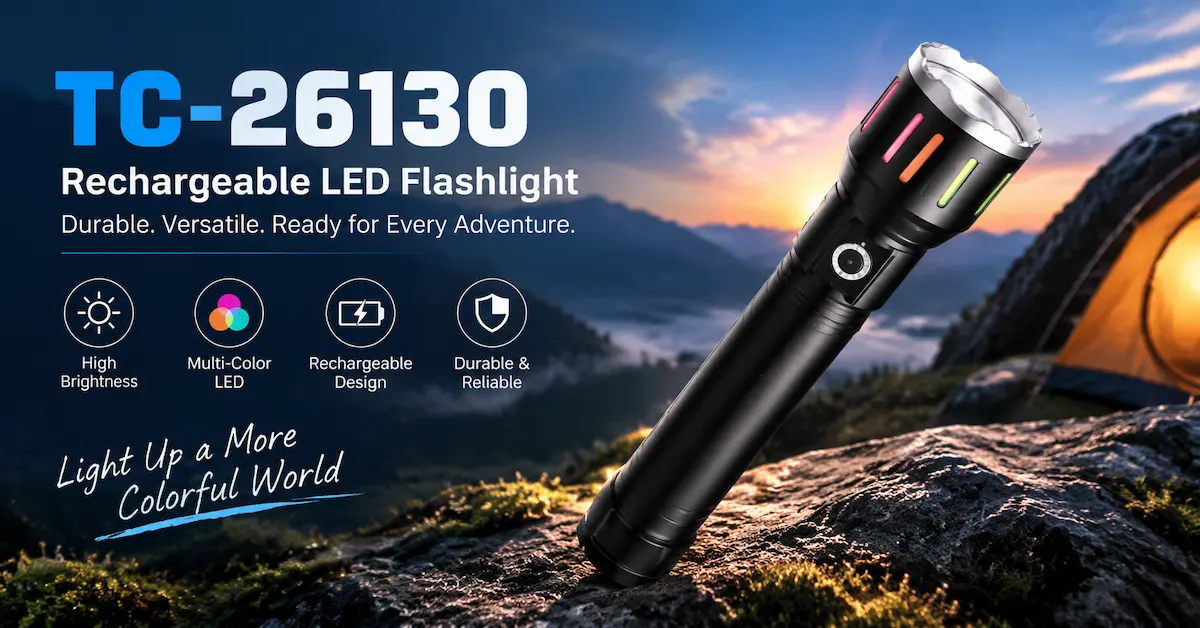
| TC-26130 | Type-C charging, adjustable head, side control, package variations | Camping kits and outdoor retail bundles | Battery version, accessories, actual lighting modes |
| S-P200W | Larger rechargeable handheld format, adjustable beam | Higher-intensity outdoor lighting | Measured lumens, beam distance, runtime, heat management |
Model availability, technical specifications, OEM options, and product configuration must be confirmed with GHS before commercial commitments.
How Should Outdoor Brands Shortlist These Models?
For portable outdoor accessories, TC-10120 offers a product format worth reviewing.
For general camping equipment, S-P900 and TC-26130 provide alternative handheld designs that can be compared for grip, charging convenience, packaging, and beam control.
For a higher-intensity product category, the S-P200W series offers a larger flashlight format for evaluation.
A useful product-development strategy is to request samples from two or three relevant platforms and compare them using the same test procedure.
Explore GHS rechargeable flashlight models
5. What Technical Specifications Matter Most for Outdoor Flashlights?
Outdoor product brands should evaluate the complete lighting system instead of focusing on one headline specification.
Outdoor Flashlight Technical Evaluation Table
| Specification | Technical Meaning | Why It Matters Outdoors |
|---|---|---|
| Light Output (lm) | Total visible light emitted | Determines overall illumination capability |
| Beam Intensity (cd) | Concentration of light in a given direction | Important for focused lighting |
| Beam Distance (m) | Distance corresponding to a defined beam-intensity threshold | Useful for distance-oriented applications |
| Runtime (h) | Duration under specified operating conditions | Influences practical use between charges |
| Battery Capacity (mAh/Wh) | Electrical charge or stored energy | Helps evaluate the power system |
| Charging Interface | USB-C or another charging connection | Influences user convenience |
| Charging Time | Time required under specified conditions | Affects equipment readiness |
| Housing Material | Metal, polymer, or other construction | Influences weight, strength, and thermal behavior |
| Ingress Protection | Tested resistance to dust and water entry | Relevant to rain, dust, and outdoor conditions |
| Impact Resistance | Performance under specified impact testing | Relevant to handling and accidental drops |
| Product Weight | Complete flashlight weight | Influences carrying comfort |
Lumens vs. Beam Distance
Lumens measure total light output, while candela describes luminous intensity in a particular direction.
A broad beam may be useful for inspecting nearby camping equipment.
A more concentrated beam may be preferable for checking objects farther away.
Therefore, outdoor brands should consider beam distribution together with light output.
Runtime vs. Maximum Brightness
Maximum brightness may only be available for a limited period.
As a flashlight operates, heat and battery conditions can affect output.
For outdoor customers, sustained performance at commonly used brightness settings may be more valuable than a very high short-duration output claim.
The ANSI/PLATO FL 1-2025 portable lighting standard provides a framework for standardized performance testing and reporting, including light output, runtime, beam distance, and other characteristics.
Brands should request comparable data whenever a product is marketed using measurable lighting claims.
6. How Do Materials and Components Affect Outdoor Reliability?
The internal construction of a rechargeable flashlight influences both user experience and manufacturing cost.
LED and Optical System
LED selection and optical components determine how light is produced and distributed.
A lens or reflector must work with the light source to achieve the intended beam pattern.
Driver and Control Electronics
The LED driver regulates electrical operation, while switches and control circuits determine how users select lighting modes.
For outdoor applications, reliable switching is particularly important when users operate the flashlight repeatedly.
Rechargeable Battery System
Battery chemistry, configuration, protection features, and charging electronics influence runtime and operational reliability.
USB-C charging can be convenient, but connector type alone does not establish charging speed, compatibility with every power adapter, or electrical safety.
Flashlight Housing and Thermal Management
Housing material affects handling, weight, appearance, and heat transfer.
Metal housings can provide a useful thermal path when properly designed. Engineering polymers may offer advantages in weight, insulation, or manufacturing cost.
Neither construction should automatically be described as superior without considering the intended application.
Sealing and Assembly Quality
For products intended for wet or dusty outdoor environments, sealing structures and assembly consistency are important.
IEC 60529 provides a recognized classification framework for enclosure protection.
Any advertised IP rating should be supported by suitable testing for the specific product configuration.
7. How Should an Outdoor Brand Test Flashlight Samples?
One of the most effective ways to reduce future retail complaints is to evaluate samples under conditions that resemble actual outdoor use.
A purchasing team can conduct practical field trials alongside technical tests.
Recommended Outdoor Sample Testing Checklist
| Test Scenario | What to Evaluate | Buyer Decision |
|---|---|---|
| Walking on a dark trail | Beam width, useful visibility, carrying comfort | Suitable for hiking positioning? |
| Operating around a tent | Close-range illumination and glare | Suitable for campsite tasks? |
| Continuous operation | Output stability, temperature, runtime | Suitable for expected usage periods? |
| Repeated charging | Connector fit, charging behavior, indicators | Convenient and consistent? |
| One-handed operation | Switch placement and grip | Easy to use outdoors? |
| Carrying with equipment | Dimensions, weight, accessories | Appropriate for the intended customer? |
| Environmental testing | Documented resistance to relevant conditions | Suitable for advertised environment? |
| Retail packaging inspection | Product protection, completeness, instructions | Ready for the target retail channel? |
Define the acceptance criteria before testing rather than relying only on subjective impressions.
For example, a flashlight intended for regular camping tasks should be evaluated at the brightness level customers are likely to use most frequently.
Tests should also be repeated across more than one sample when practical.
The best outdoor flashlight is not necessarily the brightest model. It is the product that meets the expected application requirements consistently.
8. What Manufacturing and Quality Control Should Outdoor Brands Check?
A professional flashlight manufacturer for outdoor brands should be evaluated according to its ability to reproduce agreed specifications.
Important manufacturing stages may include housing production or sourcing, surface finishing, optical component assembly, electronics integration, final assembly, and testing.
The exact in-house processes should be confirmed with the supplier.
Recommended Quality Control Areas
Incoming Material Inspection
Check important components such as batteries, LED assemblies, drivers, housings, switches, and charging connectors against approved requirements.
Assembly Process Control
Review critical assembly operations that influence electrical function, mechanical fit, and sealing consistency.
Functional Testing
Confirm switching, charging, output modes, and other functions relevant to the product configuration.
Performance Verification
Use documented sampling and test methods for key performance claims, including runtime, output, and environmental protection where required.
Final Product Inspection
Check appearance, branding, accessories, labeling, retail packaging, and carton contents.
For outdoor brands selling under their own trademarks, the approved sample should be supported by written specifications and critical component requirements.
This helps reduce unexpected differences between initial and repeat orders.
9. Can Outdoor Flashlights Be Customized for Private-Label Brands?
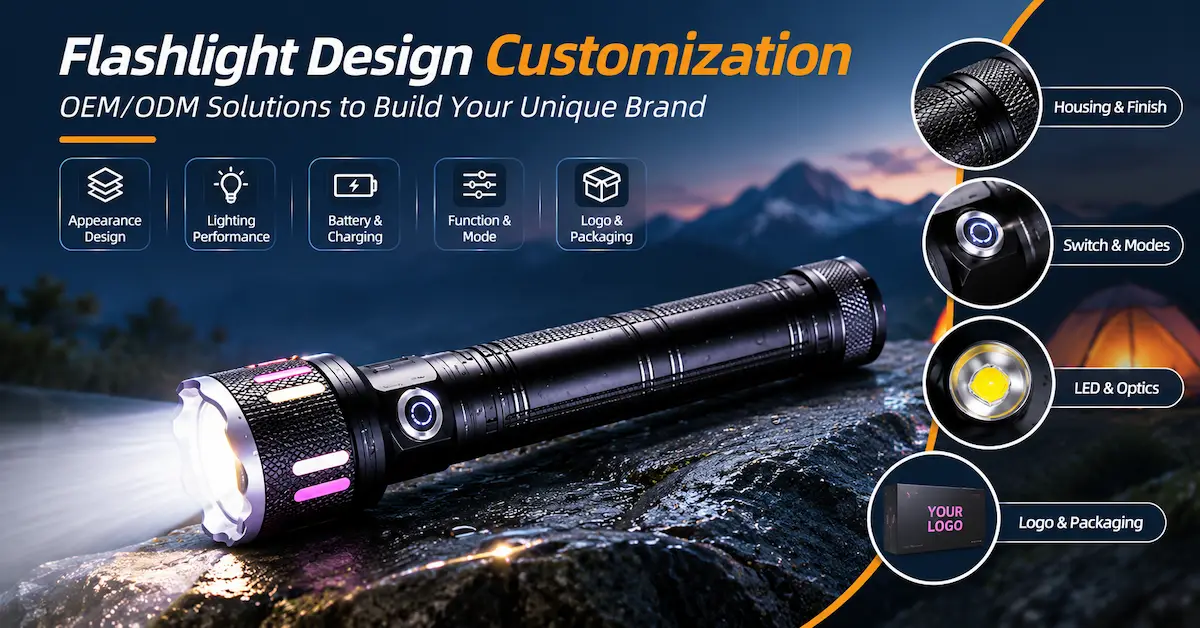
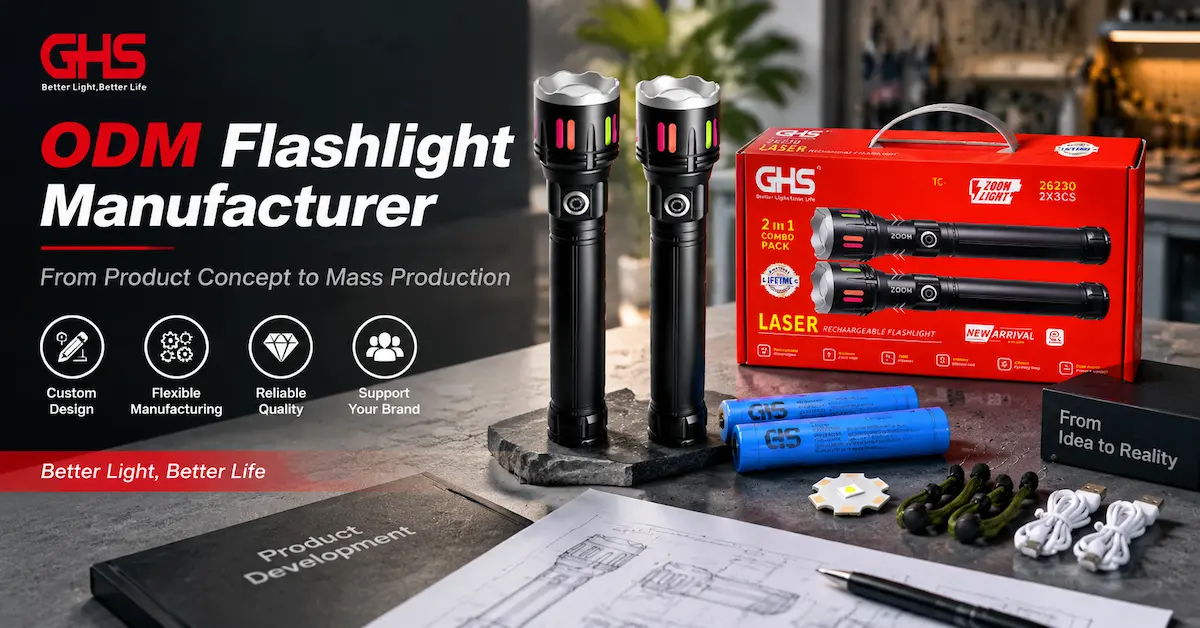
OEM/ODM cooperation can help outdoor equipment companies build a more consistent product identity.
However, different customization requests have different technical and commercial implications.
Branding Customization
Potential options include:
-
Brand logo application
-
Customized retail packaging
-
Product labels and instructions
-
Packaging artwork and barcode placement
-
Brand-specific accessory presentation
Product Configuration
Depending on model feasibility, buyers may discuss exterior finishes, accessory kits, lighting configurations, and other product requirements.
Changes to electronics, battery arrangements, optics, or structural components may require additional development and testing.
Building a Consistent Outdoor Collection
An effective outdoor product range can use consistent branding across several flashlight categories.
For example, a hiking model, camping model, and high-intensity model can share recognizable packaging design while maintaining different technical functions.
This supports clearer product differentiation and more consistent brand presentation.
GHS describes its business as integrating lighting research and development, manufacturing, and sales, with OEM/ODM cooperation available for discussion.
Outdoor brands can learn more about its business background through the GHS About Us page.
10. How Can Brands Manage MOQ, Lead Times, and Bulk Sourcing Costs?
The commercial success of an outdoor flashlight collection depends on purchasing cost, inventory management, quality consistency, and customer returns.
A lower unit price does not always deliver a lower total procurement cost.
Important Cost Factors
| Cost Factor | Business Impact | Recommended Action |
|---|---|---|
| LED and Optical Components | Affects performance and component cost | Confirm required specifications |
| Rechargeable Battery | Influences cost, performance, and shipping | Verify configuration and documentation |
| Housing and Finish | Affects appearance, weight, and durability | Approve sample construction |
| OEM Branding | May involve printing or setup costs | Request customization pricing |
| Retail Packaging | Influences presentation and shipping costs | Confirm packaging specifications |
| Inspection and Testing | Helps control performance and quality risks | Agree on test scope |
| International Freight | Influences landed cost | Review logistics early |
| Defects and Returns | Can reduce product profitability | Establish acceptance criteria |
MOQ and Lead Time Considerations
Minimum order quantities depend on product models, customization requirements, packaging, and component availability.
Similarly, production schedules may include sample approval, artwork confirmation, component procurement, manufacturing, inspection, and shipment preparation.
Rather than assuming a fixed MOQ or delivery time, buyers should request project-specific confirmation.
Rechargeable Battery Shipping Considerations
Lithium-powered flashlights may be subject to transport requirements depending on battery configuration and shipping method.
Buyers should verify applicable battery test documentation and logistics requirements, including relevant UN 38.3 information and current carrier rules.
This review should take place before finalizing international shipment plans.
11. Why Consider GHS for Outdoor Flashlight Sourcing?
GHS (Guanghuishi), operating under Guangdong Guanghuishi Electrical Appliances Co., Ltd., presents itself as a China-based manufacturer engaged in lighting product development, production, and sales.
According to its published company profile, GHS was established in 2009 and operates a production facility in Zhaoqing, Guangdong, China. The company also reports establishing a Dubai branch in 2017.
Its product portfolio includes rechargeable LED flashlights, handheld zoomable flashlights, and high-intensity lighting models.
For outdoor brands, these product platforms can serve as references when evaluating camping accessories, portable trail lighting, and higher-intensity handheld lighting products.
What Can Outdoor Brands Discuss With GHS?
Buyers can inquire about:
-
Suitable models for camping and outdoor retail
-
Product specifications and sample availability
-
Branding and private-label requirements
-
Packaging and accessory configurations
-
Available quality and testing documentation
-
Order quantities and production scheduling
-
Product combinations for a multi-tier outdoor range
The GHS factory video page and product video collection provide additional starting points for understanding its manufacturing presentation and product range.
Specific technical claims, customization options, certifications, and delivery terms should always be verified for the selected product.
12. Outdoor Brand RFQ: What Should You Send Before Requesting a Quotation?
A complete RFQ helps a flashlight supplier recommend appropriate products and provide more relevant commercial information.
Before contacting a manufacturer, prepare the following:
| RFQ Item | Information to Provide |
|---|---|
| Brand Type | Camping, hiking, outdoor retail, equipment distribution |
| Target Market | Country or region where products will be sold |
| Product Categories | Compact trail, general camping, high-intensity |
| Preferred Models | Selected model references or product images |
| Lighting Requirements | Output, beam type, runtime expectations |
| Battery Requirements | Charging interface and battery preferences |
| Environmental Requirements | Required protection and durability characteristics |
| Branding | Logo, colors, packaging, manuals |
| Quantity | Estimated first order and future purchasing volume |
| Delivery | Destination and desired commercial schedule |
| Documentation | Applicable testing, transport, and market requirements |
A detailed RFQ also makes quotation comparisons more meaningful.
Contact GHS to discuss outdoor flashlight models, OEM options, and a project-specific quotation.
13. Frequently Asked Questions About Outdoor Flashlight Manufacturing
1. What should outdoor brands look for in a flashlight manufacturer?
Outdoor brands should prioritize application suitability, measurable lighting performance, dependable charging, appropriate durability, consistent manufacturing quality, and clearly defined customization options. Product samples and supporting documentation are important before bulk purchasing.
2. Can an outdoor brand develop private-label camping flashlights?
Yes. Private-label projects may involve existing flashlight platforms with customized logos, packaging, labels, and selected accessories. Available customization options depend on the model and supplier's technical capabilities.
3. Are rechargeable flashlights suitable for camping?
Rechargeable flashlights can be suitable for camping when their runtime, beam pattern, charging method, and environmental performance match expected use. Buyers should evaluate practical operating modes rather than relying only on maximum brightness claims.
4. What is the difference between lumens and beam distance?
Lumens describe total emitted light, while beam distance relates to how far the beam meets a defined illumination threshold. A high-lumen flashlight does not automatically provide the longest beam distance.
5. Which flashlight housing material is best for outdoor use?
Material selection depends on weight, durability, thermal design, cost, and environmental requirements. Aluminum alloys and suitable engineering polymers can both be used in outdoor lighting products when designed appropriately.
6. Do camping flashlights need an IP rating?
Outdoor brands should define the level of dust or water protection required for their intended application. If an IP rating is advertised, it should be supported by appropriate testing of the relevant product configuration.
7. How can outdoor brands verify rechargeable flashlight runtime?
Request runtime measurements under defined operating conditions, including the lighting mode and test procedure. Battery capacity alone is insufficient because electrical efficiency, output settings, and temperature affect runtime.
8. What is the MOQ for custom outdoor flashlights?
MOQ varies by model, branding method, packaging, product configuration, and component requirements. Buyers should request quantity terms for the specific project instead of relying on generic minimum-order claims.
9. How can distributors reduce flashlight returns?
Distributors can reduce avoidable problems by approving samples, verifying product claims, controlling critical components, checking packaging contents, and using clearly documented inspection requirements before shipment.
10. How can I request outdoor flashlight samples or an OEM quotation from GHS?
Visit the GHS contact page and share your intended application, target market, preferred flashlight models, estimated quantity, branding requirements, and relevant technical specifications. GHS can then review the inquiry and discuss available options.
Conclusion
Finding a reliable flashlight manufacturer for outdoor brands requires a clear understanding of how customers use portable lighting equipment and what they expect from each product category.
For camping, hiking, and outdoor equipment companies, a three-tier product strategy provides a practical foundation: compact trail lighting, versatile rechargeable camping flashlights, and higher-intensity outdoor models.
The most important purchasing decisions involve matching products to real applications, verifying technical performance, evaluating durability and charging systems, and establishing quality requirements that support consistent production.
GHS offers several rechargeable flashlight platforms that outdoor brands and distributors can evaluate for wholesale sourcing and potential OEM/ODM projects, including TC-10120, S-P900, TC-26130, and S-P200W.
By selecting suitable product platforms and clearly defining branding, performance, packaging, and production requirements, buyers can create a more coherent outdoor lighting range while reducing avoidable sourcing risks.
Planning to expand your camping or outdoor equipment brand with rechargeable LED flashlights? Explore the GHS flashlight product collection and contact GHS to discuss product selection, sample evaluation, OEM customization, and bulk purchasing requirements.