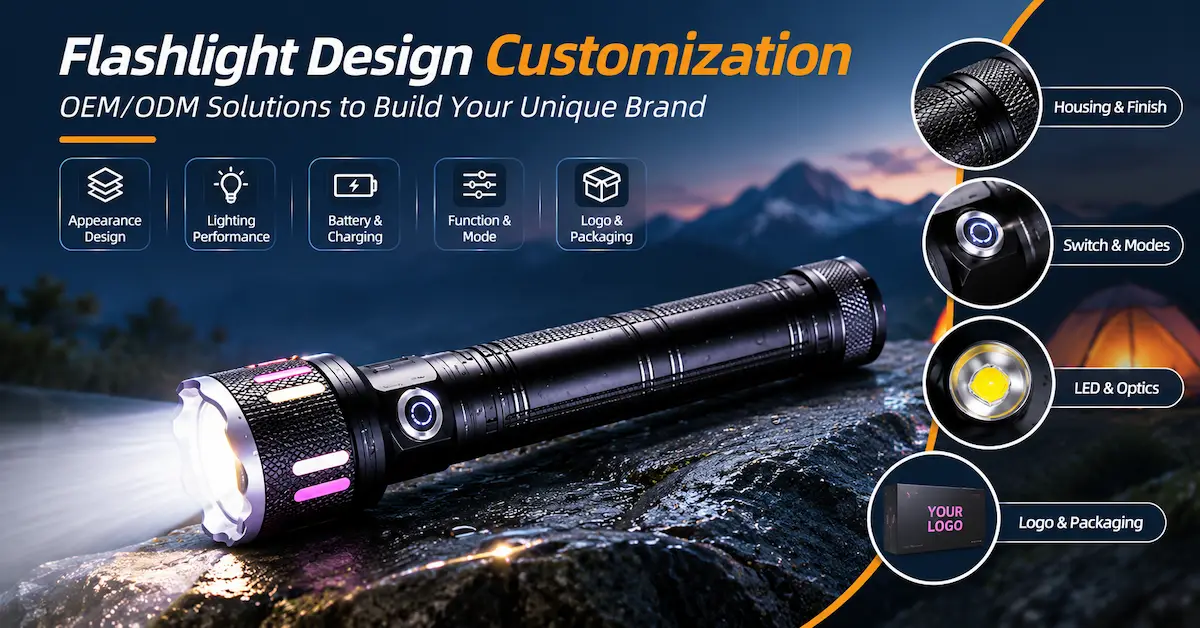
Can flashlight manufacturers customize designs? Yes. Depending on their engineering capabilities and the selected product platform, manufacturers may support changes ranging from logos and packaging to optical components, battery systems, electronic controls, and entirely new housings.
However, not every modification requires a new mold, and not every manufacturer can undertake every type of engineering change.
For overseas importers, distributors, and lighting brands, the challenge is determining which changes are technically feasible, commercially worthwhile, and compatible with an existing flashlight design.
TL;DR: Flashlight design customization can be divided into three levels: cosmetic branding, modifications to an existing product platform, and full custom development. Logo and packaging changes may use existing tooling, while changes to optics, electronics, batteries, or housings can require prototypes, testing, and new components. Buyers should request a technical feasibility review before approving costs or production.
This article provides a practical decision framework for selecting an appropriate customization approach, controlling development risks, and preparing a clear OEM/ODM purchasing inquiry.
Brands considering China-based manufacturing can explore the GHS rechargeable flashlight product range as a starting point for evaluating existing designs.
Key Takeaways
-
Manufacturers can customize flashlight designs, but the available scope depends on the model and engineering resources.
-
Cosmetic changes generally involve less engineering risk than modifications to optical, electrical, or structural systems.
-
Existing product platforms can reduce development complexity when they already meet the target application.
-
New tooling is not always necessary, but it may be required for unique housings or mechanical interfaces.
-
Technical changes can invalidate earlier performance assumptions, making additional testing essential.
-
OEM buyers should compare development cost, minimum order quantity, and expected sales volume before selecting a customization level.
1. What Are the Three Levels of Flashlight Design Customization?
The most effective way to evaluate custom flashlight development is to classify modifications by their engineering impact.
Three-Level Customization Feasibility Matrix
| Customization Level | Typical Changes | Engineering Complexity | Potential Tooling Requirements |
|---|---|---|---|
| Level 1: Cosmetic and Branding | Logo, retail packaging, manuals, approved accessories | Generally lower | Often uses existing tooling |
| Level 2: Platform Configuration | Selected finishes, optical components, lighting modes, compatible electrical configurations | Moderate to high | Depends on existing component compatibility |
| Level 3: New Product Development | Original housing, new PCB, redesigned charging system, unique mechanical structure | High | New tooling or fixtures may be required |
These levels are recommended purchasing categories rather than fixed industry certifications.
Level 1: Customize an Existing Flashlight
This approach is suitable for brands that already like an existing product's size, function, and operating characteristics.
Possible changes include logo placement, packaging, instructions, and approved accessory combinations.
The principal advantage is that the buyer may avoid unnecessary redesign of the flashlight's core systems.
Level 2: Modify a Proven Platform
This approach may involve changing selected optical or electronic features while retaining much of the existing product structure.
However, compatibility must be evaluated. A different LED, lens, battery, or driver may affect performance even when the flashlight's exterior is unchanged.
Level 3: Develop an Original Design
A new flashlight housing or substantially different electrical architecture should be treated as a product-development project.
It may require engineering drawings, prototypes, tooling, validation testing, and a formal production release.
Buyer takeaway: Select the lowest customization level that satisfies your real product differentiation requirements.
2. Which Flashlight Components Can Be Customized?
A rechargeable LED flashlight combines optical, electrical, mechanical, and user-interface components.
Each creates different opportunities and constraints for customization.
Flashlight Component Customization Matrix
| Component | Potential Customization | Key Engineering Consideration |
|---|---|---|
| Housing | Shape, size, grip, finish, color | Dimensions, materials, tooling, thermal design |
| LED | Light-source selection | Electrical compatibility, heat, optical performance |
| Optical System | Reflector, lens, beam pattern | Light distribution and mechanical fit |
| Driver | Output regulation, lighting modes | Current, thermal behavior, runtime |
| Battery | Type, capacity, configuration | Space, electrical safety, charging compatibility |
| Charging System | Connector, charging arrangement | PCB, sealing, electrical requirements |
| Switch | Position, design, mode sequence | Operation, durability, enclosure protection |
| Accessories | Lanyards, cables, packaging sets | Compatibility and supply availability |
| Branding | Logo, markings, retail presentation | Finish compatibility, labeling accuracy |
Housing and Industrial Design
Housing customization can differentiate a product through shape, grip texture, head design, or overall proportions.
But changing the housing may affect several connected components.
For example, a different head diameter can influence the optical assembly, heat-transfer path, lens retention, and manufacturing process.
A new housing should therefore be evaluated as a mechanical engineering change, not simply an appearance adjustment.
Optical and Lighting Customization
Some brands request a wider beam for nearby tasks, while others prioritize concentrated illumination.
Changing an LED or lens may affect lumens, candela, beam distance, operating temperature, and battery runtime.
Buyers should define the desired lighting function before requesting a component substitution.
Battery and Charging Customization
Battery configuration can influence the product's dimensions, weight, runtime, and charging requirements.
Changing the rechargeable power system may involve new electronics or additional safety and transport documentation.
A USB-C connector alone does not establish a particular charging speed or universal power compatibility.
3. Which Changes Can Be Made Without New Tooling?
One of the most important commercial questions in flashlight design customization is whether the requested changes can use existing molds, machining arrangements, and product components.
Changes That May Reuse Existing Production Tooling
Examples include:
-
Logo marking on an existing compatible surface
-
Custom printed retail boxes
-
Revised product manuals or labels
-
Approved accessory bundles
-
Selected finish or color variations
-
Compatible interchangeable components
However, these options still depend on the manufacturer's production processes.
A new color may require minimum finishing quantities. Different packaging may create a separate packaging MOQ. A different accessory may require supplier qualification.
When Is New Tooling More Likely?
New tooling may be required for a substantially different housing, a new molded component, an incompatible switch arrangement, or a redesigned charging interface.
Some CNC-machined components may instead require different programming, fixtures, or manufacturing operations rather than a completely new mold.
Therefore, buyers should ask the factory to identify the actual manufacturing changes rather than assume every structural modification requires injection molding.
Commercial rule: No-tooling customization can reduce initial development investment, but it does not automatically mean zero setup cost or immediate production availability.
4. What Design Changes Can Affect Flashlight Performance?
Customization creates commercial value only when the finished product still meets its required specifications.
A visual modification and a functional modification should not follow the same validation procedure.
Design Change and Retesting Matrix
| Proposed Change | Potential Effect | Recommended Verification |
|---|---|---|
| Logo Marking | Surface appearance and finish | Visual and marking durability review |
| Housing Material | Weight, strength, thermal behavior | Material and mechanical evaluation |
| New LED | Output, beam, temperature | Optical and thermal testing |
| New Lens | Beam shape, optical efficiency | Beam measurement |
| Battery Replacement | Runtime, charging, safety | Electrical and battery review |
| Charging Circuit Change | Charging performance and EMC | Relevant electrical testing |
| Switch Relocation | Operation, sealing, assembly | Functional and environmental evaluation |
| New Tailcap | Mechanical fit and water ingress | Assembly and sealing review |
Why Does Optical Retesting Matter?
The ANSI/PLATO FL 1-2025 portable lighting standard provides standardized methods for evaluating characteristics such as light output, beam performance, runtime, and relevant durability requirements.
Its updated framework also distinguishes short-duration elevated brightness from sustained operating performance.
If an OEM project changes optical or electrical components, the earlier product's advertised performance may no longer describe the customized version.
Buyers should verify the updated product instead of carrying over specifications from the original model.
Why Does Sealing Need Reassessment?
Changes to charging-port covers, switches, lenses, tailcaps, or housing connections may affect dust and water protection.
An existing model's IP rating should not automatically be transferred to a structurally modified version.
The relevant enclosure configuration should be evaluated under applicable test requirements.
5. Which GHS Flashlight Models Offer Useful Design References?
GHS (Guanghuishi) displays several rechargeable flashlight platforms that international buyers can review when considering OEM/ODM projects.
These models provide different existing formats, controls, and lighting concepts.
GHS Product Platform Comparison
| GHS Model | Displayed Features | Potential Customization Discussion |
|---|---|---|
| TC-10120 | Slim rechargeable housing, Type-C charging, side switch, adjustable-beam design | Branding, packaging, accessory configuration, operating requirements |
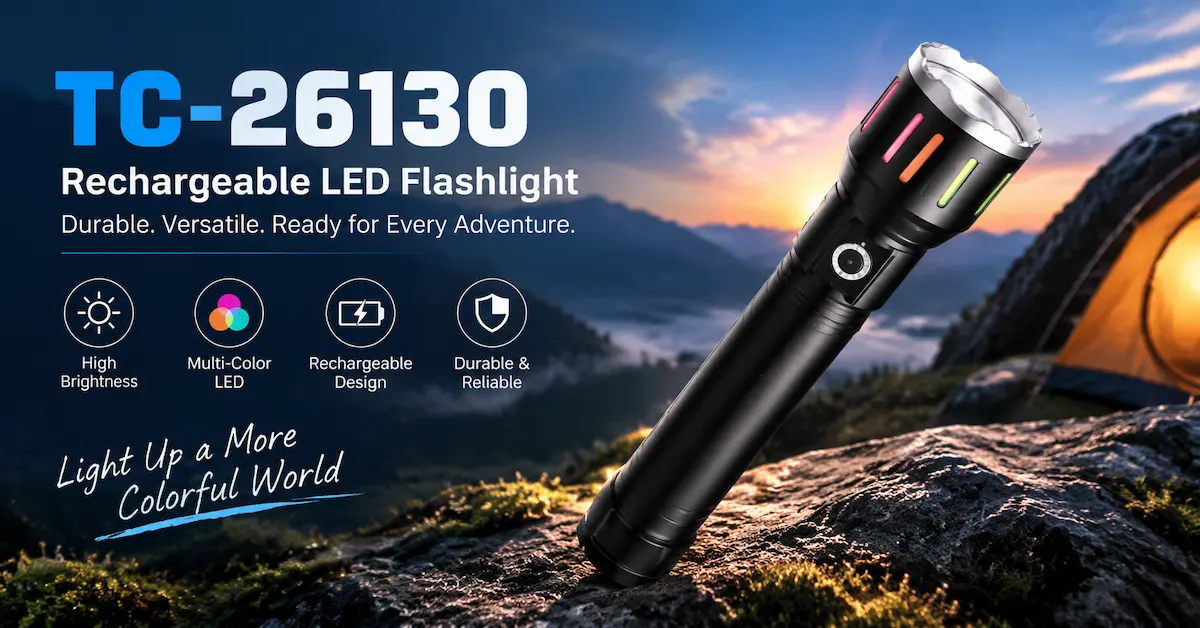
| TC-26130 | Rechargeable handheld structure, zoomable head, side controls | Housing presentation, retail sets, battery and accessory feasibility |
| S-P900 | Textured grip, rechargeable design, adjustable-beam concept | Outdoor branding, appearance and user-experience requirements |
| S-P200W | Larger handheld structure and high-intensity product positioning | Optical requirements, housing design, thermal and battery evaluation |
These are product-platform references, not confirmation that every suggested modification is available.
How Should Buyers Select a Starting Model?
The TC-10120 provides a reference for a slimmer rechargeable handheld format.
The TC-26130 offers another rechargeable structure with a distinctive head design and visible accessory arrangements.
The S-P900 can be evaluated for its textured handheld appearance.
The S-P200W provides a larger product format for discussing high-intensity lighting requirements.
For each platform, buyers should request current specifications and ask which components can be modified without affecting the existing structure.
Explore GHS rechargeable LED flashlight models
6. How Should Manufacturers Evaluate Custom Design Feasibility?
A useful feasibility review answers four questions before development begins:
Is the modification technically possible?
The manufacturer must evaluate whether the requested function can be achieved within the proposed product architecture.
Can the design be manufactured consistently?
A successful prototype may still require changes to assembly methods, component sourcing, or inspection procedures.
Which previous test results remain applicable?
The factory should identify whether the modification affects electrical, optical, mechanical, environmental, or regulatory requirements.
Does the commercial opportunity justify development?
The buyer should compare expected sales volume and differentiation value against engineering and production costs.
Recommended Approval Process
| Stage | Main Decision | Required Evidence |
|---|---|---|
| Concept Review | Is the requirement feasible? | Technical brief and initial assessment |
| Design Evaluation | What must change? | Proposed design and component changes |
| Prototype | Does the concept work? | Engineering sample |
| Verification | Does the modified product meet requirements? | Relevant test results |
| Production Review | Can the design be reproduced? | Production and QC plan |
| Final Approval | Is the configuration ready for ordering? | Approved sample and specifications |
The exact stages and deliverables depend on the complexity of the project.
7. How Are Custom Flashlight Designs and Intellectual Property Protected?
Design differentiation can be valuable to private-label and OEM brands, but buyers should distinguish product appearance from functional inventions.
The World Intellectual Property Organization's industrial design guidance explains that industrial design rights generally concern a product's ornamental or aesthetic appearance, while patents may protect technical inventions.
This distinction matters when a flashlight project involves both a distinctive exterior and new electronic functionality.
Important Contract Questions
Buyers should clarify:
-
Who owns the original design and any pre-existing technology?
-
Who owns newly commissioned appearance designs?
-
Are technical drawings and design files included in the development agreement?
-
Who owns and controls physical tooling?
-
Can the manufacturer reuse the design for other customers?
-
What happens if the purchasing relationship ends?
Paying for a prototype or mold does not automatically resolve every intellectual property question.
Ownership, permitted use, confidentiality, and transfer arrangements should be documented according to the applicable agreement and law.
8. How Much Does Flashlight Design Customization Cost?
There is no universal price for custom flashlight development.
The commercial impact depends on the actual changes and the manufacturing resources required.
Customization Cost Drivers
| Cost Item | Main Consideration |
|---|---|
| Engineering Work | Complexity of design modifications |
| Prototypes | Number of sample versions and revisions |
| Tooling | New molds, machining fixtures, or specialized equipment |
| Components | LEDs, optics, batteries, electronics, housings |
| Testing | Optical, electrical, environmental and safety verification |
| Production Setup | Assembly, process changes and inspection |
| Branding | Logo preparation and surface treatment |
| Packaging | Artwork, printed materials and accessories |
| Order Volume | Component procurement and production economics |
Should Every Brand Invest in Full ODM Development?
Not necessarily.
A brand selling general rechargeable flashlights may obtain sufficient differentiation through an existing product platform, a suitable accessory configuration, and consistent retail presentation.
Full development becomes more compelling when the product offers a clearly defined benefit that existing models cannot provide.
For example, a unique mechanical interface may be worth developing when it satisfies a documented customer requirement.
It is less attractive when the only objective is to make a standard flashlight look slightly different.
Buyer takeaway: Evaluate expected commercial value before committing to engineering charges, tooling, or additional testing.
9. Practical Example: Choosing Between OEM and ODM
Consider a hypothetical outdoor accessories brand preparing a rechargeable flashlight collection.
The brand wants a recognizable appearance, convenient charging, and a beam appropriate for general camping tasks.
Option A: Existing Platform Customization
The buyer selects a suitable rechargeable model and requests logo marking, branded packaging, and an approved accessory kit.
This approach may preserve most of the existing technical architecture.
Option B: Functional Platform Modification
The buyer requests a different beam pattern or operating sequence.
The manufacturer must assess optical or electronic compatibility, develop samples where required, and verify the changed performance.
Option C: Original Product Development
The brand wants a completely different housing, control arrangement, and internal architecture.
This becomes a substantially larger engineering project involving design development, manufacturing feasibility, and product validation.
The example illustrates purchasing choices rather than an actual GHS project or quotation.
The best option is the one that meets the brand's requirements with an acceptable balance of differentiation, technical risk, and total cost.
10. Why Consider GHS for Custom Flashlight Development?
GHS (Guanghuishi), operating under the published English name Guangdong Guanghuishi Electrical Appliances Co., Ltd., presents itself as a China-based company combining lighting product development, manufacturing, and sales.
According to its company profile, GHS was established in 2009 and operates a manufacturing facility in Zhaoqing, Guangdong.
The company displays multiple rechargeable LED flashlight platforms and describes OEM/ODM cooperation as part of its business activities.
For overseas importers and private-label brands, these platforms provide starting points for discussing flashlight design customization.
However, actual engineering capabilities, available tooling, permitted modifications, MOQ, and development schedules must be verified for the specific project.
Buyers can also review GHS factory videos and product demonstrations during their initial evaluation.
11. What Should Buyers Include in a Custom Flashlight RFQ?
A complete RFQ helps a manufacturer distinguish straightforward branding requests from engineering-intensive product development.
| RFQ Item | Required Information |
|---|---|
| Intended Application | Camping, industrial, retail, emergency or utility lighting |
| Target Market | Destination country and sales channel |
| Reference Model | Existing GHS model or design reference |
| Required Changes | Housing, lighting, battery, controls, branding |
| Performance Targets | Beam characteristics, runtime, charging requirements |
| Materials | Required housing material and finish |
| Development Scope | Existing platform modification or new design |
| Intellectual Property | Design and tooling expectations |
| Testing | Applicable verification requirements |
| Quantity | Initial order and forecast demand |
| Budget | Target product cost and development allowance |
| Schedule | Desired sample and launch milestones |
The buyer should ask the factory to identify which requests are feasible on an existing platform, which require engineering work, and which may require new tooling or validation.
Contact GHS to request a flashlight customization feasibility review and project-specific quotation.
12. Frequently Asked Questions About Flashlight Design Customization
1. Can flashlight manufacturers customize designs?
Yes. Depending on their capabilities, manufacturers may support custom logos, packaging, finishes, optics, electronics, batteries, and mechanical structures. The actual scope must be confirmed for each product platform.
2. What is the easiest way to customize a flashlight?
Using a suitable existing product with approved branding and packaging is often less complex than changing its electrical or mechanical architecture.
3. Does flashlight design customization always require new tooling?
No. Some modifications can use existing tooling and components. Unique housings or incompatible mechanical interfaces may require new molds, fixtures, or manufacturing processes.
4. Can a manufacturer customize flashlight brightness?
Potentially, but changing LED output or driver behavior may influence heat generation, runtime, and battery requirements. Revised performance should be verified.
5. Can rechargeable flashlight batteries be customized?
Battery configurations may be modified when technically feasible. Such changes require evaluation of mechanical fit, electrical compatibility, safety, charging, and transport documentation.
6. Can buyers request custom lighting modes?
Some flashlight platforms may support different mode sequences. The manufacturer must confirm whether the existing electronics allow those changes or require additional development.
7. What is the difference between OEM and ODM flashlight design?
OEM generally involves manufacturing an agreed product configuration, while ODM includes greater design or development participation by the manufacturer. Responsibilities depend on the project agreement.
8. How long does custom flashlight development take?
The schedule depends on design complexity, prototypes, tooling, testing, and production preparation. Buyers should request a project-specific timeline rather than assume a fixed development period.
9. Who owns a customized flashlight design?
Ownership depends on the design's origin, the intellectual property involved, and the parties' agreement. Buyers should clarify rights to drawings, tooling, modifications, and commercial use before development begins.
10. How can I request a custom flashlight quotation from GHS?
Visit the GHS Contact Us page and provide your application, preferred product model, requested modifications, performance targets, estimated quantity, target market, and development expectations.
Conclusion
Flashlight design customization gives brands and distributors opportunities to differentiate their products, but successful projects require a clear understanding of technical feasibility, engineering complexity, production costs, and quality requirements.
A manufacturer may be able to customize logos, packaging, finishes, and selected accessories using an existing platform. More extensive changes to optics, battery systems, charging electronics, switches, or housings may require additional engineering, prototypes, tooling, and validation.
For overseas B2B buyers, the most practical approach is to start with the required application, compare existing flashlight platforms, classify the proposed modifications, and request a structured feasibility assessment before committing to production.
GHS offers rechargeable LED flashlight models that can serve as references for evaluating different product structures and potential customization projects. Specific engineering options and commercial conditions must be confirmed directly.
Planning a custom rechargeable LED flashlight for your brand? Explore the GHS flashlight product collection and contact GHS to discuss design requirements, OEM/ODM feasibility, sample development, and bulk manufacturing quotations.