
Finding a reliable private label flashlight manufacturer is only the beginning of building a profitable flashlight brand. The real challenge is creating products that customers understand, retailers can sell, and distributors can reorder without unexpected changes in quality or cost.
A private label flashlight business typically starts with an existing product platform customized through branding, packaging, and agreed product configurations. This approach can reduce development complexity compared with designing a completely new flashlight.
However, adding a logo does not automatically create a competitive retail product.
Buyers must consider lighting performance, battery configuration, packaging design, barcode identification, landed cost, quality control, and repeat-order consistency.
The most effective private label strategy connects five elements: product positioning, technical specifications, brand presentation, commercial margins, and manufacturing consistency.
For importers, distributors, and brand owners exploring China-based sourcing, GHS LED flashlight products provide several existing platforms that can be evaluated for branded retail and wholesale programs.
1. What Does a Private Label Flashlight Manufacturer Actually Provide?
A private label flashlight manufacturer produces or supplies flashlight products that another business sells under its own brand.
Instead of developing every component independently, the buyer usually selects an existing flashlight and agrees on suitable branding, packaging, accessories, and product requirements.
Private labeling may include:
-
Custom logo printing or laser marking
-
Brand-specific retail boxes
-
Product labels and instruction manuals
-
Barcode and SKU identification
-
Customized accessory combinations
-
Selected product colors or finishes
-
Agreed product configurations
-
Bulk production and quality requirements
Actual options depend on the manufacturer's capabilities and the selected model.
Private Label vs. OEM vs. ODM Flashlights
| Manufacturing Model | Main Purpose | Best-Suited Buyer |
|---|---|---|
| Private Label | Sell an existing or adapted product under your brand | Retailers, distributors, emerging brands |
| OEM | Manufacture according to agreed branding and technical requirements | Established brands and importers |
| ODM | Develop or substantially modify product designs | Brands requiring greater differentiation |
Private labeling is especially attractive when a suitable product already exists and the buyer's main objective is market entry, consistent branding, and dependable supply.
Developing new electronics or housing structures should be considered only when the expected commercial value justifies the additional investment.
2. Which Businesses Benefit Most From Private Label Flashlights?
Private label lighting can serve multiple sales channels, but each channel has different expectations.
| Customer Segment | Purchasing Objective | Important Requirements |
|---|---|---|
| Hardware Distributors | Build a branded tool-lighting range | Practical features, competitive price, stable supply |
| Outdoor Equipment Brands | Expand camping and hiking accessories | Portability, beam control, suitable runtime |
| E-commerce Brands | Sell differentiated products online | Product appearance, packaging, reliable specifications |
| Automotive Accessory Suppliers | Add emergency lighting products | Compact packaging, charging convenience |
| Promotional Product Companies | Supply branded corporate merchandise | Logo quality, packaging, unit cost |
| Security Equipment Distributors | Offer portable inspection and patrol lighting | Usable beam, reliable operation, durability |
| Regional Wholesalers | Establish repeatable private-label inventory | Consistent specifications, MOQ, reorder availability |
When Private Labeling Is Not the Best Option
Private labeling may be insufficient when the buyer needs a unique optical system, proprietary electronics, specialized mounting structure, or equipment for regulated hazardous environments.
Such projects may require more substantial OEM/ODM development and documented testing.
Buyer takeaway: Choose private labeling when the product already fits the application and branding is the main commercial differentiator.
3. How Should Brands Build a Profitable Flashlight SKU Portfolio?
One of the most common retail mistakes is launching too many flashlight models with similar features.
Every additional SKU can increase inventory investment, packaging complexity, forecasting requirements, and the risk of slow-moving stock.
A better approach is to define a small assortment with clear customer benefits.
Create Distinct Retail Product Positions
A private label flashlight range might include:
Everyday Utility Flashlights
Designed for household use, routine inspection, maintenance, and emergency kits.
Rechargeable General-Purpose Flashlights
Products emphasizing convenient charging, practical beam adjustment, and repeated use.
High-Intensity Handheld Flashlights
Larger products intended for buyers who need more concentrated illumination or higher-performance positioning.
Retail Bundle Products
Suitable flashlight models packaged with approved accessories or sold as multi-unit sets.
Each SKU should have a reason to exist beyond a different model number.
GHS Models for Private Label Product Evaluation
GHS offers several rechargeable flashlight platforms worth considering during initial sourcing.
| GHS Model | Displayed Product Features | Potential Retail Positioning | Items Requiring Confirmation |
|---|---|---|---|
| TC-10120 | Type-C charging, handheld design, zoomable structure, side switch | Rechargeable utility and outdoor retail | Final battery, runtime, OEM options |
| TC-26130 | Rechargeable design, adjustable beam, product and accessory configurations | General-purpose retail and packaged sets | Variant, packaging contents, performance |
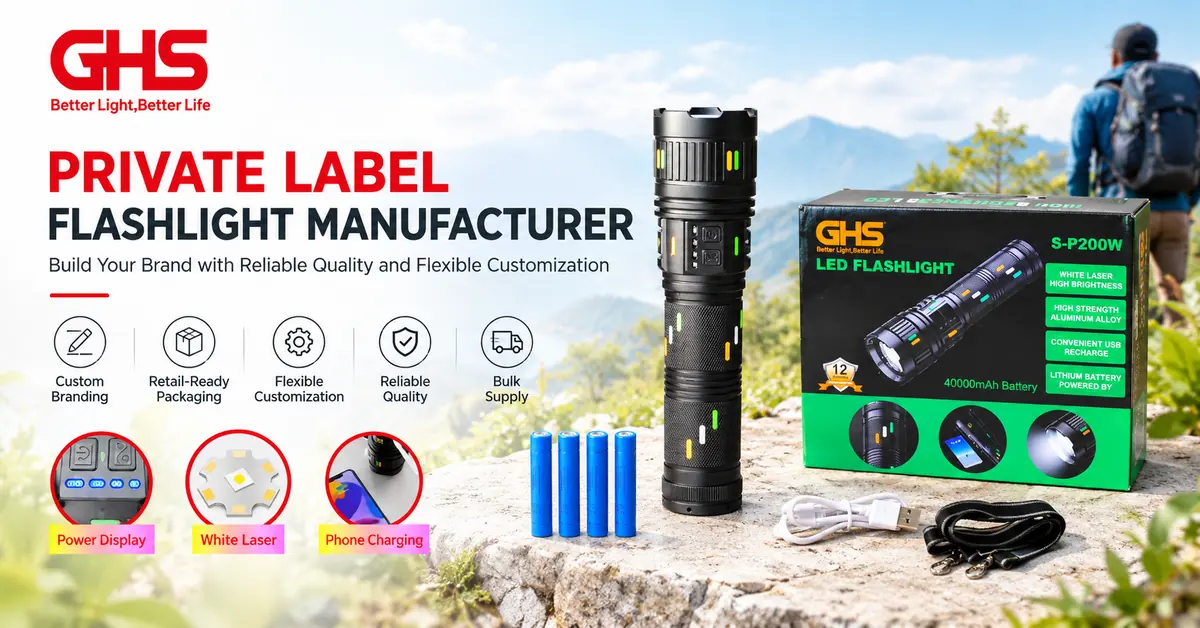
| S-P900 | Portable rechargeable design, textured grip, adjustable beam concept | Everyday utility and outdoor accessories | Exact model version, battery, testing |
| S-P200W | Larger handheld structure, rechargeable design, adjustable illumination | High-intensity product range | Light output, runtime, beam distance |
These are potential sourcing references, not confirmation that every model supports all customization options.
How Many Products Should a New Brand Launch?
Rather than introducing an extensive catalog immediately, a new brand can test a limited number of differentiated SKUs.
For example, one practical utility model and one higher-positioned rechargeable model may provide enough variety to evaluate customer demand.
Additional products can be introduced after the brand understands sales performance, warranty issues, and inventory turnover.
This helps reduce capital tied up in uncertain stock.
4. What Technical Specifications Must Be Approved Before Branding?
Brand owners should verify the flashlight's operating characteristics before approving retail packaging.
Technical specifications determine what the brand can accurately promise customers.
Private Label Flashlight Specification Checklist
| Parameter | What to Confirm | Why It Matters |
|---|---|---|
| Light Output | Measured lumens by operating mode | Prevents misleading brightness claims |
| Peak Beam Intensity | Candela under defined test conditions | Helps evaluate focused illumination |
| Beam Distance | Distance under an agreed measurement method | Supports application positioning |
| Runtime | Operating duration at defined modes | Influences customer satisfaction |
| Battery Configuration | Chemistry, capacity, protection features | Affects performance and transportation |
| Charging System | Connector, input, charging behavior | Influences convenience and compatibility |
| Housing | Material, dimensions, finish, weight | Affects handling and product appearance |
| Beam Adjustment | Fixed or adjustable beam | Determines functional positioning |
| Environmental Protection | Applicable tested ingress or impact performance | Supports outdoor or professional claims |
| Packaging Contents | Batteries, cables, straps, manuals | Prevents missing-accessory complaints |
Do not rely exclusively on the highest brightness number printed on a package.
The ANSI/PLATO FL 1-2025 portable lighting standard provides a recognized framework for measuring and reporting flashlight performance.
It includes methods relevant to light output, runtime, beam characteristics, and other performance attributes, with updated treatment of short-duration elevated brightness modes.
Retail brands should request applicable test results before placing numerical performance claims on packaging.
Referencing the standard does not mean a specific GHS model has been tested or certified against it.
5. How Do Components and Manufacturing Affect Private Label Quality?
A flashlight's retail appearance may be simple, but its performance depends on several integrated components.
LED and Optical Components
The LED, reflector, and lens determine how illumination is produced and distributed.
A bright LED alone does not guarantee a suitable beam pattern.
Driver Electronics
The driver controls electrical operation and influences brightness regulation and operating modes.
Changes in driver components can affect output consistency.
Battery and Charging System
The battery and charging circuit influence runtime, recharging behavior, and electrical safety.
USB-C connectivity is convenient, but the presence of a Type-C port does not automatically establish a particular charging speed or compatibility specification.
Housing and Surface Finish
A flashlight housing affects handling, protection, heat management, and visual quality.
Logo application must suit the actual surface material and finish.
For example, a marking method suitable for a particular coated metal housing may behave differently on molded polymer.
Assembly and Workmanship
Brands should check switch alignment, bezel fit, charging-port construction, grip consistency, and the operation of any beam-adjustment mechanism.
These details influence both perceived quality and functional reliability.
The manufacturing process should be evaluated according to the selected product platform, not assumed from generic industry descriptions.
6. How Can Custom Packaging Improve Retail Readiness?
For a private label flashlight manufacturer, packaging is not just a protective box.
It connects the product's physical features to the customer's purchasing decision.
A product may perform well but still struggle in retail if customers cannot understand its main advantages or if product information is inconsistent across the packaging and online listing.
Essential Private Label Packaging Elements
| Packaging Element | Commercial Purpose | Buyer Responsibility |
|---|---|---|
| Brand Logo | Establishes product identity | Provide approved artwork |
| Product Name | Identifies the product type | Match SKU and technical configuration |
| Feature Description | Communicates customer benefits | Verify all performance claims |
| Barcode / GTIN | Supports retail identification | Assign and manage correctly |
| Product Images | Shows design and included items | Use matching product configuration |
| Instructions | Supports correct operation | Confirm accuracy and language |
| Battery Information | Communicates relevant product details | Check actual configuration |
| Warnings and Labels | Supports applicable market requirements | Confirm destination-market obligations |
| Carton Identification | Supports warehouse and logistics handling | Match purchase order and SKU |
Who Should Own the Barcode?
GS1 explains that the brand owner is normally responsible for assigning the Global Trade Item Number (GTIN) to a trade item.
For a private-label arrangement, this means the importer, retailer, or distributor selling the product under its brand will often be the responsible party.
Different trade items may require different GTINs according to applicable GS1 rules.
A barcode should not simply be copied from an unrelated product.
The brand owner should confirm SKU identification and barcode requirements before finalizing packaging artwork.
Match the Packaging to the Actual Product
If a flashlight is sold with a charging cable, wrist strap, or battery, the packaging contents must accurately reflect the approved configuration.
Avoid printing unverified claims such as:
-
Guaranteed 24-hour runtime
-
IP68 waterproof protection
-
Extreme long-distance illumination
-
Universal fast charging
Such claims require evidence appropriate to the exact product and test conditions.
A trustworthy private label brand is built on accurate information, not exaggerated packaging.
7. How Do You Calculate the Real Cost of Private Label Flashlights?
A profitable retail program requires more than negotiating the lowest factory price.
Private label buyers should calculate the complete commercial cost of getting a product into saleable inventory.
Main Cost Categories
| Cost Category | Potential Impact |
|---|---|
| Flashlight Unit Price | Base manufacturing expense |
| Custom Logo | Marking and setup costs |
| Retail Packaging | Printed boxes, inserts, manuals |
| Accessories | Batteries, charging cables, straps |
| Testing and Inspection | Verification and quality-management costs |
| Freight and Import Charges | Transportation, duties, handling |
| Warehousing | Storage and inventory management |
| Returns and Warranty | Replacement products and service costs |
| Marketplace or Distribution Fees | Selling-channel costs |
Calculate Gross Margin Using Landed Cost
Gross Margin = (Net Selling Price − Landed Product Cost) ÷ Net Selling Price × 100%
For example, assume a distributor has the following hypothetical economics:
| Item | Illustrative Amount |
|---|---|
| Wholesale Selling Price | $8.00 |
| Landed Product Cost | $5.60 |
| Gross Profit per Unit | $2.40 |
| Gross Margin | 30% |
These are illustrative figures, not GHS quotations or market price estimates.
This gross margin does not include all downstream operating costs, such as marketing, warranty handling, overhead, and certain selling fees.
If packaging becomes more expensive, freight increases, or the defect rate rises, the commercial margin may fall.
Procurement lesson: A slightly higher-cost flashlight with consistent performance can sometimes be more profitable than a cheaper product that generates excessive returns.
MOQ Should Be Evaluated by Customization Level
Minimum order quantities can be influenced by the selected flashlight, printing method, packaging format, component requirements, and production preparation.
Buyers should request separate clarification of product MOQ and customized packaging MOQ where relevant.
This helps prevent excess packaging inventory and unnecessary upfront spending.
8. What Quality Control Should Be Required for Branded Flashlights?
A private-label brand is responsible for the reputation of the products sold under its name.
Therefore, quality control should verify both the flashlight's function and the accuracy of its branded presentation.
Recommended Inspection Stages
Incoming Component Inspection
Review the agreed LED, battery, electronic components, housing, switches, and packaging materials.
Assembly Inspection
Check component fit, charging connections, switch installation, housing assembly, and relevant workmanship.
Functional Verification
Confirm light modes, charging operation, beam adjustment, status indicators, and other specified functions.
Performance Sampling
Evaluate agreed performance characteristics using documented methods and acceptance limits.
Final Packaging Inspection
Verify logo placement, printed text, model numbers, barcodes, accessories, manuals, quantities, and carton information.
Protect Repeat-Order Consistency
A sample approved for the first order should remain a reference for later production.
However, a physical sample cannot reveal every internal component.
A controlled specification and critical component list can help identify changes involving batteries, LEDs, drivers, charging circuits, or other parts affecting performance.
Buyers should establish a process for reviewing important component substitutions.
This reduces the risk of receiving a visually identical flashlight with materially different behavior.
9. How Should Private Label Brands Manage Lead Time and Inventory?
Product availability can be as important as unit pricing.
A brand that launches successfully but cannot replenish inventory may lose customer momentum.
A practical procurement schedule should separate the following activities:
-
Product model selection
-
Specification and quotation confirmation
-
Branding and packaging artwork
-
Sample approval
-
Component and packaging preparation
-
Production and inspection
-
Shipping and inventory receipt
-
Repeat-order planning
The supplier should confirm actual timing based on the approved model and project requirements.
Establish a Reorder Point
A useful planning principle is:
Reorder Point = Expected Demand During Replenishment Lead Time + Safety Stock
For example, a distributor selling 100 units per week with a six-week replenishment lead time would expect demand of approximately 600 units during that period.
Additional safety stock would depend on demand variability, shipment reliability, and inventory risk.
These numbers are illustrative and do not represent GHS production or shipping lead times.
Brand owners should also retain approved packaging files and technical specifications so repeat orders do not require unnecessary redesign.
10. Why Consider GHS as a Private Label Flashlight Manufacturer?
GHS (Guanghuishi), operating under the name Guangdong Guanghuishi Electrical Appliances Co., Ltd., is a China-based lighting company presenting integrated product development, manufacturing, and sales capabilities.
According to its published company profile, GHS was established in 2009 and operates a manufacturing facility in Zhaoqing, Guangdong, China.
The company also reports establishing a Dubai branch in 2017, supporting its business activities in the Middle East.
GHS offers multiple handheld LED flashlight models, including rechargeable utility products and high-intensity flashlight platforms.
For private-label buyers, this range creates starting points for evaluating product formats, charging options, appearance, and potential retail configurations.
Product Platforms and Manufacturing Support
Potential buyers can review:
Branding, packaging, accessories, and product modifications should be discussed for each specific model.
GHS's published company information provides a basis for initial supplier research, but buyers should request current samples, specifications, applicable documents, and commercial terms before placing bulk orders.
11. What Should You Include in a Private Label Flashlight RFQ?
A detailed request for quotation makes it easier for a manufacturer to propose suitable products and confirm customization feasibility.
Recommended RFQ Information
| Requirement | Details to Include |
|---|---|
| Company and Brand | Business name, purchasing contact, brand type |
| Destination Market | Country and intended retail channel |
| Target Application | Household, outdoor, maintenance, emergency |
| Preferred Models | GHS model references or product images |
| Specifications | Beam, runtime, battery, charging requirements |
| Branding | Logo, colors, marking preferences |
| Packaging | Retail box, manual, barcode, accessories |
| Order Quantity | Initial order and estimated repeat demand |
| Quality Requirements | Inspection criteria and required testing |
| Delivery | Destination, expected launch schedule |
| Compliance | Relevant product and transportation documentation |
Providing a realistic sales channel and target price position can also help the supplier identify suitable product configurations.
Looking for private label LED flashlights for your brand?
12. Frequently Asked Questions About Private Label Flashlight Manufacturing
1. What is a private label flashlight manufacturer?
A private label flashlight manufacturer produces or supplies flashlight products that another company sells under its own brand. Depending on the project, this may include custom logos, retail packaging, labels, accessories, and selected product configurations.
2. Can I start a flashlight brand without developing a new product?
Yes. A business can begin by selecting a suitable existing flashlight platform and developing a branded retail presentation. The product's technical suitability, available customization options, and commercial conditions should be verified first.
3. Can GHS put my brand logo on flashlights?
GHS presents OEM/ODM cooperation as part of its business direction. The specific logo methods, eligible products, artwork requirements, and customization costs should be confirmed directly for each model.
4. What is the MOQ for private label LED flashlights?
There is no universal MOQ. Requirements depend on the model, branding process, packaging, components, and production conditions. Buyers should request model-specific minimum quantities.
5. Can I customize flashlight packaging and accessories?
Customization may include retail boxes, manuals, labels, and accessory sets, depending on the supplier's available options. Buyers should confirm packaging quantities, artwork specifications, and exactly which accessories are included.
6. Who is responsible for the barcode on a private label flashlight?
Under GS1 principles, the brand owner is normally responsible for GTIN allocation. The buyer should confirm the appropriate numbering and barcode requirements for each retail trade item.
7. How do I verify flashlight performance before bulk ordering?
Request written technical specifications and applicable test evidence. Verify light output, runtime, beam characteristics, battery configuration, and charging behavior under defined conditions before using performance claims in product listings.
8. How can I reduce private label flashlight returns?
Approve the complete product and packaging configuration, establish inspection criteria, control important components, and make sure retail product descriptions accurately reflect the delivered flashlight.
9. Is private label manufacturing cheaper than ODM development?
Private labeling can require less initial development investment when using an existing suitable product. ODM projects involving new electronics, optics, tooling, or structural designs may involve additional engineering and validation costs.
10. How can I request a private label flashlight quotation from GHS?
Visit the GHS Contact Us page and share your preferred flashlight model, target market, estimated order quantity, logo artwork, packaging requirements, and technical expectations. The company can then review the project and discuss available options.
Conclusion
Choosing a private label flashlight manufacturer is not simply about finding a factory that can print a logo on a flashlight.
A commercially successful private-label program requires suitable products, accurate performance claims, consistent packaging, properly managed product identification, predictable procurement costs, and dependable repeat-order quality.
For importers, distributors, and emerging lighting brands, starting with established flashlight platforms can reduce unnecessary development complexity while providing opportunities for differentiation through product selection and brand presentation.
The most effective strategy is to begin with a focused SKU assortment, verify the product specifications, approve retail packaging, calculate realistic landed costs, and establish clear quality and replenishment requirements.
GHS offers multiple rechargeable LED flashlight platforms that buyers can explore for private-label and wholesale sourcing projects.
Ready to develop your own branded flashlight collection? Browse the GHS flashlight product range and contact GHS to discuss model selection, custom branding, retail packaging, sample evaluation, and bulk quotation requirements.